
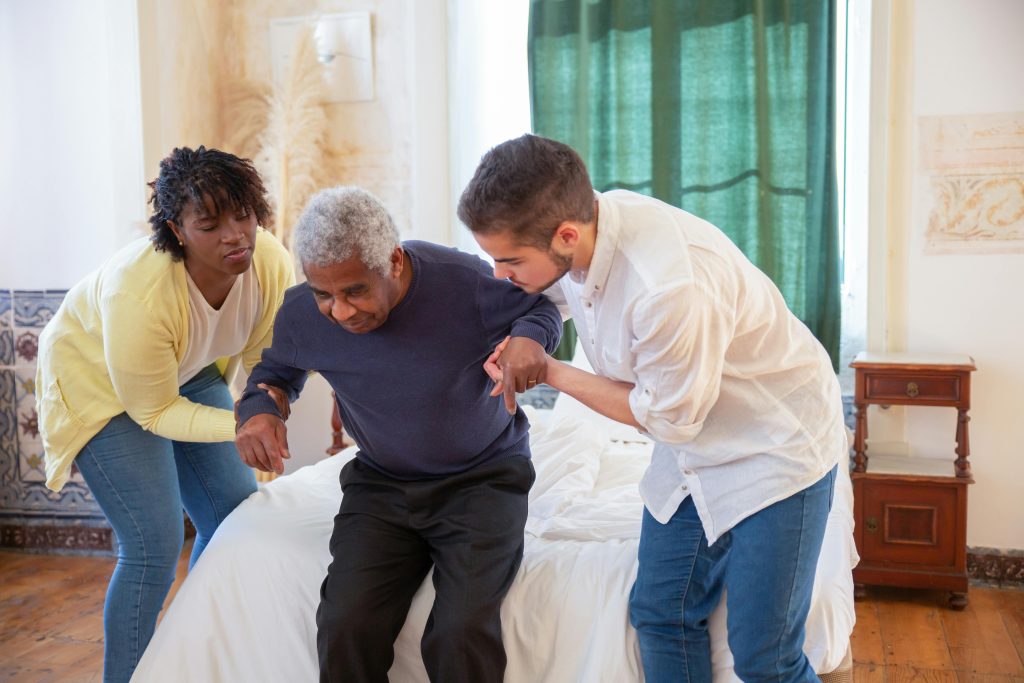
In the journey of aging, most people notice a loss of endurance first—the feeling that they can’t walk as far as they used to. However, the most dangerous change happening inside the body is actually the loss of the “emergency gear.” This “gear” is composed of your fast-twitch muscle fibers, and their decline is the primary reason why balance becomes precarious and movements feel sluggish. At geriatricrehab.es, we believe that understanding the difference between your Muscle Fiber Types is the key to moving from “surviving” to “thriving.”
1. The Loss of the “Emergency Gear”
When we talk about Muscle Fiber Types, we are essentially talking about how your body handles different demands. You have Type I (slow-twitch) fibers, which are built for endurance and “low-octane” activities like standing or walking. Then, you have Type II (fast-twitch) fibers, the high-power units designed for speed, strength, and quick reactions.
The biological tragedy of aging is that the body does not lose these fibers equally. Research cited in Geriatric Physical Therapy (2020) shows that while slow-twitch fibers remain relatively stable, fast-twitch fibers can shrink by as much as 25-50% between the ages of 30 and 80. This is the “Why” behind the “fade.” Losing your Type II fibers means losing your “emergency gear”—the ability to catch yourself when you trip or to move your foot quickly to the brake pedal in a car. Reversing this isn’t just about “staying active”; it’s about specifically targeting the fibers that aging tries to delete.
2. The ‘Why It Matters’ Section: The Functional Carryover of Power
At geriatricrehab.es, we emphasize that power (force x velocity) is more important for independence than strength alone. Strength is the ability to lift a heavy grocery bag; power is the ability to lift it quickly before it slips or to step over a curb with confidence.
For Seniors: More Than Just Muscle
Targeting the right Muscle Fiber Types provides direct Functional Carryover to your daily life:
- The Fall Recovery: If you trip over a rug, your slow-twitch fibers are too slow to help. You need the “snap” of your fast-twitch fibers to move your leg into a stable position.
- Crossing the Street: That moment when the pedestrian light starts flashing, and you need to speed up? That is a Type II fiber task.
- Playing with Family: Keeping up with a grandchild who is running toward the street or playing a game of catch requires “instant-on” muscle power. Strength training ensures you aren’t just a spectator in your own life.
3. Understanding Age-Related Changes in Muscle Fiber Types
Why does the body let the “fast” fibers go first? It comes down to a process called Motor Unit Remodeling. Your muscles are controlled by nerves (motor neurons). The nerves that control fast-twitch fibers are “expensive” for the body to maintain. As we age, these “high-power” nerves can die off or become disconnected.
For Professionals: The “Fiber Type Grouping” Phenomenon. Clinically, we see a fascinating and problematic shift. When a fast-twitch motor neuron dies, the neighboring slow-twitch nerve often “adopts” the abandoned muscle fibers. This turns a once-fast fiber into a slow one. While this preserves some muscle mass, it destroys the muscle’s explosive capacity. This is why a senior might look like they have muscle but cannot generate the power needed for a Timed Up and Go (TUG) test. To stop this, we must provide a “use it or lose it” signal that is loud enough to keep those high-threshold nerves alive. This is where high-intensity loading becomes mandatory.
4. Applying Physical Stress Theory to Different Muscle Fiber Types
To understand why walking isn’t enough to save your power, we look to the Physical Stress Theory (PST) . This framework reminds us that muscle tissue only adapts when the stress exceeds its current capacity. Because Type I and Type II fibers have different capacities, they require different levels of stress.
- Death: In the context of Muscle Fiber Types, this is the complete loss of fast-twitch motor units, leading to a total inability to generate rapid force.
- Injury: Often, seniors injure themselves because they try to use “fast” fibers that have atrophied and become brittle.
- Increased Tolerance (The Training Zone): To reach the Type II fibers, we must push the body into this zone. This requires an intensity of 60-80% of 1-Rep Max (1RM). Anything less is handled by the slow-twitch fibers, leaving the “emergency gear” untouched.
- Maintenance: Walking and light aerobics live here. They keep the slow-twitch fibers healthy but do nothing to stop the “silent pruning” of the power fibers.
- Decreased Tolerance (Atrophy): The default state of aging. Without high-intensity stress, the body systematically dismantles its Type II fibers to save energy.
5. Recruitment Thresholds and the Size Principle
The “Why” behind the 1RM mandate is a biological rule called Henneman’s Size Principle. This principle states that the body recruits motor units in order of size, from the smallest (slow-twitch) to the largest (fast-twitch).
For Professionals: High-Threshold Motor Units. The body is efficient; it won’t use the “high-threshold” Type II fibers unless the load is heavy enough or the movement is fast enough. To trigger myofibrillar protein synthesis rates in these fibers, the nervous system must be forced to “call up” the big motor units. As cited in Geriatric Physical Therapy (2020), if the resistance is low, the small Type I motor units do all the work, and the mTOR pathway in the Type II fibers remains dormant. We aren’t just lifting weights; we are “knocking on the door” of the nerves that control power.
For Seniors: The “Light Switch” Analogy
Imagine your muscles are controlled by a dimmer switch.
When you walk or do light chores, the light is turned down low. Only the “small, dim bulbs” (slow-twitch) are on. They don’t use much energy, but they aren’t very bright.
To turn on the “bright, powerful floodlights” (fast-twitch), you have to turn the dimmer switch all the way up. At geriatricrehab.es, our high-intensity training is the hand that turns that switch. We want your “power bulbs” to stay bright so you can see your way through any physical challenge.
6. Power, Pressure, and the “Afterload” Effect
Maintaining these specific Muscle Fiber Types isn’t just about moving; it’s about protecting your heart. Powerful muscles act as a secondary pump for your entire system.
For Professionals: Acute Vascular Response When we engage in high-intensity loading, the recruitment of Type II fibers creates significant intramuscular pressure. While this sounds intense, it actually trains the vasculature to handle pressure changes more efficiently. Over time, having powerful muscles reduces the afterload —the pressure the heart must pump against—during daily tasks. A senior with powerful legs can stand up from a chair with a lower heart rate spike than a senior who has to “struggle” through the movement using atrophied fibers.
For Seniors: The “Hydraulic Lift” Analogy
Think of your legs as a hydraulic lift. If the lift is strong, it raises the car easily without the pump (your heart) having to work too hard. But if the lift is weak and “leaky” (atrophied fast-twitch fibers), the pump has to work at maximum speed just to get the car off the ground. By training for power, you are making your “lift” so strong that your heart can stay calm and steady, even when you’re working hard.
7. The Professional Perspective: The ICF Framework and Power Assessment
At geriatricrehab.es, we don’t just assess if a senior can do a movement; we assess how fast they can do it. In the comparison of Muscle Fiber Types, speed is the variable that determines safety.
- Body Structures & Functions: We look at the “Velocity-Force” relationship. While a senior may have the raw strength to lift a heavy object, they may lack the Type II fiber recruitment to do it quickly.
- Activities: We use the 5-Times Sit-to-Stand (5TSTS) as a gold standard for power. If it takes longer than 12-15 seconds, it indicates a significant decline in fast-twitch motor unit efficiency.
- Participation: This is the “Safety Gap.” A senior might be able to walk (Participation), but if they can’t step quickly enough to avoid a moving car or a closing elevator door, their participation in the community is at risk.
Using the ICF Framework, we identify that a deficit in “Body Structure” (Type II atrophy) creates a “Participation Restriction” (fear of falling in public). Rebuilding power is the fastest way to close that gap.
8. The Caregiver Corner: Safety Spotting for Explosive Movements
Training for power requires “explosive intent”—meaning we want the senior to move the weight or their body as fast as possible during the “up” phase. For a caregiver, this requires a higher level of Safety Spotting.
Safety Spotting Tips for “Power” Sit-to-Stands:
- The “Acceleration” Guard: When a loved one attempts to stand up quickly, their momentum might carry them too far forward. Stand in the Shadow Position (behind and to the side), with your hands ready near their hips to “brake” them if they over-lean.
- The Bench Block: Ensure the chair or bench is anchored against a wall. Because power movements involve a “push-off,” an unanchored chair could slide backward, causing a fall.
- Identifying “The Lag”: Watch for a delay between the brain’s signal and the body’s movement. If they are “thinking” about standing but the legs aren’t firing, it’s a sign that we need to simplify the movement before adding more speed.
- Quality over Quantity: In power training, we want the first rep to be just as fast as the last. If you see them slowing down, the set is over—don’t let them “grind” through slow reps, as that only trains the slow-twitch fibers.
9. Targeted Training for Fast-Twitch Muscle Fiber Types
To stop the fade, we must move beyond traditional “senior fitness.” The “Why” is found in the high-intensity studies cited in Geriatric Physical Therapy (2020). We use a two-pronged approach to target these specific Muscle Fiber Types.
The High-Intensity Loading Mandate: We utilize 60-80% of 1-Rep Max (1RM). When the load is heavy, the brain has no choice but to recruit the high-threshold Type II motor units. This triggers the myofibrillar protein synthesis rates necessary to “thicken” the power fibers.
- Functional Carryover: We perform “Heavy Carries” (simulating groceries) and “High-Load Step-Ups” (simulating stairs).
The Velocity Component (Power Training): We take a sub-maximal load (about 40-50% 1RM) and focus on moving it with maximal speed.
- The “Quick-Step” Drill: Practicing rapid stepping in different directions to simulate “catching” oneself during a trip.
- The Explosive Chair Rise: Standing up as fast as possible, then sitting down slowly and with control (the “eccentric” phase).
By combining heavy loads with fast movements, we ensure the “Emergency Gear” stays lubricated and ready for use when it matters most.
10. Conclusion: Re-Igniting the Spark
The loss of power in aging is not an inevitable slide into frailty; it is a physiological response to the lack of high-intensity stimulus. As we have seen, your Muscle Fiber Types are highly specialized, and the “emergency gear” of your fast-twitch fibers will only stay active if you give them a reason to exist. By shifting our focus from merely “staying active” to “training with intent,” we can reverse the “unplugging” of our motor units and reclaim the speed that keeps us safe.
At geriatricrehab.es, we don’t just want you to move; we want you to move with authority. By utilizing the Physical Stress Theory and pushing into the 60-80% 1RM threshold, you are doing more than just building muscle—you are preserving your ability to react, to recover, and to participate fully in your own life. You are re-igniting the spark that allows you to live without the fear of being “too slow.”
Is your “emergency gear” starting to fade? Don’t wait for a trip or a fall to find out that your power is missing. Rebuild your fast-twitch fibers before you need them most. Schedule a “Power vs. Strength” Clinical Audit at geriatricrehab.es today. Our expert team will assess your 5-Times Sit-to-Stand speed, test your Type II fiber recruitment, and design a high-intensity protocol tailored to your specific needs. Consult a specialist today at geriatricrehab.es and let’s re-ignite your power together.













