
In the clinical framework of Geriatric Physical Therapy (2020), breathing is the primary regulator of the Physiological Reserve. While it is normal to breathe harder during exercise, many older adults experience a distressing sensation of “air hunger” that limits their daily life. Identifying the root cause of Shortness of Breath in Seniors is critical for maintaining functional independence. By understanding the difference between “expected” deconditioning and pathological dyspnea, we can expand your Safety Buffer and provide the clarity needed to reclaim your Vigor.
1. Decoding the Sensation of Dyspnea
Dyspnea, commonly referred to as “air hunger,” is one of the most debilitating symptoms a senior can face. It is not merely a physical sensation; it is a neurological alarm. According to Geriatric Physical Therapy (2020), dyspnea occurs when there is a “perceived mismatch” between the brain’s demand for oxygen and the body’s ability to deliver it.
When addressing Shortness of Breath in Seniors, we must look beyond the lungs. This sensation often leads to a “Fear-Avoidance” cycle: a senior feels breathless, becomes afraid, moves less, and eventually becomes so deconditioned that even the smallest task triggers the alarm again. This is the Slippery Slope of Aging in action. Our goal is to break this cycle by rebuilding the Physiological Reserve, ensuring you have enough “breath in the tank” to live with Vigor.
2. Physiology Deep-Dive: Why Shortness of Breath in Seniors Occurs
To understand why breathlessness becomes more common with age, we must look at the “Hard Science” of the respiratory system. Much like the arterial stiffening discussed in cardiovascular health, the lungs and chest wall undergo significant structural changes that increase the “Work of Breathing.”
- Elastin Breakdown: The tiny air sacs (alveoli) where oxygen enters the blood lose their elastin fibers. This makes the lungs less “springy,” leading to air trapping and inefficient exhalation.
- Collagen Buildup: The rib cage and costal cartilages become stiffer due to increased collagen deposits. This means the primary breathing muscles (the diaphragm and intercostals) must work much harder to expand a rigid chest wall.
- Vascular Compliance: The pulmonary arteries also stiffen, which can increase the pressure the heart must generate to move blood through the lungs for oxygenation.
From a Professional Perspective, these changes often manifest in two distinct patterns. Obstructive patterns (like COPD) make it hard to get air out, while Restrictive patterns (like pulmonary fibrosis or simply a stiff chest wall) make it hard to get air in. When a senior experiences Shortness of Breath in Seniors, they are often fighting against a respiratory system that has lost its mechanical efficiency.
3. The “Safety Box”: Managing Acute Shortness of Breath in Seniors
While we want to empower movement, safety is our first priority. Every caregiver and senior must know the “Safety Box” for respiratory health to differentiate between exercise-induced exertion and a medical crisis.
The “Safety Box”: When to Call the Doctor
Seek Immediate Emergency Care (Call 911) if:
- Shortness of breath is sudden, severe, and occurs while resting.
- Breathlessness is accompanied by chest pain, pressure, or fainting.
- Lips or fingernails appear blue or gray (Cyanosis).
- Vital Sign Alerts: Resting heart rate >120 bpm, Resting respiratory rate >30 breaths per minute, or Oxygen Saturation (SpO2) <90% on a home pulse oximeter.
Call your Primary Physician if:
- You need to prop yourself up with multiple pillows to breathe at night (Orthopnea).
- You notice significant new swelling in your ankles or legs (Edema).
- A chronic cough changes in color (green, yellow, or blood-tinged).
Establishing these Shortness of Breath in Seniors protocols ensures that we are training within a safe Safety Buffer, allowing for rehabilitation without unnecessary risk.
4. Heart vs. Lung: The Complex Intersection of Systems
From a Professional Perspective, determining whether Shortness of Breath in Seniors stems from a cardiac or pulmonary origin is one of the greatest challenges in geriatric rehab. In many patients, these systems are inextricably linked; a “tired heart” (Congestive Heart Failure) causes fluid to back up into the lungs, while “tired lungs” (COPD) force the heart to pump against higher resistance.
- The Borg Scale of Perceived Exertion: Instead of relying solely on heart rate, we use the Borg 0–10 scale. A rating of “3” (Moderate) is our target for building Vigor. If a senior hits a “7” (Very Severe) just walking to the mailbox, it indicates a significant breach of their Safety Buffer.
- The Overlap: It is common for a senior to have “Silent Ischemia” where they don’t feel chest pain, but instead experience sudden, profound breathlessness. This is why we treat any new, unexplained respiratory distress as a potential cardiac event until proven otherwise.
5. SOT Deep-Dive: Breathing Mechanics and Postural Stability
In the clinical world of Sensory Organization Testing (SOT), we analyze how a patient uses visual, vestibular, and somatosensory inputs to stay upright. What is often overlooked is the “Metabolic Cost” of balance.
- Condition 2 and 5 (Eyes Closed): When a senior is experiencing Shortness of Breath in Seniors, they often switch to “Accessory Muscle Use.” They lift their shoulders and tighten their neck muscles (the scalenes and sternocleidomastoid) to gasp for air.
- The Postural Trade-off: This upper-body tension shifts the center of gravity upward and stiffens the torso. In SOT Condition 5 (sway-referenced surface), this stiffness prevents the natural “Ankle Strategy” needed to recover from a tilt. The body is so busy fighting for air that it “forgets” to fight for balance, leading to a catastrophic fall.
6. The Caregiver Action Plan: The Pursed-Lip Breathing Script
When a loved one feels they cannot breathe, they often panic. Panic increases the heart rate, which increases oxygen demand, creating a vicious cycle. As a caregiver, your role is to be the “External Regulator” of their nervous system.
The “Calm Command” Coaching Script
- Positioning: “I need you to lean forward and put your hands on your knees (Tripod Position). This helps your diaphragm move better.”
- The Prompt: “Look at me. We are going to slow the air down. Smell the roses, then blow out the candles.”
- The Technique (Pursed-Lip): “Breathe in slowly through your nose for two seconds… now, pucker your lips like you’re going to whistle… blow out slowly for four seconds. Make the ‘out’ breath twice as long as the ‘in’ breath.”
- The Reassurance: “You have air. We are just clearing out the old air so the new air can get in. Keep your shoulders dropped. Good.”
Take-Home Tip: This technique creates “Back Pressure” in the airways, preventing the collapsed alveoli we discussed in the Physiology Deep-Dive from slamming shut. This allows more oxygen to cross into the bloodstream and immediately lowers the perceived level of Shortness of Breath in Seniors.
7. Professional Insight: Calculating Heart Rate Reserve for Shortness of Breath in Seniors
From a Professional Insight perspective, we cannot prescribe aerobic exercise for Shortness of Breath in Seniors based on age alone. To reach the “Vigor Zone” safely, we must account for the individual’s resting heart rate (RHR), which is often influenced by beta-blockers or other cardiovascular medications.
The Karvonen Formula: Target Heart Rate = ((Maximum Heart Rate – Resting Heart Rate) × % Intensity) + Resting Heart Rate
Consider two 70-year-old patients with chronic lung disease:
- Max HR (Estimate): 220 – 70 = 150 bpm
- Patient A (Resting HR of 60): Training at 50% intensity.
- ((150 – 60) × 0.50) + 60 = 105 bpm
- Patient B (Resting HR of 80 due to deconditioning): Training at 50% intensity.
- ((150 – 80) × 0.50) + 80 = 115 bpm
Why this matters: Patient B has a much smaller Physiological Reserve. Their “engine” is already idling at a higher speed, meaning they will hit their respiratory threshold much sooner than Patient A. Without calculating the HRR, a therapist might push Patient B into a zone of severe dyspnea, causing a panic response that compromises their Safety Buffer.
8. Assistive Devices: A Buyer’s Guide for Oxygen and Mobility
When Shortness of Breath in Seniors becomes a barrier to community participation, assistive technology acts as a bridge back to Vigor. However, the “Psychology of the Tank” is a real hurdle; many seniors feel that using oxygen or a walker marks the end of their independence. In reality, these tools are “Freedom Enhancers.”
- Portable Oxygen Concentrators (POCs): Unlike heavy tanks, POCs are lightweight and can be slung over a shoulder. They ensure that even during exertion, the blood-oxygen levels remain above 90%, preventing the “brain fog” associated with hypoxia.
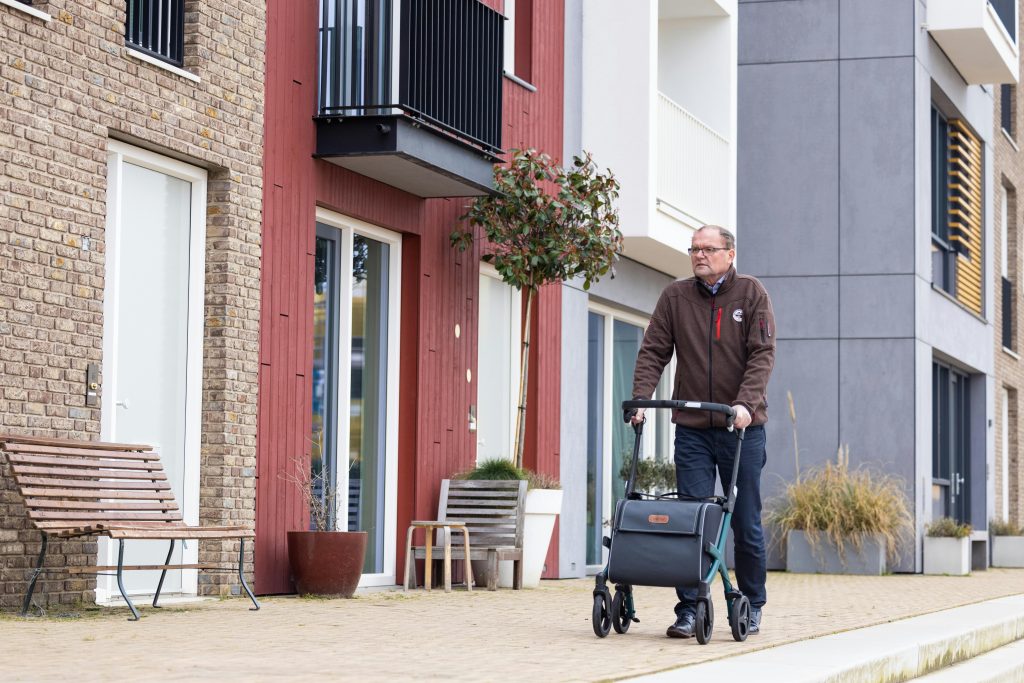
- The Rollator with Integrated Seat: This is the gold standard for dyspnea management. It provides a stable base for the Tripod Position whenever the senior needs a “breathing break.” Knowing a seat is always behind them significantly reduces the anxiety that worsens breathlessness.
- Pulse Oximeters: Every senior with chronic lung issues should own one. It provides objective data: if you feel out of breath but your SpO2 is 94%, you know you are safe to continue your Pursed-Lip Breathing. If it drops to 88%, it’s time to sit down.
9. Word Count Tip: The 4-Week Progressive Activity Diary
To reverse the Slippery Slope of Aging, we must move from “Avoidance” to “Graded Exposure.” This 4-week diary is designed for a senior with COPD or restrictive lung disease to track their recovery and build their Physiological Reserve.
The “Vigor Tracker” Diary Template
| Week | Activity Goal | Expected Borg (0-10) | Recovery Time |
| 1 | Walk to the mailbox and back | 3 (Moderate) | < 2 Minutes |
| 2 | 5-minute continuous indoor walk | 4 (Somewhat Hard) | < 3 Minutes |
| 3 | 10-minute walk with 1 rest break | 4 (Somewhat Hard) | < 4 Minutes |
| 4 | 15-minute walk (Community level) | 5 (Hard) | < 5 Minutes |
Clinical Goal: The key is not to avoid Shortness of Breath in Seniors, but to ensure that the breathlessness is “Recoverable.” If it takes more than 10 minutes to catch your breath after a walk, the intensity was too high for your current Safety Buffer. By documenting these sessions, the senior can see their “Recovery Window” shrinking—a surefire sign that their cardiovascular and respiratory systems are becoming more efficient.
10. Conclusion: Reclaiming Vigor and Aerobic Capacity
The ultimate victory in managing Shortness of Breath in Seniors is not the total elimination of breathlessness, but the elimination of the fear of it. In the clinical framework of Geriatric Physical Therapy (2020), we define health not by the absence of disease, but by the size of your Physiological Reserve. When you understand the “Hard Science” of your lungs and master the Pursed-Lip Breathing technique, you stop being a prisoner to your respiratory rate.
The Psychological Shift: From Fragility to Vigor
Reclaiming your movement requires a transition from a “static” lifestyle—where you sit to avoid breathing hard—to a “dynamic” one, where you lean into moderate exertion to strengthen your heart and diaphragm.
- The Recovery Window: As you follow the 4-Week Progressive Activity Diary, you will notice a miraculous shift. While you may still get “winded” walking up a hill, your body will recover in two minutes instead of ten. This shrinking recovery window is the definitive proof that your Safety Buffer is expanding.
- The Confidence Loop: Every time you successfully navigate a grocery store or a family walk using your Tripod Position and rhythmic breathing, you reinforce a new neurological pathway. You are teaching your brain that “Shortness of Breath” is a signal to adjust, not a signal to stop.
Breathing is the Engine of Independence
Your lungs are the bellows that fuel the engine of your life. By monitoring your Senior Blood Pressure Norms, calculating your Heart Rate Reserve, and respecting the “Red Flags” in our Safety Box, you are building a fortress of functional safety. Do not let the Slippery Slope of Aging tell you that your wandering days are over. With the right clinical tools and a commitment to graded exposure, you can breathe deep, move far, and live with the Vigor you deserve.
Are you ready to stop gasping and start moving? Download our printable 4-Week Progressive Activity Diary and the Caregiver Coaching Script at geriatricrehab.es today. Let’s expand your safety buffer together, one breath at a time!













