
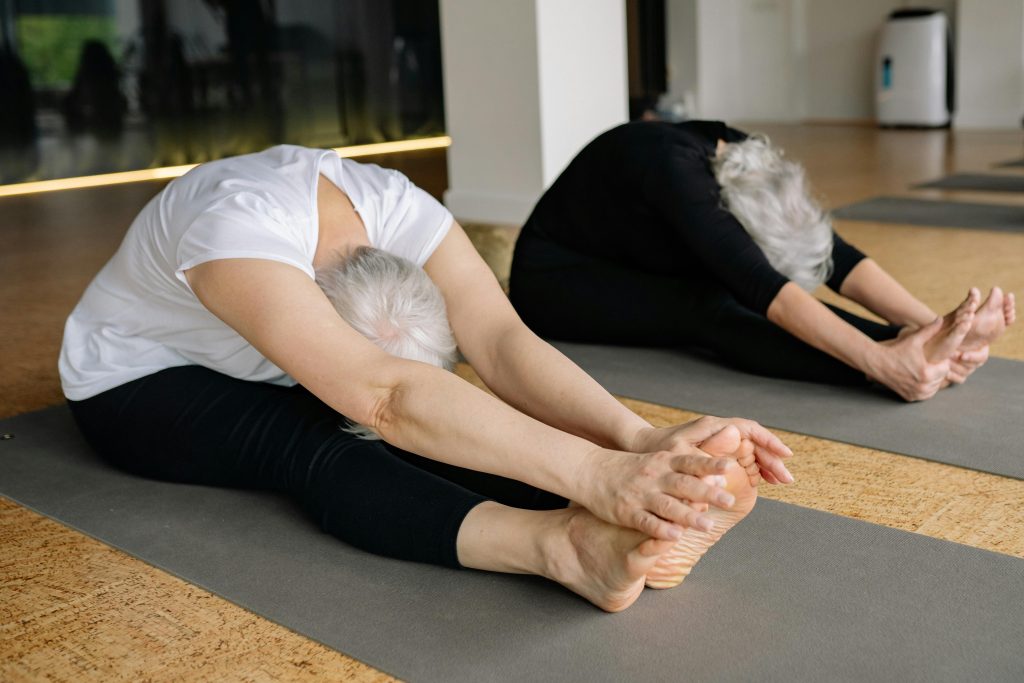
In the world of geriatric rehabilitation, we often talk about strength and balance, but we frequently overlook the “biological WD-40” that keeps the entire system running: flexibility. At geriatricrehab.es, we believe that Geriatric Flexibility is the cornerstone of independence. Based on the gold-standard principles of Geriatric Physical Therapy (2020), maintaining the range of motion (ROM) in your joints is not about becoming a yogi or touching your toes; it is about ensuring your body can meet the specific demands of daily life. When your joints are supple, they act as the “grease” for your internal engine, providing the Vigor necessary to climb the “Slippery Slope” of aging. Without it, your movement becomes restricted, your energy costs skyrocket, and your risk of a life-altering fall increases.
1. The Biological WD-40
Most people view stretching as an optional “cool-down” or a luxury for the young and athletic. However, for an older adult, Geriatric Flexibility is a clinical necessity. Think of your joints like the hinges on a door. If the hinges are rusted and tight, it takes a massive amount of force to push the door open. If the hinges are well-oiled, the door swings with the slightest touch.
When we apply the “Exercise is Medicine” philosophy, we aren’t just stretching for the sake of stretching. We are applying the SAID Principle (Specific Adaptation to Imposed Demands). If you want to be able to reach into the back of a kitchen cabinet, your shoulder requires a specific degree of flexibility. If you want to walk without shuffling, your ankles require a specific degree of “bend.” By maintaining this range, we ensure that exercise remains the “fuel” that adds years to your life and life to your years.
2. The ‘Feelings’ Section: The “Rusty Hinge” Syndrome
For many seniors, the decline in flexibility is not a sudden event but a slow, creeping sensation of “tightness” that alters how they interact with the world.
For Seniors: Reclaiming Your Fluidity
- The Morning “Old Gate” Feeling: Do you wake up feeling like your joints are “stuck” or “rusty”? This morning stiffness is often a sign that the fluids in your joints have become viscous overnight. Movement is the only way to “thin” that fluid and get the hinges moving again.
- The “Tight Rubber Band” Sensation: You might feel like the back of your calves or your hamstrings is under constant tension, like a rubber band stretched to its limit. This makes every step feel like a struggle against your own body.
- Vigor as Fluidity: When you reclaim your flexibility, that “heavy” feeling in your limbs begins to dissipate. You move with Vigor—a sense of lightness and ease that makes daily chores feel less like a workout and more like a natural part of your day.
- The Fear of the Reach: Many seniors stop reaching for things on high shelves or picking things up from the floor because it “pulls” or hurts. This avoidance is the first step down the Slippery Slope.
3. The Clinical Reality of Geriatric Flexibility
For the Allied Health Professional, understanding the pathophysiology of aging connective tissue is essential for safe prescription. As we age, our tissues undergo structural changes that make them less resilient to sudden stress.
For Professionals: Collagen, Elastin, and Cross-Linking
- The Collagen Shift: Geriatric Physical Therapy (2020) notes a decrease in the ratio of elastin to collagen in aging tendons and ligaments. This makes the tissue “stiffer” and less able to absorb shock.
- Cross-Linking: At a molecular level, “cross-links” form between collagen fibers, essentially “gluing” them together. This reduces the ability of the fibers to slide past one another during movement.
- The “Short-Short” Position: Many seniors spend a significant amount of time in seated positions (hip flexion and knee flexion). According to the SAID Principle, the body adapts to this by shortening the muscles and tightening the joint capsules.
- The Goal of Intervention: Our clinical goal is to apply “low-load, long-duration” stress to these tissues to safely break those cross-links without causing micro-tears in the fragile geriatric tissue.
Take-Home Tips for Caregivers:
- The “Gentle Warmth” Rule: Never stretch a “cold” muscle. Encourage your loved one to walk around the house for 5 minutes before performing any flexibility exercises. This increases blood flow and makes the tissue more “pliable.”
- Hydration is Key: Connective tissue is largely made of water. If a senior is dehydrated, their joints will feel much stiffer. Ensure they are drinking water consistently to keep the “WD-40” in their joints working.
- Focus on the “Exhale”: When helping a loved one with a stretch, remind them to breathe out as they move into the stretch. Holding the breath (the Valsalva maneuver) increases internal pressure and makes the muscles tighten up in resistance.
4. The Ankle-Hip Connection: The Foundation of Balance
In the clinic, we often look at the body as a kinetic chain. For a senior, the two most important links in that chain are the ankles and the hips. If these two areas lose their range of motion, the body’s primary balance strategies begin to fail, leading directly toward the “Slippery Slope” of falls.
For Professionals: The Ankle and Hip Strategies
- The Ankle Strategy: To maintain upright posture during small sways, the body relies on “dorsiflexion”—the ability of the foot to pull upward. If a senior has tight calves (limited dorsiflexion), they cannot “catch” themselves during a small stumble.
- The Hip Strategy: When the sway is too large for the ankles, the hips must hinge rapidly to keep the center of gravity over the feet. Tight hip flexors, often caused by prolonged sitting, prevent this hinge from working, forcing the senior to take a frantic, unstable step instead.
- Gait Mechanics: Geriatric Physical Therapy (2020) highlights that restricted hip extension leads to shorter step lengths and a “shuffling” gait. This is not just a sign of aging; it is a mechanical failure of Geriatric Flexibility.
5. Dose-Response: Static vs. Dynamic Tension
When prescribing movement as medicine, the “dose” is everything. For the aging population, we must move beyond the old-school “no pain, no gain” mentality and understand the physiological response of the tissue to different types of stress.
For Professionals: Understanding Tissue Creep
- Static Stretching: For seniors, a 30-to-60-second hold is the clinical gold standard. This allows for “tissue creep,” where the fibers slowly elongate under constant, gentle tension. However, if the intensity is too high (above a 4/10 on the pain scale), the “Stretch Reflex” triggers, causing the muscle to contract in self-defense, which can lead to micro-tears.
- Dynamic Mobility: This involves moving a joint through its available range without a long hold. This is excellent for “lubricating” the joint with synovial fluid and should be the “primary dose” before any functional activity.
- Intensity Calibration: We are aiming for a sensation of “productive pull”—never sharp or stabbing. For the fragile geriatric patient, a “lower dose” (less intensity) for a “longer duration” (more frequent sessions) is always superior to aggressive, infrequent stretching.
6. Flexibility as High-Octane Fuel: Reclaiming Vigor
One of the most profound benefits of Geriatric Flexibility is its ability to reduce the “Metabolic Cost” of movement. When your joints are tight, every step you take requires extra muscle force to overcome the resistance of your own stiff tissues.
For Seniors: Why Supple Joints Add Life to Your Years
- Reducing the “Brake” Effect: Imagine driving a car with the parking brake slightly pulled. You can still move, but you burn more gas and wear out the engine faster. Tight muscles are like those brakes. When we “release” them through flexibility training, your walking becomes more efficient.
- Vigor is Efficiency: By making movement easier, you save your energy for the things that matter—playing with grandkids, traveling, or gardening. This saved energy is what we call Vigor.
- Fueling the Engine: Exercise is the fuel that keeps you off the Slippery Slope. When your joints move freely, you are more likely to stay active, which in turn keeps your heart and muscles strong. Flexibility is the delivery system that allows the rest of your body to function at its peak.
Take-Home Tips for Caregivers:
- The “Slow-Motion” Check: Watch your loved one as they stand up. Do they look like they are “unfolding” a stiff piece of cardboard? If they have to “pump” their legs before walking, they need a “dose” of dynamic hip mobility before they even leave the chair.
- The Shoe Test: Can your loved one reach their own feet to put on shoes? If they’ve started wearing only slip-ons because they “can’t reach,” their Geriatric Flexibility has dropped below a functional threshold.
- Safety Spotter’s Guide for Sitting: When your loved one is stretching their hamstrings in a chair, stand beside them with one hand on their shoulder. Ensure they “hinge” at the hips and don’t round their lower back, which can put dangerous pressure on aging spinal discs.
7. The Functional Audit: Mapping Tightness to Daily Struggle
The Functional Audit is a specialized tool designed to help you identify exactly where a lack of Geriatric Flexibility is limiting your independence. By mapping your daily physical struggles to specific joint ranges, we transform the abstract feeling of “getting old” into a clear, actionable plan for regaining mobility.
- Task: Reaching a dish from the top shelf of the kitchen.
- The Functional Demand: Shoulder flexion and thoracic (mid-back) extension.
- The Audit: If you find yourself needing a step-stool for a shelf you used to reach easily, your “overhead reach” has atrophied.
- The Flexibility Cure: Wall Slides. Stand with your back against a wall and slide your arms up in a “V” shape. This opens the chest and restores the range needed for the kitchen.
- Task: Getting in and out of a car or a bathtub.
- The Functional Demand: Hip abduction and external rotation (opening the legs).
- The Audit: If you have to “lift” your leg with your hands to get it into the car, your hip capsule is tightening.
- The Flexibility Cure: Seated “Figure-4” Stretch. While sitting, cross one ankle over the opposite knee and lean forward slightly. This targets the deep hip rotators.
- Task: Stepping over a curb or a rug without tripping.
- The Functional Demand: Ankle dorsiflexion (pulling the toes up).
- The Audit: Look at your shoes. If the toes are scuffed, you aren’t clearing the ground properly because your calves are too tight.
- The Flexibility Cure: Standing Calf Stretch. Use a sturdy counter for support, step one foot back, and keep the heel on the floor. This “unshackles” the ankle for a safer stride.
- Task: Looking over your shoulder to back up the car.
- The Functional Demand: Cervical (neck) and trunk rotation.
- The Audit: If you rely entirely on your mirrors or a backup camera because it “hurts to turn,” you’ve lost your rotational buffer.
- The Flexibility Cure: Seated Trunk Twists. Sit tall and gently rotate to hold the back of your chair. This restores the “spiral” mobility required for driving safety.
8. The Caregiver Corner: The “Safety Spotter’s Guide” to Stretching
As a caregiver, you are the “Safety Spotter” for your loved one’s mobility. When assisting with flexibility, you must be the “eyes and ears” for their joints, ensuring the dose is challenging but never crosses into the Injury Zone.
Safety Spotter Protocols:
- The “Stoplight” Communication: Ask your loved one to rate the stretch. Green is a “good pull,” Yellow is “starting to burn,” and Red is “sharp pain.” Never stay in the Red.
- Recognize “The Grimace”: In seniors with cognitive decline or who are non-verbal, watch their face. A furrowed brow, pursed lips, or holding their breath are signs that the “dose” is too high. Back off immediately.
- Support the Joint, Not the Bone: If you are helping someone stretch their leg, place your hands near the joints (the hip or knee), not in the middle of the long bone. This provides better leverage and protects fragile aging bones from unnecessary stress.
- Protect Your Own Back: When assisting with stretches, never reach across the senior. Stand on the side you are working on, keep your knees bent, and move with your whole body rather than twisting your spine.
9. Reducing Pain Cascades through Geriatric Flexibility
In the “Exercise is Medicine” framework, Geriatric Flexibility acts as a powerful alternative to the “Medication Cascade.” Many seniors are prescribed NSAIDs (like Ibuprofen) or muscle relaxants for “back pain” or “hip pain” that is actually caused by mechanical tightness.
For Professionals: The Root Cause Analysis
- Postural Pain: Tight hip flexors pull the pelvis into an anterior tilt, which compresses the lumbar spine. This results in “lower back pain.” Instead of a pill to mask the pain, stretching the hip flexors fixes the mechanical cause.
- The Muscle Relaxant Trap: Muscle relaxants can cause drowsiness and increase fall risk. Improving ROM through active mobility reduces the “protective guarding” of muscles, often eliminating the need for these high-risk medications.
- Improving Vascular Flow: Stiff, compressed tissues can actually impede local circulation. By restoring flexibility, we improve “hemodynamics” at the local level, allowing the body’s natural inflammatory-clearing processes to work better.
10. Conclusion: Engineering a Fluid Future
Maintaining Geriatric Flexibility is not a pursuit of vanity; it is a pursuit of autonomy. At geriatricrehab.es, we view every stretch and every mobility drill as a victory over the “Slippery Slope” of frailty. By understanding that our joints require a specific “dose” of movement to remain lubricated and functional, we can effectively engineer a future where movement remains a joy rather than a chore.
As we have discussed, exercise is the high-octane fuel that adds years to your life and life to your years. When we prioritize our range of motion, we aren’t just “stretching muscles”—we are preserving our ability to drive, to garden, to play, and to live without the constant shadow of a fall. Whether you are an allied health professional applying the SAID principle to help a patient reclaim their gait, or a senior performing your first set of “Wall Slides” to reclaim your kitchen, you are engaging in a powerful form of biological maintenance. Stay supple, stay mobile, and stay vigorous.
Are you ready to trade those “rusty hinges” for fluid movement? Don’t let stiffness dictate the boundaries of your life. At geriatricrehab.es, we provide the clinical expertise you need to regain your range of motion safely and effectively. Visit geriatricrehab.es today to download our “Daily Fluidity Guide” and book your personalized Joint Mobility & Vigor Assessment!













