
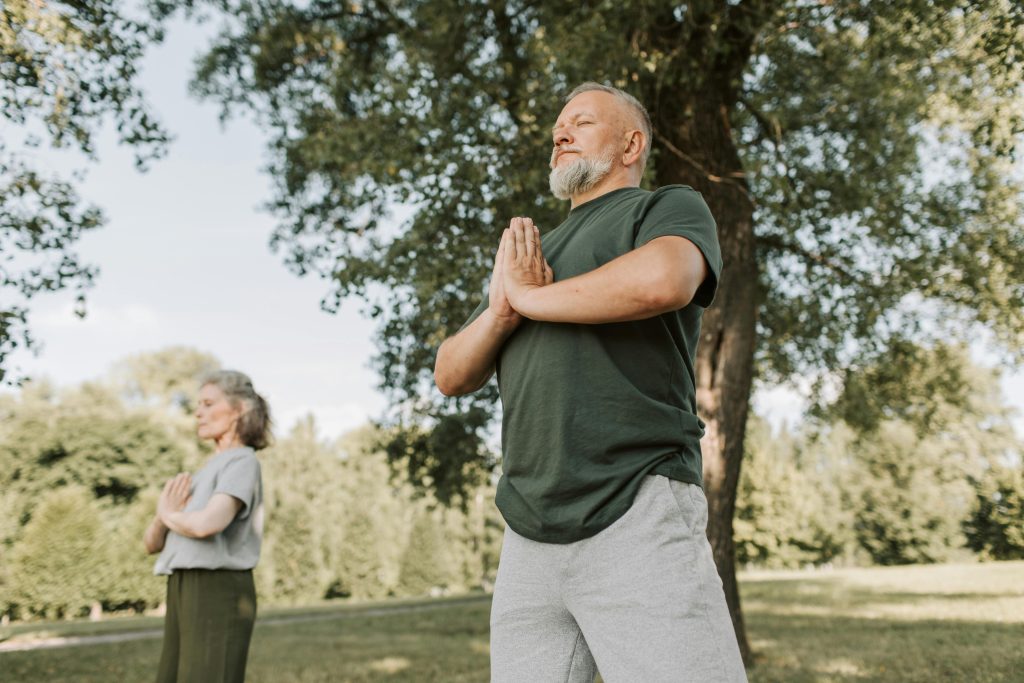
In the clinical landscape of geriatric rehabilitation, we are constantly searching for interventions that address the “Slippery Slope of Frailty.” At geriatricrehab.es, we recognize that fall prevention is not just about muscle strength; it is about the sophisticated integration of the visual, vestibular, and somatosensory systems. This is where Tai Chi for Seniors emerges as a gold-standard intervention. Often described as “meditation in motion,” Tai Chi provides a unique, evidence-based “medicine” that targets the root causes of instability. By practicing these slow, intentional movements, seniors are not just stretching; they are fueling their bodies with the Vigor needed to reclaim their independence and add meaningful life to their years.
1. The Dance of Stability
Fall prevention in older adults often focuses on high-intensity resistance training or repetitive treadmill walking. While these have their place, they often miss the nuanced “neuromuscular timing” required to navigate a cluttered living room or a busy sidewalk. Tai Chi for Seniors bridges this gap. It is a multi-component exercise that incorporates balance, flexibility, and cardiovascular elements into a single, cohesive practice.
According to Geriatric Physical Therapy (2020), the effectiveness of Tai Chi lies in its ability to challenge the body’s limits of stability. Unlike stationary exercises, Tai Chi requires continuous weight-shifting and trunk rotation. This constant movement forces the brain to recalibrate its “internal map” of where the body is in space. In the “Exercise is Medicine” framework, Tai Chi acts as a low-impact, high-reward stimulus that prevents the biological decay associated with sedentary aging. It is the fuel that keeps the “Slippery Slope” at bay, ensuring that a senior’s physical “ledger” remains in the black.
2. The ‘Feelings’ Section: From “Walking on Ice” to “Rooted Like a Tree”
For a senior who has experienced a fall—or the fear of one—the world can feel like a dangerous, unstable place. Clinical metrics are important, but the true success of Tai Chi is found in how it changes a senior’s daily “feeling.”
For Seniors: Reclaiming Your Vigor
- The “Walking on Ice” Sensation: Many seniors describe their gait as feeling “tentative” or “shaky,” as if every step might lead to a slip. This fear often leads to a “shuffling” walk, which actually increases fall risk.
- The “Rooted” Feeling: Through Tai Chi, that shakiness is replaced by a sensation of being “rooted like a tree.” You begin to feel the ground beneath your feet with more clarity. This is the return of proprioception—your body’s ability to sense its own position.
- Vigor as Confidence: As you move through the “Slippery Slope,” exercise becomes the fuel that powers your movements. Tai Chi doesn’t just make you stronger; it makes you feel “solid.” When you feel solid, you stop avoiding the stairs or the garden. You start saying “yes” to life again because your “tank” is full of Vigor.
- Fluidity vs. Stiffness: Instead of feeling like “rusty hinges,” your joints begin to feel fluid. The slow movements of Tai Chi act as the “WD-40” for your body, making the transition from sitting to standing feel smooth rather than a struggle.
3. The Clinical Science of Tai Chi for Seniors
For the allied health professional, Tai Chi is a masterclass in the SAID Principle (Specific Adaptation to Imposed Demands). The “demands” of Tai Chi—slow-motion eccentric control, narrowed base of support, and rotational torque—trigger specific adaptations in the nervous system.
For Professionals: Biomechanics and Postural Sway
- Eccentric Control: Tai Chi emphasizes the “lowering” and “holding” phases of movement. This builds eccentric strength in the quadriceps and gluteals, which is critical for controlling the descent into a chair or navigating a curb safely.
- Reduction in Postural Sway: Research cited in Geriatric Physical Therapy (2020) shows that seniors who practice Tai Chi demonstrate significantly less “sway” when standing still. Their nervous system becomes more efficient at making micro-adjustments at the ankle and hip.
- The Three Strategies: Tai Chi trains the three primary balance strategies:
- Ankle Strategy: Small sways.
- Hip Strategy: Larger perturbations.
- Stepping Strategy: When the center of mass moves outside the base of support.
- Neuromuscular Efficiency: By moving slowly, the patient is forced to fire motor units that are often bypassed during “fast” or “jerky” movements. This improves the “resolution” of the brain’s motor commands, making daily movements more precise and less energy-expensive.
Take-Home Tips for Caregivers:
- The “Soft Knee” Check: When your loved one is practicing, ensure their knees are never “locked” straight. A slightly bent, “soft” knee allows the muscles to act as shock absorbers and improves balance instantly.
- Environment is Medicine: Create a “Safe Zone” for practice. Clear away throw rugs and ensure there is a sturdy chair nearby that they can touch with two fingers for “light-touch” balance support.
- Vocal Cues: Use the phrase “feel the floor.” Encourage them to visualize their feet growing “roots” into the carpet. This mental imagery helps transition the brain from a state of anxiety to a state of focus.
4. The Cognitive Component: Moving with Intention
In the “Exercise is Medicine” framework, we must address the brain as much as the hamstrings. One of the primary reasons Tai Chi for Seniors is so effective at preventing falls is its demand on “Executive Function.”
For Professionals: Dual-Tasking and Cognitive Reserve
- Dual-Task Interference: Many falls occur when a senior is distracted—walking while talking or looking for keys. Tai Chi is a “dual-task” by nature; it requires the brain to memorize complex movement sequences (cognitive) while maintaining a narrowed base of support (motor).
- Attention Allocation: Geriatric Physical Therapy (2020) notes that Tai Chi improves “attentional switching.” This means the brain becomes faster at shifting focus from a cognitive thought back to the physical environment, effectively “armoring” the senior against the distractions of real-world walking.
- Neuroplasticity: The slow, novel patterns of Tai Chi stimulate the prefrontal cortex, helping to build “Cognitive Reserve” that protects against the mental “fog” often associated with the Slippery Slope.
5. Strength Without Strain: The Secret of Weight-Shifting
A common misconception is that an exercise must be “fast” or “heavy” to build strength. However, the biomechanics of Tai Chi for Seniors tell a different story. The secret lies in the prolonged single-limb stance.
For Professionals: Single-Limb Stance and Gluteal Loading
- The “Invisible” Strength: Every time you move from one Tai Chi pose to the next, you spend several seconds on one leg. This imposes a significant demand on the Gluteus Medius and the lateral hip stabilizers.
- Closed-Chain Loading: Unlike a seated leg extension, Tai Chi is a “closed-chain” exercise. This means it improves bone mineral density in the hip and femur by applying a controlled, compressive force through the joint, but without the high-impact “shock” of running or jumping.
- SAID Principle in Action: If the demand is to “control your weight on one leg,” the adaptation is “pelvic stability.” This stability is exactly what is needed to step over a bathtub or navigate a curb safely.
6. The “Functional Audit”: From the Form to the Furniture
To provide actionable value for your mobility, we utilize the Functional Audit. This guide maps specific Tai Chi concepts directly to the “micro-struggles” of daily life, transforming your living room into a laboratory for building Vigor. By applying these movements to your routine, you can bridge the gap between exercise and independence.
- Task: Getting out of bed safely.
- The Tai Chi Concept: “Commencing the Form.” This involves a slow, controlled sinking of the weight and a steady push through the feet.
- The Mapping: Use the “sink” to stabilize your blood pressure before standing. By engaging the legs intentionally, you prevent the dizziness that often leads to morning falls.
- Task: Reaching for a heavy jar on a high shelf.
- The Tai Chi Concept: “Fair Lady Works the Shuttles.” This movement involves a diagonal reach combined with a shift in the center of gravity.
- The Mapping: Instead of “over-reaching” with your back, practice the Tai Chi weight-shift. By moving your weight into the reach, you keep your spine neutral and your base of support wide.
- Task: Stepping over a rug or a high doorstep.
- The Tai Chi Concept: “Golden Rooster Stands on One Leg.” This is a high-knee lift combined with a stable single-leg stance.
- The Mapping: If you find yourself “scuffing” your feet, practice this form. It trains the hip flexors to lift the foot clear of obstacles while the opposite hip stays “fortified.”
- Task: Turning around to see who called your name.
- The Tai Chi Concept: “Cloud Hands.” This is a continuous trunk rotation while maintaining a stable base.
- The Mapping: Many seniors fall because they “pivot” on a stiff knee. Cloud Hands teaches you to rotate your spine and hips as one unit, preventing the “torque” that leads to a loss of balance.
Take-Home Tips for Caregivers:
- The “Nose Over Toes” Rule: During a weight-shift, ensure your loved one keeps their “nose over their toes.” If their head leans too far back or forward, they are exiting their “Stability Box.”
- Safety Spotter’s Back Protection: When assisting with a weight-shift, stand to the side with one hand near their waist. Do not bend your back. Keep your knees bent so you can move with them. This allows you to catch a small stumble without straining your own spine.
- The Two-Finger Touch: If they are struggling with a single-leg form, don’t hold their whole hand. Ask them to touch a counter with just two fingers. This “light touch” provides enough sensory input for the brain to stabilize without taking the “work” away from their muscles.
7. Dose-Response: How Much “Medicine” is Enough?
In the “Exercise is Medicine” framework, every movement has a dosage. For practitioners using Tai Chi for Seniors, we must distinguish between a relaxing session and a therapeutic intervention designed to build stamina and “Vigor.”
For Professionals: The 40% vs. 85% Intensity Spectrum
- The 40% Heart Rate Reserve (HRR) Dose: Most traditional Tai Chi falls into this category. It is a “base-building” intensity that focuses on parasympathetic activation, lowering cortisol, and improving vascular compliance. It is the “fuel” that prevents the engine from overheating.
- The 85% HRR Dose: While Tai Chi is slow, certain “martial” applications or “Vigorous Flow” sequences can push a senior toward higher cardiovascular demands. Research shows that for seniors who have already moved past the “fragile” zone of the Slippery Slope, occasional bursts of higher-intensity movement (even within a slow form) are necessary to trigger mitochondrial biogenesis and improve VO2 max.
- The Consistency Factor: Geriatric Physical Therapy (2020) emphasizes that for balance adaptation, frequency is more important than duration. A 15-minute daily “dose” of weight-shifting is more effective for neuroplasticity than a single 90-minute class once a week. The brain needs daily “reminders” to stay rooted.
8. The Caregiver Corner: The “Safety Spotter’s Guide”
As a caregiver, your role is to be the “Safety Spotter” while your loved one explores their limits of stability. Training Tai Chi for Seniors requires a balance between challenging the nervous system and ensuring absolute physical safety.
Safety Spotter Protocols:
- The “Shadow” Position: When your loved one is practicing a form like “Brush Knee and Push,” stand slightly behind and to their side. This is your “Safety Zone.” If they sway, you are perfectly positioned to guide them back to center.
- Protect Your Own Back: Never reach out to grab a senior with straight arms. Keep your elbows tucked and your knees bent. If they lose balance, you should “sink” your weight along with theirs. By using your legs to stabilize the situation, you avoid the common caregiver injury of a lumbar strain.
- The “Light Touch” Evolution: Encourage your loved one to move from holding onto a walker, to a counter, to eventually using just “two fingers” for balance. This gradual reduction in support is how you “titrate” the dose of the exercise.
- Nose Over Toes: Continually cue them to keep their head aligned over their center of gravity. A “forward head” posture during Tai Chi acts like a heavy weight that pulls the body off its “root.”
9. Reversing the Medication Cascade through Mindful Flow
In geriatric medicine, we often see the “Medication Cascade”: a senior takes a pill for high blood pressure, which causes dizziness, which leads to a fall, which leads to pain medication, which causes confusion. Tai Chi for Seniors acts as a “circuit breaker” for this dangerous cycle.
For Professionals: The Relaxation Response
- Blood Pressure Management: The deep, diaphragmatic breathing in Tai Chi stimulates the vagus nerve. This can lead to a significant reduction in resting blood pressure, potentially allowing a physician to reduce the “dose” of antihypertensive medications.
- Anxiety and the Fear of Falling: Chronic “Fear of Falling” (FOF) keeps the body in a state of “High Guard.” This muscle tension causes pain and stiffness. Tai Chi’s meditative focus reduces this sympathetic “fight or flight” response, often reducing the need for anti-anxiety or sedative medications that contribute to grogginess and further falls.
- Cognitive Clarity: By improving blood flow to the prefrontal cortex and reducing the “chemical stress” of cortisol, Tai Chi helps maintain the mental Vigor needed to manage complex medication schedules safely.
10. Conclusion: Engineering a Balanced Future
As we have explored, the transition from “shaky” to “rooted” is not an overnight miracle, but a systematic biological adaptation. At geriatricrehab.es, we view Tai Chi for Seniors as an essential tool in the modern geriatric toolkit. It is the perfect marriage of ancient wisdom and the modern SAID Principle, offering a way to strengthen the body while calming the mind.
By treating movement as medicine, we provide the heart and the nervous system with the fuel they need to resist the “Slippery Slope.” Tai Chi is the ultimate expression of Vigor—it is the ability to move through the world with grace, intention, and, most importantly, safety. Whether you are an allied health professional prescribing this “mindful flow” or a senior taking your first “rooted” step, remember: every minute spent in the flow is a minute added to your independence.
Are you ready to trade the “fear of falling” for the “joy of moving”? Don’t let the Slippery Slope dictate your future. At geriatricrehab.es, we are dedicated to helping you reclaim your Vigor through evidence-based movement. Visit geriatricrehab.es today to download our “Tai Chi Home Flow” guide and book your personalized Balance and Vigor Screening!













