
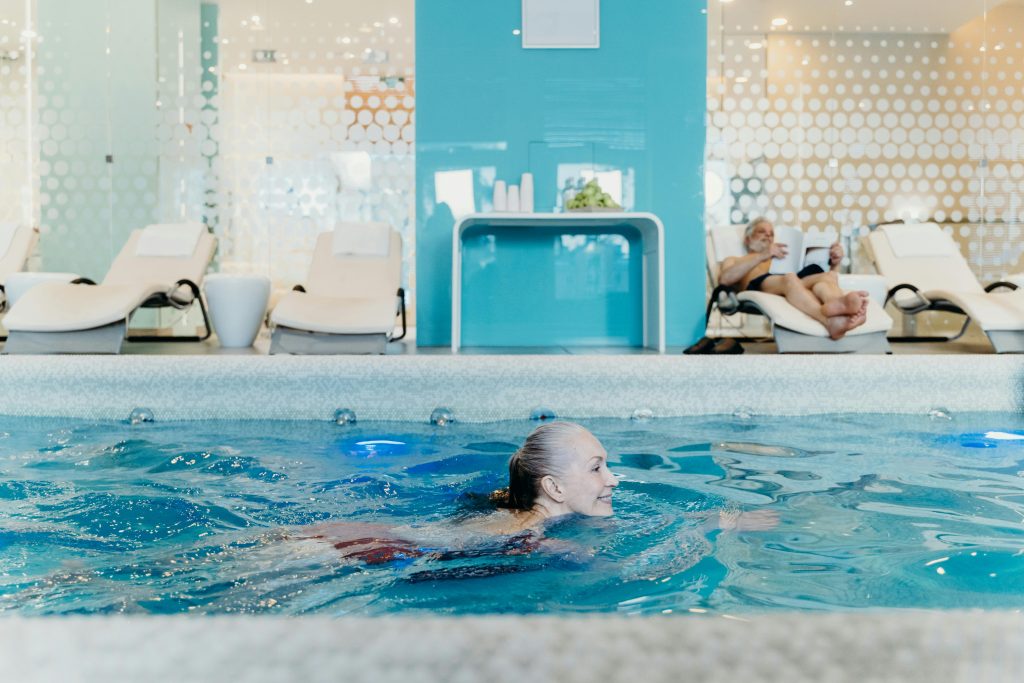
In the clinical landscape of geriatric rehabilitation, we often encounter patients who are physically “stuck.” Whether due to chronic osteoarthritis, obesity, or a significant loss of balance, the terrestrial environment—where gravity is a constant, unforgiving force—can make traditional exercise feel impossible. This is where Water Aerobics for Seniors and structured aquatic therapy become transformative. By utilizing the unique properties of the aquatic environment, we can bypass the limitations of the Slippery Slope of Aging, allowing patients to build strength and cardiovascular resilience in a “gravity-reduced” sanctuary.
1. Defying Gravity in Geriatric Rehab
In the clinical framework of Geriatric Physical Therapy (2020), we visualize the senior’s health journey as the Slippery Slope of Aging. As we lose Physiological Reserve, the energy cost of moving against gravity on land becomes increasingly expensive. For many, this leads to a sedentary lifestyle that accelerates the slide toward frailty. However, Water Aerobics for Seniors offers a unique “gravity-reduced” sanctuary where the rules of the slope are temporarily suspended.
For the senior, exercise is the fuel that adds years to your life and life to your years. In the water, we restore your Vigor—the vitality that allows you to move without the crushing fear of joint pain or falling. By entering the pool, you are not just swimming; you are refilling your physiological tank in an environment where you are 90% lighter. This allows for movements that would be impossible on a sidewalk, helping you fight back against the descent of the slope.
2. The Physics of Water Aerobics for Seniors
From a Professional Perspective, the therapeutic power of water is rooted in the SAID Principle (Specific Adaptation to Imposed Demands), but the “demand” is modified by the unique physics of the medium.
- Buoyancy: According to Archimedes’ Principle, the upward thrust on a body in water reduces joint compression. A senior submerged to the neck is only weight-bearing at roughly 10% of their body weight. This is critical for those with severe osteoarthritis or obesity, as it allows for high-intensity movement without mechanical joint damage.
- Hydrostatic Pressure: Water exerts pressure equally on all surfaces. This pressure assists with venous return, effectively acting as a full-body compression stocking. It reduces peripheral edema and can improve cardiac efficiency during the session.
- Viscosity: Water provides resistance in 360 degrees. Unlike a land-based dumbbell that only offers resistance against gravity (downward), water resists every movement you make, allowing for balanced muscle development.
3. Cardiovascular Demand: The Dose-Response in the Pool
When prescribing Water Aerobics for Seniors, the Allied Health Professional must adjust the Dose-Response calculation. Due to the effects of hydrostatic pressure and the cooling effect of the water, heart rate is typically 10 to 15 beats per minute lower in the pool than for the same intensity of work on land.
- The 40% Target: At 40% of heart rate reserve, the senior is achieving metabolic benefits and improved circulation. This is an ideal entry point for those at the bottom of the “Slippery Slope.”
- The 85% Target: To achieve a “Vigor” response and significant cardiovascular adaptation, we must push toward 85% of HRR. In the pool, this requires rapid, large-amplitude movements or the use of aquatic “fins” to increase drag.
Take-Home Tip for Caregivers (The Dose Detective): Because the water is supportive and cool, seniors often don’t realize how hard they are working until they exit the pool. Be prepared for the “heavy leg” feeling once they return to gravity. Always ensure your loved one sits for two minutes immediately after exiting the water to prevent a sudden drop in blood pressure (the “Dizzy Pivot”).
4. Functional Training: The Aquatic Functional Audit
In geriatric rehabilitation, we don’t just exercise for the pool; we exercise in the pool to survive and thrive on land. Because water reduces the fear of falling, we can use it to rehearse high-risk daily activities. By applying the SAID Principle, we can map aquatic movements to the specific land-based demands that currently deplete a senior’s Vigor.
Below is a Functional Audit mapping common land-based struggles to their aquatic “corrective” movements.
1. Stepping over a bathtub or a high threshold
- The Land Struggle: Inability to lift the foot high enough (poor toe clearance) and fear of losing balance.
- The Aquatic Dose: Deep-Water High Marches. The Response: The water supports the standing leg while providing resistance to the lifting leg, strengthening the hip flexors without risk of a fall.
2. Reaching for a heavy item on a high kitchen shelf
- The Land Struggle: Shoulder stiffness and a loss of “upward” power.
- The Aquatic Dose: Underwater Sculling and Bilateral Overhead Presses (using water resistance).
- The Response: Strengthens the rotator cuff and serratus anterior in a 360-degree resistance environment, increasing the range of motion.
3. Navigating a crowded grocery store (Gait Speed)
- The Land Struggle: Walking slowly and shuffling due to poor confidence.
- The Aquatic Dose: Resistance Walking (Waist-deep, focus on long strides).
- The Response: Moving against the viscosity of water forces the glutes and core to engage, which directly improves stride length on land.
4. Getting up from a low garden bench or toilet
- The Land Struggle: Needing to use the arms to “heave” the body upward.
- The Aquatic Dose: Aquatic Squats (Chest-deep to start, moving to waist-deep).
- The Response: The buoyancy assists the “up” phase initially, allowing the senior to build the necessary eccentric control in the quads for the “down” phase on land.
5. Obesity and Joint Pain: The Perfect Therapeutic Window
For seniors struggling with obesity or chronic osteoarthritis, the terrestrial environment can feel like a trap. Every step on land applies forces up to 3 to 5 times body weight through the knee and hip joints. This creates a “pain-inactivity” cycle that leads to a rapid slide down the Slippery Slope.
Water Aerobics for Seniors breaks this cycle by creating a “therapeutic window.” Because buoyancy negates up to 90% of body weight, we can achieve high-intensity cardiovascular work without the inflammatory response of joint pounding.
- For Professionals: This is the ultimate application of the SAID Principle. We can impose a high metabolic demand (raising the heart rate to 70% of HRR) while imposing a near-zero mechanical demand on the articular cartilage.
- For Seniors: This is your chance to feel “weightless.” That “heavy leg” feeling you experience on land disappears in the pool, allowing you to move with the Vigor of your younger years.
6. Clinical Safety: Water Aerobics for Seniors and Balance
Water is not just a place for strength; it is a gymnasium for the brain. We use the properties of the water to challenge the vestibular system (your internal balance center) without the danger of a hard landing.
- Perturbation Training: In the pool, we create “turbulence” by moving our arms or having others walk nearby. This turbulence acts as a gentle, invisible force that tries to push the senior off balance.
- The Response: The senior must use their core and “righting reactions” to stay upright. This translates directly to land-based safety—if a senior can stay balanced in turbulent water, they are much more likely to recover from a trip on a sidewalk rug.
Take-Home Tip for Caregivers: While the pool is safe, the “transition zone” is not. The most common site for injury is the pool ladder or the wet tiles of the locker room. Always act as a “Safety Spotter” during the exit, ensuring your loved one has a firm grip and dry feet before they attempt to walk independently.
7. Pharmacokinetics and the Aquatic Environment
For the Allied Health Professional, the aquatic environment introduces unique physiological shifts that alter how medications behave in the aging body. When a senior is immersed in water, the hydrostatic pressure causes a shift of fluid from the extremities to the central thoracic cavity. This “central volume shift” has a direct impact on pharmacokinetics.
- Volume of Distribution (Vd): Because immersion increases central blood volume and renal (kidney) blood flow, the Vd of water-soluble medications may be temporarily altered. This can lead to a more rapid “washout” of certain drugs, or conversely, a higher concentration in the blood during the session.
- Drug Clearance: The increased kidney filtration caused by water pressure (often noticed as the need to use the restroom shortly after entering the pool) can accelerate the clearance of medications.
- The “Dizzy Pivot” Risk: Seniors on antihypertensives or diuretics are at high risk when exiting the pool. The sudden transition from the hydrostatic “compression” of the water back to the pull of gravity can cause blood to pool in the legs, leading to orthostatic hypotension.
8. The Story of Mr. L: A Case Study in Aquatic Resilience
Mr. L, a 78-year-old retired architect, provides a classic example of the Slippery Slope of Aging. Diagnosed with severe spinal stenosis and bilateral knee osteoarthritis, his land-based “dose” of exercise had dwindled to nearly zero. He reported a constant “heavy leg” feeling and a fear that any step could lead to a fall. His Physiological Reserve was so low that he could no longer walk from his car to the grocery store entrance.
The Aquatic Intervention: We moved Mr. L’s rehab to the pool. In chest-deep water, his perceived pain dropped from an 8/10 to a 2/10. Because he was 75% lighter, he could stand tall without the neurogenic claudication (leg pain) caused by his stenosis.
- Phase 1 (The 40% Dose): We began with simple water walking and “Step-Ups” on a submerged bench.
- Phase 2 (The 85% Dose): Once his confidence grew, we used aquatic fins to increase resistance, raising his heart rate to 85% of his reserve. We applied the SAID Principle by having him rehearse the “sit-to-stand” movement from a submerged bench at varying depths.
The Result: After 12 weeks, Mr. L’s land-based gait speed improved by 30%. By “refilling” his tank of Vigor in the pool, he regained the strength to walk independently on land. He proved that the water isn’t just a place to relax—it is a powerful clinical tool for rebuilding a life.
9. The Beers Criteria: Safety Screening for Pool Entry
Before a senior begins Water Aerobics for Seniors, we must perform a safety audit using the Beers Criteria. Certain medications can make the warm environment of a therapy pool dangerous.
- Anticholinergics: These medications can impair the body’s ability to regulate temperature. In a warm pool, a senior may overheat without realizing it, as the water masks the sensation of sweating.
- Sedatives and Benzodiazepines: These drugs stay in the system longer due to an increased half-life in seniors. In the pool, the relaxing effect of the water combined with these meds can lead to dangerous lethargy or reduced “righting reactions” during a balance challenge.
- Nitrates: For seniors with heart conditions, the central blood volume shift of immersion can interact with nitrates to cause a profound drop in blood pressure.
Caregiver Focus: If your loved one is on a new medication, check the “Beers list” or consult their PT before pool day. Look for signs of “glassy eyes” or unusual sluggishness before they enter the water. Safety in the water begins with a clear mind and a stable internal “dose.”
10. Conclusion: Maximizing Water Aerobics for Seniors
To truly maximize the benefits of Water Aerobics for Seniors, we must respect the Dose-Response relationship. In the aquatic environment, the “dose” is a combination of depth, speed of movement, and the use of resistance equipment.
- The 40% Dose (Therapeutic Entry): Characterized by slow, rhythmic movements in chest-deep water. This is where we manage pain and improve Vigor without exhausting the Physiological Reserve.
- The 85% Dose (Resilience Building): This involves rapid, multidirectional movements in waist-deep water or deep-water jogging. By applying the SAID Principle at this intensity, we force the heart and muscles to adapt, effectively adding life to your years.
Caregiver Focus: The Safety Spotter’s Guide
The transition from the weightlessness of the pool to the heavy reality of land is the most precarious moment of the session. As a caregiver, you are the “Safety Spotter” for this transition.
- The Gravity Re-Entry: As your loved one exits the pool, they will suddenly feel the “heavy leg” sensation as their full weight returns to their joints. Stand on their weaker side and provide a steadying hand at the elbow or waist.
- The Back-Safe Assist: If they need help standing from a bench in the locker room, do not pull on their arms. Instead, stand in front of them with a wide base, knees bent. Have them lean “nose over toes” while you provide a gentle lift from the hips. This protects your own back from strain while ensuring their safety.
- The “Dizzy” Check: Always ask, “How is your head?” immediately after they exit. If they report the “Dizzy Pivot,” have them sit and perform ankle pumps for two minutes to stabilize their blood pressure.
Movement is the fuel that keeps the Slippery Slope at bay. By utilizing the power of water, you are giving your body a chance to move with a freedom that land cannot provide. Embrace the buoyancy, respect the intensity, and watch your Vigor return.
Are you ready to dive into a pain-free future? Don’t let gravity hold you back. Schedule an aquatic evaluation with our clinical experts at geriatricrehab.es today and learn how to make the water work for you.













