
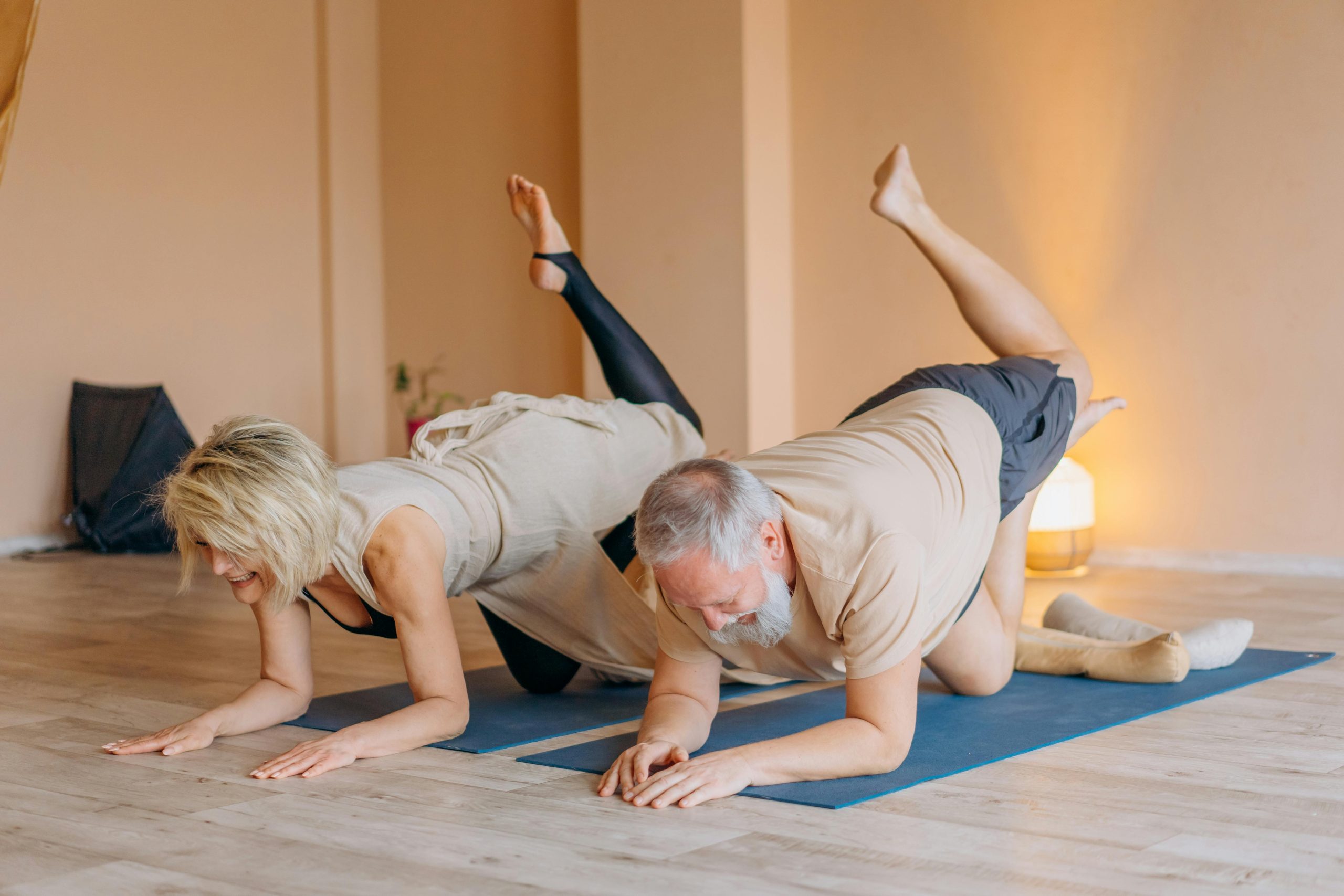
In the journey of aging, we often view the skeleton as a static structure—a scaffolding that inevitably weakens. At geriatricrehab.es, we reject this notion of inevitable decline. We advocate for the “Exercise is Medicine” philosophy, where Yoga for Seniors serves as a sophisticated delivery system for bone-loading and postural restoration. Movement is the “fuel” that powers your independence, adding years to your life and, more importantly, life to your years. According to Geriatric Physical Therapy (2020), the aging skeleton is highly responsive to the mechanical stresses provided by weight-bearing asanas. By utilizing yoga not as a flexible “pretzel” challenge, but as a clinical tool for Vigor, we can effectively halt the slide down the Slippery Slope of Frailty and build a body that is as resilient as it is calm.
1. The Biological Benefits of Yoga for Seniors
The traditional image of yoga—young, hyper-mobile bodies in complex contortions—has created a “perception barrier” for the very population that needs it most. For a senior, the Slippery Slope of Frailty is often paved with a loss of proprioception (body awareness) and a gradual thinning of bone mineral density. Yoga for Seniors addresses these deficits simultaneously. Unlike repetitive gym machines, yoga requires the body to move through multi-planar transitions, challenging the nervous system to maintain the “Internal Scaffolding” of the core.
From a biological standpoint, yoga is an “Osteogenic” activity. When we hold a pose like a modified Warrior, we aren’t just stretching; we are creating a sustained pull of muscle against bone. This mechanical tension is the language our bones speak, signaling the body to deposit more minerals and strengthen the cortical wall. This is how we build Vigor. By the end of this guide, you will see that every “Down Dog” at a chair or “Tree Pose” at the kitchen counter is a deposit into your lifelong independence fund.
2. The ‘Feelings’ Section: Breaking the “Pretzel” Myth
The most common phrase I hear in the clinic is: “I can’t do yoga; I’m not flexible.” This is a fundamental misunderstanding of what yoga represents in geriatric rehab.
For Seniors: Reframing the Flow
- Flexibility vs. Mobility: We don’t need you to touch your toes; we need you to be able to reach your shoes. Yoga is about Functional Mobility —the ability to move through your day with ease and without the shadow of chronic pain.
- The “Internal Fuel”: Think of yoga as the fuel that lubricates your joints. When you move slowly and mindfully, you are pumping synovial fluid into your joints, reducing the “stiffness” that often leads to a sedentary lifestyle.
- Confidence as a Skill: The first time you balance on one leg for five seconds, your Vigor tank overflows. That confidence is what allows you to walk across a parking lot or a rug-filled room without the paralyzing fear of a fall.
- Ending the “Grin and Bear It” Culture: Yoga teaches you to listen to your body’s “Stop Signs.” We move to the edge of the challenge, not over the cliff. This mindfulness is a powerful tool for self-regulating your health.
3. Clinical Mechanics of Yoga for Seniors and Bone Health
For the healthcare professional, the value of yoga lies in Mechanotransduction —the process by which the body converts mechanical loading into cellular responses.
For Professionals: The Science of the Hold
- Osteoblastic Stimulation: Bone remodeling is highly sensitive to “long-hold” isometric tension. Geriatric Physical Therapy (2020) notes that while high-impact work is good for bones, many seniors cannot tolerate the joint stress of jumping. Yoga provides a “Low-Impact, High-Tension” alternative. By holding a pose for 30-60 seconds, we stimulate osteoblasts (bone-building cells) through sustained muscular pulling on the periosteum.
- The “Piezoelectric” Effect: When bone is slightly “bent” or stressed during a yoga pose, it creates a small electrical charge that attracts mineral deposits. This is why modified weight-bearing is essential for those in the “Pre-Frailty” zone of the Slippery Slope.
- Proprioceptive Enrichment: Yoga increases the density of Golgi Tendon Organs and Muscle Spindles. This improves the senior’s “Satellite Navigation System,” allowing them to make micro-adjustments in their balance before a stumble becomes a fracture.
Take-Home Tips for Caregivers:
- The “Stability Shield”: When your loved one is practicing standing poses, stand behind them with your hands two inches away from their hips. Do not hold them unless they wobble—give them the “space” to find their own vigor while you remain the ultimate safety net.
- Protect Your Back: If you are helping a senior transition from the floor to standing after a yoga session, do not pull on their arms. Instead, have them move to “All Fours” and use a sturdy chair for a “half-kneeling” stand while you provide a steadying hand on their shoulder.
- The “Breath Observation”: If you see your loved one holding their breath during a pose, they have crossed into the “Red Flag” zone. Remind them that “The breath is the engine; if the engine stops, the movement stops.”
4. The SAID Principle in the Yoga Studio
The Specific Adaptation to Imposed Demands (SAID) principle is the cornerstone of why we prescribe certain asanas. In Yoga for Seniors, we aren’t just stretching; we are imposing specific mechanical and neurological demands to force the body to adapt.
For Professionals: Engineering the Adaptation
- The “Tree Pose” (Vrksasana) Demand: When a senior stands on one leg, we are imposing a demand on the lateral hip stabilizers (gluteus medius) and the ankle’s proprioceptive receptors. The “Adaptation” is an increase in sway-reduction—a direct clinical defense against hip fractures.
- The “Warrior” (Virabhadrasana) Demand: This pose imposes a massive eccentric load on the quadriceps and a stretching demand on the hip flexors. For a senior sliding down the Slippery Slope, this specifically adapts their body to handle the “deceleration” needed when walking downhill or descending stairs.
- Neoplasticity through Complexity: By changing hand positions or closing eyes during a pose, we impose a “Sensory Demand.” This forces the brain to rely on the vestibular system rather than just vision, essentially “re-wiring” the balance centers of the brain.
5. The Functional Audit: Mapping Yoga Poses to Independence
The Functional Audit is our tool for proving that these exercises are not “extra” work—they are “foundational” work for daily survival. By mapping specific poses to everyday tasks, we transform clinical drills into essential life skills.
- Task: Getting a heavy dish from a high kitchen shelf.
- The Yoga Pose: Warrior I (Modified).
- The Mapping: Warrior I trains the “reach” combined with a stable base. It teaches the senior how to extend the spine and shoulders without losing their center of gravity or “toppling” backwards.
- Task: Stepping over a bathtub or a high threshold.
- The Yoga Pose: Mountain Pose (Tadasana) into a High March.
- The Mapping: This asana focuses on “Verticality.” It trains the core to hold the spine tall while the weight shifts to one leg, mirroring the exact mechanics needed to enter a shower safely.
- Task: Rising from a low toilet seat or a soft sofa.
- The Yoga Pose: Chair Pose (Utkatasana).
- The Mapping: Chair Pose is essentially a “Slow-Motion Squat.” It builds the Vigor in the quadriceps and glutes required to rise without “plopping” or requiring multiple attempts.
- Task: Picking up a fallen item from the floor.
- The Yoga Pose: Downward Facing Dog (on a Counter or Chair).
- The Mapping: This stretches the hamstrings and strengthens the back. It allows a senior to hinge at the hips rather than rounding the spine, protecting the vertebral discs from “bulging” under load.
6. Respiratory Vigor and Yoga for Seniors
In the “Exercise is Medicine” framework, the breath is the “coolant” and the “stabilizer.” For seniors, breathing is often shallow, which limits oxygen delivery and increases the “Slippery Slope” risk of fatigue and confusion.
For Professionals: Managing the Internal Canister
- The “Canister Model” and Pranayama: The diaphragm is the “lid” of the core. Yoga teaches Pranayama (breath control), which coordinates the diaphragm with the pelvic floor. This manages intra-abdominal pressure, ensuring that when a senior lifts a laundry basket, they aren’t “pushing down” on their pelvic floor or “straining” their heart.
- Autonomic Regulation: Deep, rhythmic breathing during Yoga for Seniors stimulates the Vagus nerve. This shifts the body from “Fight or Flight” (anxiety) to “Rest and Digest” (recovery). For seniors with chronic pain, this is a potent analgesic that reduces the need for “The Medication Cascade.”
- Fueling the Engine: By increasing lung expansion, we improve the VO2 max—even in low-impact movement. This “Respiratory Vigor” means the senior does not get “winded” as easily when performing the basic tasks of life.
Take-Home Tips for Caregivers:
- The “Mirror Breath”: If your loved one is struggling to find their rhythm, sit in front of them and breathe loudly and deeply. They will naturally “entrain” to your rhythm, lowering their heart rate and anxiety.
- The Stability Shield for High Reach: During the “Warrior” reach, stand behind them with a hand hovering near their shoulder blades. This gives them the “Tactile Confidence” to reach higher without fear of falling backwards.
- Check the Environment: Ensure the yoga mat is “sticky” and not placed on a loose rug. In the world of Yoga for Seniors, the “ground” must be an immutable fact, not a variable.
In the “Exercise is Medicine” framework, the “dose” is everything. For many, yoga is seen as a 100% “relaxation” activity, but to reverse the Slippery Slope, we must introduce periods of intensity.
For Professionals: Titrating the Yogic Load
- The 40% HRR “Recovery Flow”: This is the base layer of Yoga for Seniors. It involves seated movements and gentle stretching. It is excellent for “joint lubrication” and lymphatic drainage, but it is not enough to build bone.
- The 85% HRR “Vigor Hold”: To stimulate the SAID adaptation for bone and heart health, we must move into the “Vigor Zone.” This is achieved through standing balance flows and sustained isometric holds (like a 60-second Chair Pose). At this level, the senior should feel “warm,” their heart rate should be elevated, and their muscles should feel a “healthy fatigue.”
- The RPE Scale in Yoga: Since many seniors are on medications that affect heart rate (the Medication Cascade), we use the Rate of Perceived Exertion (RPE). A Vigor-building yoga session should hover around an RPE of 7 or 8—”Hard work, but I can still maintain my yogic breath.”
8. The Caregiver Corner: The “Stability Shield” Yoga Guide
As a caregiver, you are the “Physical Anchor” for your loved one’s practice. Your goal is to provide just enough support to ensure safety without taking away the “challenge” that builds their Vigor.
The “Safety Spotter” Protocol for Yoga:
- The “Hula Hoop” Space: When your loved one is practicing balance, don’t hold them. Instead, keep your arms in a circle around them (the “Stability Shield”). This allows their nervous system to “wobble” and self-correct—which is where the actual brain-training happens—while ensuring you are there to catch them if the wobble becomes a fall.
- Assisting Floor Transitions: Moving from “Down Dog” to standing is the most common time for dizziness. Stand to their side and offer a forearm (not a hand) for them to grip. This provides a more stable lever for them to pull against.
- Protecting Your Back: When assisting with a low pose, do not lean over from the waist. Get down on one knee (the half-kneeling position). This keeps your center of gravity low and protects your lumbar spine from the “Shear Force” of lifting a person from a compromised position.
9. Spinal Integrity and Modified Yoga for Seniors
The spine is the “Central Pillar” of independence. However, for many seniors with osteopenia or osteoporosis, traditional yoga “twists” and “folds” can be dangerous.
For Professionals: The Extension-First Protocol
- Avoiding Hyper-Flexion: Geriatric Physical Therapy (2020) warns against aggressive forward folding (rounding the back) in osteoporotic patients, as this increases the risk of vertebral compression fractures. In Yoga for Seniors, we replace the “Toe Touch” with the “Flat Back Table.”
- The Power of Extension: Most seniors live in a state of “Kyphosis” (hunched forward). We prioritize “Extension” poses like the Cobra (Bhujangasana) and Sphinx. These poses strengthen the erector spinae muscles, which act as a “Biological Brace” for the spine.
- Axial Elongation: We teach the senior to “grow tall” through the crown of the head before any rotation. This creates space between the vertebrae, ensuring that the movement is distributed across the whole spine rather than “pinching” at a single vulnerable segment.
Take-Home Tips for Caregivers:
- The “Visual Red Flag” Check: During standing poses, watch your loved one’s ankles. If the ankles are “shaking” violently, the muscle is fatigued beyond the Vigor zone. This is the time to cue them to use a chair or take a break.
- Temperature Check: Ensure the room is comfortably warm but not “hot.” Seniors regulate their internal temperature less efficiently than younger adults, and “Hot Yoga” is a clinical red flag for this population.
- The “Dizzy” Pause: If they feel lightheaded when standing up, have them sit down and perform “Ankle Pumps” (moving feet up and down). This acts as a “Second Heart” to pump blood back up to the brain.
10. Conclusion: The Lifelong Practice of Vigor
Yoga is not a destination to be reached; it is a clinical practice to be lived. As we have explored throughout this guide, Yoga for Seniors is a sophisticated method for delivering the weight-bearing loads and proprioceptive challenges necessary to stay off the “Slippery Slope of Frailty.” By integrating the ancient wisdom of the breath with the modern science of mechanotransduction, we create a “Biological Shield” that protects the bones, stabilizes the joints, and calms the mind.
At geriatricrehab.es, we believe that every senior is a “Master of Movement” in training. Your mat is your laboratory, your breath is your fuel, and your newfound balance is the map to your future independence. Whether you are holding a Chair Pose for 30 seconds or simply practicing a mindful Mountain Pose in the kitchen, you are adding years to your life and life to your years. It is time to step onto the mat and claim the Vigor you deserve.
Is your current routine lacking the balance and bone-building power you need? Don’t let the “Slippery Slope” dictate your future. At geriatricrehab.es, we specialize in “Clinical Yoga Integration”—designing modified flows that fit your unique skeletal profile. Visit geriatricrehab.es today to download our “Yoga for Vigor” Pose Guide and book your virtual Yoga Safety & Mobility Assessment!













