
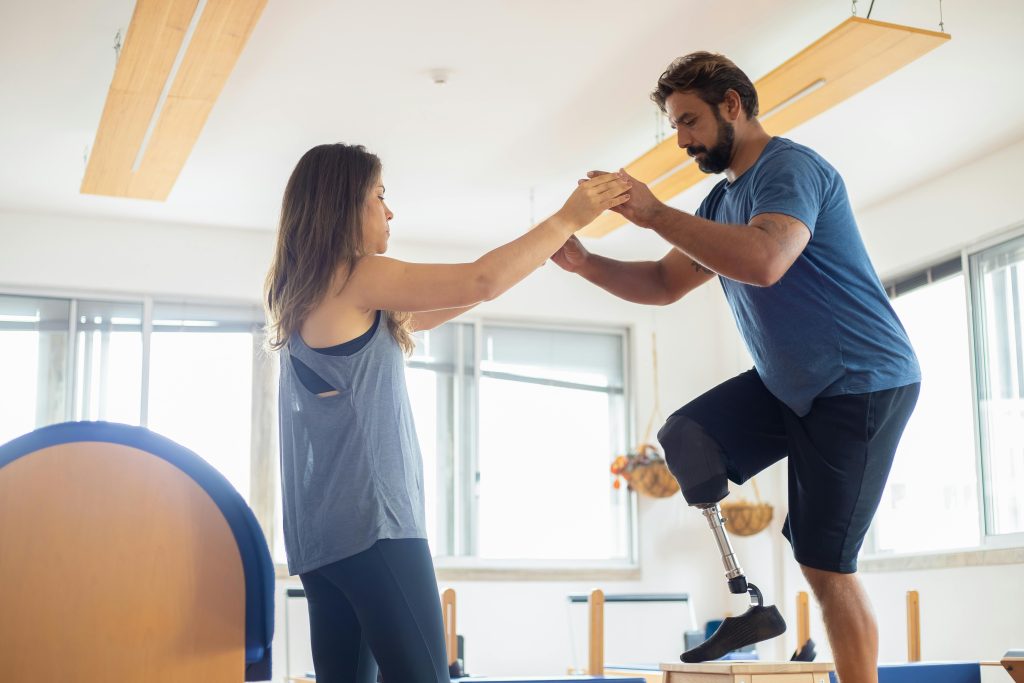
In the clinical framework of Geriatric Physical Therapy (2020), balance is not a static state of standing still; it is a dynamic process of reacting to the unexpected. For many seniors, the fear of falling isn’t about their ability to walk on a flat floor, but rather their ability to recover from a sudden bump or trip. This is where Perturbation Training becomes a vital clinical intervention. By introducing safe, controlled “surprises” during therapy, we can sharpen the nervous system’s response time, expanding your Safety Buffer and providing the Vigor needed to navigate a busy, unpredictable world.
1. The Science of the “Stumble”
In the clinical framework of Geriatric Physical Therapy (2020), balance is described not as the ability to stand still, but as the ability to maintain the body’s center of mass over an ever-shifting base of support. Life is a series of “perturbations”—a dog pulling on a leash, a gust of wind, or a slippery patch of tile.
Perturbation Training is the evidence-based practice of introducing controlled, external forces to trigger a recovery response. For many seniors, the fear of falling causes them to limit their world, effectively sliding down the Slippery Slope of Aging. By “practicing the stumble,” we help you reclaim your Vigor. We aren’t just preventing a fall; we are giving you back the confidence to walk through the supermarket or enjoy a sunset stroll in your garden without the paralyzing fear of the unexpected.
2. The Biomechanics of Perturbation Training
From a Professional Perspective, a perturbation triggers a “bottom-up” neurological response. To stay upright, the nervous system must fire muscles in a precise, distal-to-proximal sequence (starting at the feet and moving toward the hips).
- Muscle Latencies: In a healthy system, the ankles react within 90–120 milliseconds. In the geriatric population, this latency—the “time gap” between the bump and the muscle fire—often increases. Perturbation Training acts as a “neural tuner,” shortening this delay.
- The Strategy Hierarchy: Depending on the force, the body chooses a tool:
- The Ankle Strategy: For small, slow displacements.
- The Hip Strategy: For faster or larger sways where the ankles cannot cope.
- The Stepping Strategy: The ultimate “emergency brake” used when the center of mass is pushed beyond the base of support.
- Take-Home Tip for Caregivers: A fall is rarely a result of “weakness” alone; it is often a failure of timing. If a senior is slow to apply their “neurological brakes,” they will miss the window for an ankle or hip recovery.
3. Sensory Organization Testing (SOT) and Reactive Power
Before we can effectively implement Perturbation Training, we must identify the senior’s “Sensory Weighting” profile using Sensory Organization Testing (SOT). This test reveals which system (visual, vestibular, or somatosensory) the brain is relying on too heavily.
- Identifying Visual Dependency: Many seniors rely 90% on their eyes for balance. If they trip in a dim room (where the visual system is “offline”), their reaction will be delayed. SOT Conditions 5 and 6 isolate this deficit.
- The Clinical Stress Test: While SOT measures how a patient stands under sensory conflict, perturbation training measures how they recover when that conflict is combined with a physical nudge.
- Take-Home Tip for Professionals: Use SOT scores to “dose” your perturbations. If a patient fails Condition 5 (Vestibular), they likely have a “Lateral Leak” in their balance. Focus your perturbation drills on side-to-side displacements to force a lateral Stepping Strategy response.
4. The Slippery Slope: When Reactions Slow Down
In the progression of the Slippery Slope of Aging, one of the most significant losses is not strength, but the “speed of processing.” As neural pathways face age-related changes, the time it takes for a signal to travel from the sensors in the feet to the brain and back down to the muscles begins to lengthen.
- The “Frozen” Response: When a senior with a slow reaction time is perturbed, they often “freeze.” Instead of a fluid Ankle Strategy, the body becomes rigid. This rigidity moves the center of mass higher, making a fall more likely and more impactful.
- Draining the Physiological Reserve: A slow reaction requires more conscious effort. If a senior has to “think” about their balance because their automatic reactions are failing, they quickly exhaust their Physiological Reserve. This leads to the rapid fatigue often seen during a simple walk in a supermarket.
- Caregiver Focus: Watch for the “startle” response. If a minor bump causes your loved one to gasp or clutch for furniture, their automatic reactive system is struggling. This is the signal that their Safety Buffer is shrinking.
5. Stepping Strategies: The “Emergency Brake” of Balance
When a perturbation is too large for the ankles or hips to handle, the body must employ a Stepping Strategy. This is the clinical “Emergency Brake.” From a Professional Perspective, training the stepping strategy is the single most important element of Perturbation Training for fall prevention.
- The Lateral Step: Most falls that lead to hip fractures occur because the senior cannot take a rapid lateral (sideways) step. If they are bumped from the side, they often “cross over” their own feet and trip.
- The Magnitude of Displacement: In the clinic, we increase the “dose” of the nudge until the patient is forced to take a step. We aren’t looking for a “perfect” stand; we are looking for a “successful” recovery.
- The Transition: We train the brain to recognize when the Ankle and Hip strategies have failed and to immediately jump to the Step. This prevents the “hesitation” that leads to a fall.
6. Perturbation Training Protocols: From Clinic to Life
To move a senior from a state of frailty back to Vigor, the training protocol must be specific and progressive. At geriatricrehab.es, we utilize the SAID Principle to ensure the “surprises” in therapy translate to the real world.
- Manual Nudges: The therapist provides unpredictable “taps” at the hips or shoulders while the patient performs a functional task, like reaching for a cupboard. This trains the Hip Strategy in a real-world context.
- Treadmill Perturbations: By suddenly increasing or decreasing the treadmill speed for a fraction of a second, we force the patient to adjust their gait speed and stepping length. This is excellent for building the Physiological Reserve needed for busy sidewalks.
- The “Surface Shake”: Having the patient stand on a foam pad or a “balance board” while catching a ball. This forces the brain to “up-weight” the vestibular system (the inner ear) because the ground is no longer reliable.
- Seniors Focus: These drills might feel like a “game,” but they are actually high-level neurological tuning. Every time you successfully recover from a nudge in the clinic, you are building the “muscle memory” that will save you from a trip at the supermarket.
7. The SAID Principle: Specific Training for Sudden Trips
In geriatric rehabilitation, we adhere to the SAID Principle (Specific Adaptation to Imposed Demands). This principle dictates that the body only gets better at exactly what you train it to do. From a Professional Perspective, this is why traditional, static balance exercises—like standing on one leg for 30 seconds—often fail to prevent real-world falls.
- Static vs. Dynamic: Standing still is a “proactive” task. Recovering from a trip is a “reactive” task. If we only train a senior to stand still, they become excellent at standing still, but their Safety Buffer remains dangerously narrow when they hit an uneven sidewalk.
- The “Neural Dose”: To elicit a change in the geriatric nervous system, the perturbation must be unpredictable. If the senior knows exactly when and where the “nudge” is coming from, they use their Visual System to prepare. True Perturbation Training requires “sensory conflict,” forcing the brain to rely on the faster, automatic pathways of the inner ear and feet.
- Refilling the Reserve: By pushing the patient just slightly outside their comfort zone, we “up-dose” the neurological challenge. This is what ultimately refills the Physiological Reserve, transforming a fragile balance system into one characterized by Vigor.
8. Caregiver’s Tool: The “Safe Surprise” Home Audit
As a caregiver, you play a vital role in maintaining the Safety Buffer at home. While the therapist handles the high-intensity drills, you can provide “Safe Surprises” that keep the nervous system sharp.
The “Safe Surprise” Checklist
- [ ] Surface Variability: Introduce “texture changes” in safe hallways. Placing a thin, non-slip yoga mat over a hardwood floor creates a minor somatosensory perturbation that forces the brain to “re-weight” its sensors.
- [ ] The “Hips, Not Hands” Rule: When practicing balance at home, never hold the senior’s hands. If they sway, provide a firm, stabilizing touch at the hips. This allows their upper body to move and react, which is essential for developing a functional Hip Strategy.
- [ ] Distraction Drills: Have the senior walk while naming “types of fruit” or “grandchildren’s names.” This “Cognitive Perturbation” mimics the multitasking required at the supermarket, ensuring their balance doesn’t fail just because they are thinking.
- [ ] The “Dimmed” Walk: Practice walking in slightly dimmed (but still safe) lighting. This reduces visual input and forces the “Sixth Sense” of proprioception to take the lead.
9. Assistive Devices and Perturbations: Maintaining Stability
When the Physiological Reserve is significantly lowered, an assistive device becomes an essential external Safety Buffer. However, the device itself changes how a senior reacts to a perturbation.
The Assistive Device Buyer’s Guide
- Single-Point Canes: Best for those who need a “sensory anchor.” It provides a third point of contact that sends extra proprioceptive data to the brain during a minor sway.
- Pros: Lightweight and portable.
- Cons: Provides almost zero support during a major lateral (sideways) perturbation.
- Front-Wheeled Walkers (2-Wheeled): These are the clinical gold standard for those with a “Forward Leak” in their balance. They provide a stable frame to lean into if a forward trip occurs.
- Pros: Promotes a natural gait.
- Cons: Can be cumbersome in tight “Environmental Audit” spaces like small bathrooms.
- 4-Wheeled Rollators: These are for the senior with high Vigor who needs endurance for community outings.
- Pros: Includes a seat for rest.
- Cons: Cautionary Note: The wheels can move too fast during a perturbation, potentially pulling the senior into a fall if the brakes aren’t managed.
The Psychology of the Cane
Many seniors resist using a device because they feel it makes them “look old.” We must shift this perspective: the cane is not a sign of weakness; it is a stability tool that allows you to keep walking in the garden and the supermarket. It is the “mechanical armor” that protects your independence.
10. Conclusion: Reaching the 85% HRR with Perturbation Training
The ultimate goal of Perturbation Training is not to keep you standing still in a quiet room; it is to give you the Vigor to live a loud, moving, and unpredictable life. In the clinical framework of Geriatric Physical Therapy (2020), we understand that true safety is found in the ability to adapt. When your Safety Buffer is reinforced by sharp reflexes, you are no longer a “passive” walker—you are an active participant in your own mobility.
Professional Perspective: Moving to High-Intensity Functional Training (HIFT)
For the allied health professional, perturbation work is the final gateway to high-intensity training. We cannot safely push a senior into the “training zone” if their reactive system is dormant.
- The 40% HRR Zone (Baseline Stability): This is where we begin, focusing on slow, predictable nudges. While necessary for early-stage rehab, staying here does not refill the Physiological Reserve.
- The 85% HRR Zone (The Vigor Zone): Once the Stepping Strategy is automatic, we increase the intensity. By combining perturbations with weighted carries or rapid “Step-and-Reach” drills, we push the heart rate toward 85% of the reserve. This is the intensity required to trigger the cardiovascular and neurological changes that truly climb the Slippery Slope of Aging.
Living with Confidence
By committing to “practicing the trip,” you are making an investment in your independence. Whether it is navigating the vegetable aisle at the supermarket or walking across the lawn to greet a neighbor, your body now has the “emergency brakes” it needs to handle the unexpected. You aren’t just preventing a fall; you are choosing to live with Vigor.
Is your reaction time ready for the real world? Don’t let a “slow start” shrink your world. Visit geriatricrehab.es today to download our “Reactive Reflexes Masterclass” or to schedule a session with a clinical specialist who can help you recalibrate your balance for the life you want to lead!













