
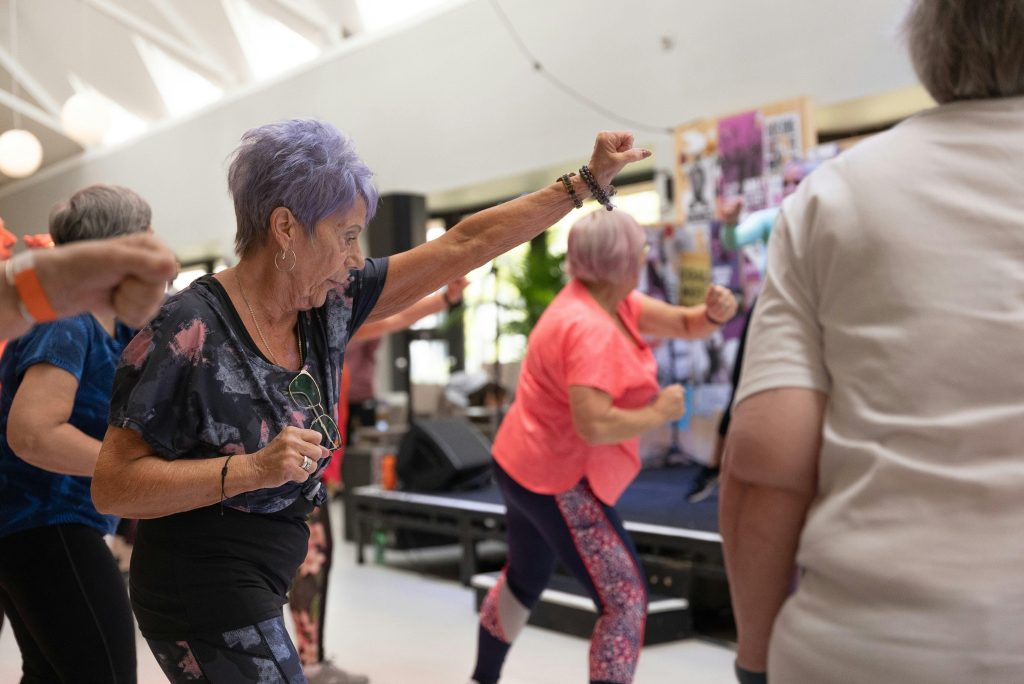
In the isolation that often accompanies aging, the gym should be more than a place for solitary movement; it should be a hub for collective resilience. At geriatricrehab.es, we have observed that the most consistent transformations occur not in isolation, but within the framework of Group Resistance Training. While the biological goals remain the same—hypertrophy and skeletal density—the social “glue” of a group environment acts as a powerful adherence multiplier. For the senior who finds it difficult to self-motivate at home, the presence of peers provides the necessary psychological “nudge” to embrace the high intensities required for true functional change.
1. The Power of the Pack
The traditional model of geriatric rehabilitation often relies on one-on-one sessions or solitary home exercise programs. While effective for acute recovery, these models frequently struggle with long-term “adherence decay.” Group Resistance Training solves this by leveraging “Social Cohesion”—the sense of belonging and mutual responsibility that forms when a group pursues a difficult goal together.
When a senior joins a group, they aren’t just committing to a workout; they are committing to a community. This social contract is a primary predictor of long-term success. The shared experience of overcoming a heavy set of squats or a challenging balance circuit transforms the gym from a clinical chore into a social highlight. By creating an environment where peers encourage one another, we move the needle from “I have to exercise” to “I don’t want to let my group down.”
2. The ‘Why It Matters’ Section: Functional Carryover and Community Resilience
At geriatricrehab.es, we define “Functional Carryover” as the ability of clinical gains to improve real-world autonomy. In a group setting, this carryover extends beyond the physical and into the realm of “Community Mobility.”
For Seniors: Strength in Numbers
- Navigating Social Spaces: Group training builds the confidence to navigate public environments. If you can move through a crowded gym with your peers, you can navigate a busy museum or a bustling family wedding with ease.
- The “Antidote to Isolation”: Physical decline often leads to social withdrawal. By engaging in Group Resistance Training, you are simultaneously strengthening your quadriceps and your “social muscle.”
- Active Play with Family: The vigor gained from group sessions ensures you have the stamina for the “real-world group” that matters most: your family. Stronger legs mean more energy for playing with grandchildren or joining the family on a holiday stroll without needing a “recovery day.”
3. The Physiological Impact of Group Resistance Training
For the healthcare professional, the benefit of group training is rooted in the “Kohler Effect.” This phenomenon occurs when a person works harder as part of a group than they would alone, especially when they perceive themselves as a valuable member of that collective.
For Professionals: The Kohler Effect and PST. As cited in Geriatric Physical Therapy (2020), high-intensity loading is the only way to significantly elevate myofibrillar protein synthesis rates in the elderly. However, many seniors tend to “self-select” loads that are too light when training alone. In a Group Resistance Training environment, the subtle competitive drive and collective energy push participants into the 60–80% 1RM threshold.
By applying the Physical Stress Theory (PST), we see that group dynamics help patients safely cross into the “Overload Zone.” The collective pace ensures that rest intervals are respected and that the intensity remains high enough to trigger the hormonal and cellular adaptations necessary for reversing sarcopenia. We aren’t just socializing; we are using social psychology to drive biological remodeling.
Take-Home Tips for Caregivers:
- The “Social Bridge”: If your loved one is hesitant about a group, suggest an “observation day” first. Seeing other seniors lifting and moving with confidence is often the most powerful “Motivation for Exercise” they can receive.
- Safety Spotting in Pairs: In a home setting, if you have two family members present, use “Dual Spotting.” One person stands behind the senior during sit-to-stands, while the other provides verbal encouragement. This mimics the supportive group environment.
- Adherence Tracking: Focus on the “Social Win.” Instead of asking “How much did you lift?”, ask “Who did you talk to today?” and “How did the group do?” This reinforces the social connection as the primary driver.
4. Ensuring High-Intensity Standards in Group Resistance Training
A common pitfall in community-based senior fitness is the transition to “low-impact” or “gentle” movement. While social, these classes often fail to meet the biological requirements for muscle growth. At geriatricrehab.es, we ensure that Group Resistance Training remains high-intensity.
For Professionals: Individualizing the Collective Load. To trigger meaningful adaptation, we must adhere to the Physical Stress Theory (PST). This means that even in a group of ten, each participant must be working at 60-80% of their individual 1RM. We achieve this through “RPE Coaching” (Rate of Perceived Exertion). In a group setting, we don’t just tell everyone to lift the same 5lb dumbbell; we coach them to find a weight that feels like an “8 out of 10” effort for their specific body. This ensures that myofibrillar protein synthesis rates are stimulated across the entire room, regardless of the varying baseline strengths of the participants.
5. Common Myths of Fragility: “Group Classes are Dangerous for Seniors”
The “Fragility Myth” suggests that seniors are too delicate for the “hustle and bustle” of a group environment. This fear often keeps high-risk seniors isolated, which is far more dangerous than a supervised group session.
- Myth: “I’ll be forced to keep up with people much stronger than me.”
- The Reality: Professional Group Resistance Training is tiered. A good clinician uses the group energy for motivation but keeps the physical tasks individualized. You are racing against your own previous records, not the person next to you.
- Myth: “The instructor can’t watch everyone, so I’ll get hurt.”
- The Reality: Group settings actually provide more “eyes on the floor.” Peers often look out for one another’s form, and a trained therapist manages the room to ensure everyone is moving within their “Safe Load Zone.”
- Myth: “Group exercise is just for ‘active’ seniors, not for people with my condition.”
- The Reality: Group training is an equal-opportunity regenerator. Whether you have Parkinson’s, Osteoarthritis, or are recovering from a stroke, the social support and high-intensity stimulus are what drive the neuroplasticity and muscular repair you need.
6. The Mental Health Connection: Endorphins and Oxytocin
There is a unique neurochemical “cocktail” that occurs during collective high-intensity effort. When you participate in Group Resistance Training, you aren’t just getting a physical workout; you are getting a hormonal “reset” that is specifically potent for the geriatric brain.
The Social High. As you push through a heavy set of resistance band rows or weighted lunges with your peers, your brain releases endorphins to manage the physical stress. Simultaneously, the social interaction triggers the release of oxytocin—the “bonding hormone.” For seniors, this combination is a powerful defense against the “geriatric triad” of depression, anxiety, and loneliness. We find that participants who train in groups report higher levels of “Self-Efficacy” and a significantly improved “Will to Live” compared to those who train in isolation.
Take-Home Tips for Caregivers:
- Evaluate the “Energy” of the Room: When choosing a class for your loved one, look for an instructor who encourages effort rather than just “going through the motions.” If no one is sweating or breathing a bit heavy, the intensity is likely too low to build bone or muscle.
- Safety Spotting for the Group “Hangover”: Sometimes, the excitement of the group causes seniors to push too hard. In the 48 hours following a new group class, be extra vigilant with Safety Spotting for sit-to-stands at home, as their legs may be more fatigued than usual.
- The “Buddy System”: If your loved one is nervous, help them find a “training partner.” Having one specific person to meet in class increases the social accountability and makes the first few weeks much less intimidating.
7. Measuring Success: Social Efficacy and Adherence Metrics
In a solitary training program, success is often measured only by the weight on the bar. In Group Resistance Training, we expand our clinical metrics to include “Social Efficacy.” This refers to a senior’s confidence in their ability to perform and interact within a group setting, which is a key driver of long-term health.
The Adherence Multiplier. At geriatricrehab.es, we track attendance as a primary vital sign. In geriatric populations, “adherence decay” typically happens at the 3-month mark for solo programs. However, those involved in group settings show a 40% higher retention rate. Success is also measured by the “Group Environment Questionnaire” for older adults, which assesses:
- Task Cohesion: “Are we working together to get stronger?”
- Social Cohesion: “Do I feel welcome and supported here?”
When these scores are high, the physical gains—such as improved gait speed and grip strength—follow naturally because the patient is showing up and pushing hard.
8. The Caregiver Corner: Evaluating the Right Group
For caregivers, the goal is to find an environment that balances the social fun with clinical rigor. Not all “senior classes” are created equal. Some may be too “gentle” to provide a metabolic benefit, while others may be too crowded to be safe.
Technical Standards for Caregivers:
- The Instructor-to-Student Ratio: For high-intensity Group Resistance Training, look for a ratio no higher than 1:10. This ensures the instructor can provide individual feedback on form and load.
- The “Intensity Check”: Observe a class. Are the participants being challenged? Are they performing movements like weighted sit-to-stands or lunges? If the class is performed entirely while sitting, it may lack the “Axial Loading” necessary for bone density.
- Safety Spotting Culture: A high-quality group program teaches seniors how to be safe. The instructor should be moving around the room, providing tactile cues, and ensuring that no one is “ego-lifting” or sacrificing form for speed.
9. A 12-Week Roadmap: From Solo Struggle to Group Mastery
Transitioning into a group setting can be intimidating. This 12-week roadmap is designed to build the physical foundation and social confidence needed to thrive in a high-intensity community.
Phase 1: Small Group Foundation & Form (Weeks 1-4)
- Goal: Establishing a “Safe Language of Movement.”
- Intensity: 40-50% 1RM.
- Focus: Small groups of 3–4 people. We focus on mastering the “Big Three” (Squat, Hinge, Push) so the senior feels competent and doesn’t feel the “pressure” of a larger class.
Phase 2: Building Collective Intensity (Weeks 5-8)
- Goal: Crossing the Physical Stress Theory threshold.
- Intensity: 60-70% 1RM.
- The Shift: Participants begin to “partner up.” This introduces the Kohler Effect, where the presence of a partner encourages them to hit those extra two reps that stimulate myofibrillar protein synthesis rates.
Phase 3: High-Performance Community (Weeks 9-12)
- Goal: Sustained Mastery and Autonomy.
- Intensity: 75-80% 1RM.
- The Result: The senior is now a core member of the group. They are not only performing high-intensity Group Resistance Training but are also encouraging new members. Their “Functional Carryover” is evident in their faster walking speed and renewed “Vigor” at home.
10. Conclusion: Strength is a Shared Experience
At geriatricrehab.es, we have seen time and again that while individuals can make progress alone, they achieve true longevity together. Group Resistance Training is more than a fitness trend; it is a clinical intervention that addresses the physical, cognitive, and social needs of the geriatric population simultaneously. By stepping into a group environment, you are choosing to surround yourself with a “living mirror” of what is possible.
By applying the Physical Stress Theory within a supportive community, you ensure that your workouts never lose their edge. You are pushing towards that 60–80% 1RM threshold not just for yourself, but for the peers who stand beside you. This collective effort creates a “Functional Carryover” that extends far beyond the gym doors—giving you the strength to lead an active, socially connected, and deeply fulfilling life.
Are you ready to stop training in isolation and start thriving in a community? It’s time to join the “Pack.” At geriatricrehab.es, we offer a specialized “Group Placement Consultation”—a clinical assessment to find the perfect high-intensity group for your current level and goals. Consult a specialist today at geriatricrehab.es to find your strength in numbers.













