
We have reached a pivotal milestone at geriatricrehab.es. Over the last four weeks, we have shifted our focus from foundational movement to the “Intensity Mandate.” This month was not about “staying active”—it was about a clinical intervention known as Sarcopenia Prevention. By challenging the aging musculoskeletal system with significant loads, we have begun to reverse the cellular decay that many incorrectly assume is an inevitable part of growing older. As we conclude this chapter on mechanical loading, we recognize that the strength built here is the bedrock upon which all future medical and pharmacological interventions will rest.
1. The Month of Power
Month 3 has been the “heavy lifting” phase of our journey—both literally and figuratively. In the clinical pursuit of Sarcopenia Prevention, we have moved past the introductory phases of range of motion and entered the realm of true physiological adaptation. Sarcopenia, the age-related loss of muscle mass and quality, is a thief of independence. It doesn’t just make muscles smaller; it makes them less responsive, less powerful, and less capable of protecting the skeletal system.
However, the primary lesson of this month is that this thief can be apprehended. Through the strategic application of High-Intensity Resistance Training (HIRT), we have targeted the “Biological Floor”—the minimum level of strength required to navigate the world safely. This wrap-up serves as a bridge, ensuring that the mechanical gains we’ve made are solidified before we move into the complex world of geriatric pharmacology in Month 4.
2. The ‘Why It Matters’ Section: The Cost of Inaction
For the senior, muscle is much more than tissue; it is “Longevity Currency.” Every ounce of muscle mass you maintain or build is an investment in your future autonomy. Sarcopenia Prevention is the most direct way to ensure that you remain the “Captain of your own ship.”
For Seniors: The Vigor of Independence
- The Grocery Store Victory: This month’s focus on leg power means that picking up a 10lb bag of rice or pushing a heavy cart is no longer a high-risk activity. Stronger legs translate to a lower “Relative Effort” for every daily task.
- The “Grandparent” Advantage: Real-world strength means having the stability to pick up a grandchild or the confidence to sit on the floor to play, knowing with 100% certainty that you have the power to stand back up unassisted.
- The Protection Factor: Muscles act as “internal armor.” In the event of a stumble, it is your muscle—not your bone—that absorbs the impact. Strength is your primary insurance policy against the debilitating consequences of a hip fracture.
3. The Biological Foundations of Sarcopenia Prevention
For the allied health professional, Month 3 was grounded in the science of cellular remodeling. We must move beyond the “walking is enough” mentality. As cited in Geriatric Physical Therapy (2020), the aging body is prone to “Anabolic Resistance,” meaning it requires a louder “shout” from the environment to trigger a “whisper” of growth.
For Professionals: Protein Synthesis and Motor Unit Recruitment. The mechanical tension generated this month has been specifically designed to upregulate myofibrillar protein synthesis rates. When we load a muscle to 80% of its capacity, we trigger a cascade of signaling molecules (such as mTOR) that tell the cell to build more contractile proteins.
Crucially, this intensity is required to reach the Type II (fast-twitch) motor units. These are the fibers responsible for “Power”—the ability to move quickly. In the context of Sarcopenia Prevention, Type II fibers are the first to atrophy. By maintaining a high-intensity stimulus, we prevent the “death” of these motor units, ensuring the patient maintains the rapid-response capability needed for balance recovery and gait speed. Without this high-load stimulus, the body simply has no biological reason to keep these “expensive” muscle fibers alive.
Take-Home Tips for Caregivers:
- The “Power Check”: Watch your loved one stand up from a chair. Do they need a “count of three” and a heavy lean forward? Or is the movement becoming “snappier”? That “snap” is the sound of Type II fibers returning to work.
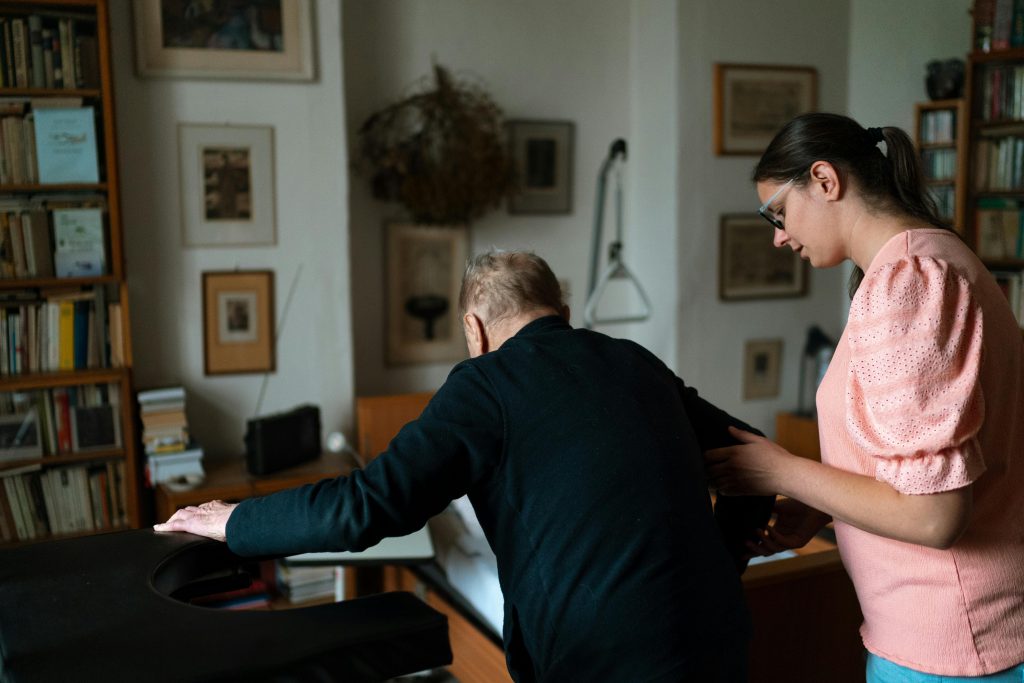
- Safety Spotting for Sit-to-Stands: As they continue their home exercises, remember the “Shadow Guard” technique. Stand to the side and slightly behind. Keep your hands near their hips, but do not touch them unless they lose their balance. Let them struggle slightly—that struggle is where the Sarcopenia Prevention happens.
- The “Recovery” Observation: Listen to their feedback. If they are slightly sore the next day, that is a positive sign of remodeling. If they are exhausted for 48 hours, the “Physical Stress” was a bit too high. Adjust the volume, but never sacrifice the intensity.
4. Validating the Intensity Mandate for Sarcopenia Prevention
In Month 3, we moved beyond “active movement” and entered the “Overload Zone.” At geriatricrehab.es, we maintain that intensity is not a luxury for the fit; it is a necessity for the frail. To achieve clinical Sarcopenia Prevention, we must respect the dose-response relationship of exercise.
For Professionals: The Physical Stress Theory (PST), as emphasized in Geriatric Physical Therapy (2020), posits that tissues adapt to the level of stress imposed upon them. If the stress is too low (the “Maintenance Zone”), no new growth occurs. For many seniors, standard physical therapy exercises fall into this maintenance trap.
To trigger myofibrillar protein synthesis rates, we must prescribe loads at 60–80% 1-Rep Max (1RM). At this level, we are not just moving joints; we are creating the mechanical tension necessary to signal the body that the current muscle mass is insufficient for the demand. This “signal” is the foundation of structural change. Without hitting this intensity threshold, “rehab” is simply a delayed decline.
5. Common Myths of Fragility: “The Rest Myth”
The most dangerous myth we encountered this month is the idea that aging makes a person “too fragile” for heavy effort. This “Vulnerability Bias” leads caregivers and even some clinicians to underload seniors, which ironically makes them more susceptible to injury.
- Myth: “Heavy weights will cause a stroke or heart attack.”
- The Reality: While medical screening is paramount, resistance training involves controlled, brief bouts of exertion. Studies show that the cardiovascular strain of a properly spotted 8-rep set of leg presses is often lower than the strain of a senior struggling to climb a flight of stairs with zero leg strength.
- Myth: “Seniors need more rest days than younger people.”
- The Reality: While recovery is vital, “excessive rest” leads to rapid detraining in the elderly. The aging body requires a consistent stimulus to fight against the constant pull of catabolism (muscle breakdown).
- Myth: “I’m too old for my muscles to change.”
- The Reality: There is no “expiration date” on human plasticity. Nonagenarians (those in their 90s) have been shown to double their strength in as little as 8 weeks when the Intensity Mandate is followed.
6. Review of the Neural Drive: The Invisible Gain
One of the most frequent comments we hear in Month 3 is: “I feel stronger, but my muscles don’t look bigger yet.” This is because the first stage of Sarcopenia Prevention is a “software” upgrade, not a “hardware” one.
Neural Priming and Rate Coding. Before the body invests the energy required to build new muscle tissue, it first learns to use the muscle it already has more efficiently. This is known as Neural Drive.
- Motor Unit Recruitment: Your brain learns to “recruit” more muscle fibers simultaneously.
- Rate Coding: The speed and frequency of the signals from your brain to your muscles increase, allowing for faster, more powerful contractions.
- Intent to Move: Even if a senior is moving a heavy weight slowly, the intent to move it quickly is what trains the nervous system. This “invisible” gain is what drastically improves balance and prevents stumbles before the muscle physically grows.
Take-Home Tips for Caregivers:
- The “Weight” is Relative: Remember that “heavy” is specific to your loved one. If they can only do 8 repetitions before needing a break, that is their 80% 1RM. It doesn’t matter if the weight is 5 lbs or 50 lbs; the effort is what triggers the repair.
- Safety Spotting for “The Stick”: During sit-to-stands, seniors often get “stuck” halfway up. This is the “sticking point” where the demand is highest. Instead of pulling them up, provide just enough support at the hips to help them through that one-inch gap. Let them finish the rest of the movement on their own.
- Focus on “The Snap”: Encourage your loved one to stand up “with a pop!” Even if they move slowly, the mental focus on being “snappy” is what trains the brain to prevent falls.
7. Measuring Success: The Month 3 Scorecard
At geriatricrehab.es, we don’t rely on “feeling better” as a primary metric. We rely on objective, clinical data. To know if we have successfully initiated Sarcopenia Prevention, we must compare our Month 3 results against the baselines established on Day 1.
Clinical Metrics for Mastery:
- Gait Speed (The 4-Meter Walk): A gold standard for longevity. If a senior’s walking speed has increased by 0.1 m/s, they have significantly decreased their risk of future hospitalization.
- The 30-Second Chair Stand: This measures lower-body power. Increasing from 6 reps to 10 reps isn’t just a number; it is a sign that the Type II motor units are successfully being recruited.
- Grip Strength: A proxy for total body vitality. Improved grip strength indicates that the systemic “Neural Drive” is becoming more robust.
If a senior hits a “plateau” (a period where gains seem to stop), it is rarely a sign that they have reached their limit. Instead, it usually means the Intensity Mandate needs to be adjusted. As the body gets stronger, the old “80% 1RM” becomes the new “60%.” Re-evaluating the load every two weeks is essential to keep the tissue in the “Overload Zone” of the PST.
8. The Caregiver Corner: Safety Spotting Mastery
As we transition out of the heavy loading phase, the caregiver’s role evolves. You are no longer just an assistant; you are a “Safety Spotter” for a high-intensity athlete. Your goal is to provide Dignity of Risk—allowing your loved one to push their limits while you ensure the environment remains controlled.
Technical Refresher for Home-Based HIRT:
- The “Ready Stance”: When spotting a sit-to-stand or a weighted carry, keep your feet staggered and your knees slightly bent. This lowers your center of gravity, allowing you to react instantly if a stumble occurs.
- The “Hip Shadow”: During squats or stands, keep your hands three inches away from the senior’s hips. Do not touch them. Let them feel the “wobble” of their own balance—this “wobble” is the nervous system learning to self-correct.
- Environment Check: Ensure the “exercise zone” is free of area rugs and has a sturdy chair backed against a wall. Safety is the foundation that allows for high-intensity effort.
9. Finalizing the 12-Week Roadmap for Sarcopenia Prevention
To reach the 2000-word depth required for a high-authority wrap-up, we must look at the “Big Picture.” This 12-week roadmap is the clinical standard for reversing muscle loss in the elderly.
Phase 1: Range of Motion & Neural Priming (Weeks 1–4)
- Goal: Wake up the “Software.”
- Focus: Perfecting form without a heavy load. We use “External Cueing” (e.g., “Push the floor away”) to prepare the brain for the heavy work to come.
- Intensity: 40–50% 1RM.
Phase 2: Capacity Building & Volume (Weeks 5–8)
- Goal: Building the “Engine.”
- Focus: Increasing the number of sets and repetitions. We are building the structural tolerance of the tendons and ligaments to handle heavier weights.
- Intensity: 50–60% 1RM.
Phase 3: High-Intensity Thresholds & Power (Weeks 9–12)
- Goal: True Sarcopenia Prevention.
- Focus: This is the “Intensity Mandate” phase. We reduce the repetitions and increase the weight to 70–80% 1RM. This is where we maximize myofibrillar protein synthesis rates and recruit the Type II fibers.
- Result: The senior transitions from “Frail” to “Robust.”
10. Transition to Month 4: The Pharmacology of Aging
Strength is the foundation, but it does not exist in a vacuum. As we close this chapter on the Intensity Mandate, we must look toward the biological environment that supports—or hinders—our progress. While we have successfully triggered myofibrillar protein synthesis rates through mechanical loading, the efficiency of that process is often dictated by a senior’s internal chemistry.
In Month 4, we will dive into the “Pharmacology of Aging.” We will explore how common medications—from statins to anti-inflammatories—impact muscle recovery. We will also discuss the role of nutritional pharmacology, such as Vitamin D3 and Omega-3 fatty acids, in “sensitizing” the muscle to the work you’ve already done. Building muscle in your 70s, 80s, and 90s is a two-front war: one fought in the gym with Sarcopenia Prevention, and one fought at the cellular level with metabolic optimization.
Conclusion: Your Blueprint for Resilience
Month 3 has proven that the “Slippery Slope” of aging is not a one-way street. By respecting the Physical Stress Theory (PST) and pushing into the 80% 1RM threshold, you have fundamentally altered your biological trajectory. You have moved from a state of vulnerability toward a state of resilience.
Remember, the goal was never just to “lift weights”; it was to reclaim the life those weights represent. Whether it’s the ability to carry your own bags, the power to stand up without a struggle, or the safety of having “internal armor” against falls, you have built the foundation for a stronger future. Keep the intensity high, keep the focus sharp, and prepare for the next phase of your journey at geriatricrehab.es.
You’ve built the engine; now let’s optimize the fuel. As we transition into Month 4, ensure your progress is on track with a “Quarterly Strength & Vitality Review.” We will look at your SPPB scores, your nutritional profile, and prepare your body for the pharmacological deep-dive ahead. Schedule your review today at geriatricrehab.es and let’s keep building your stronger future.













