
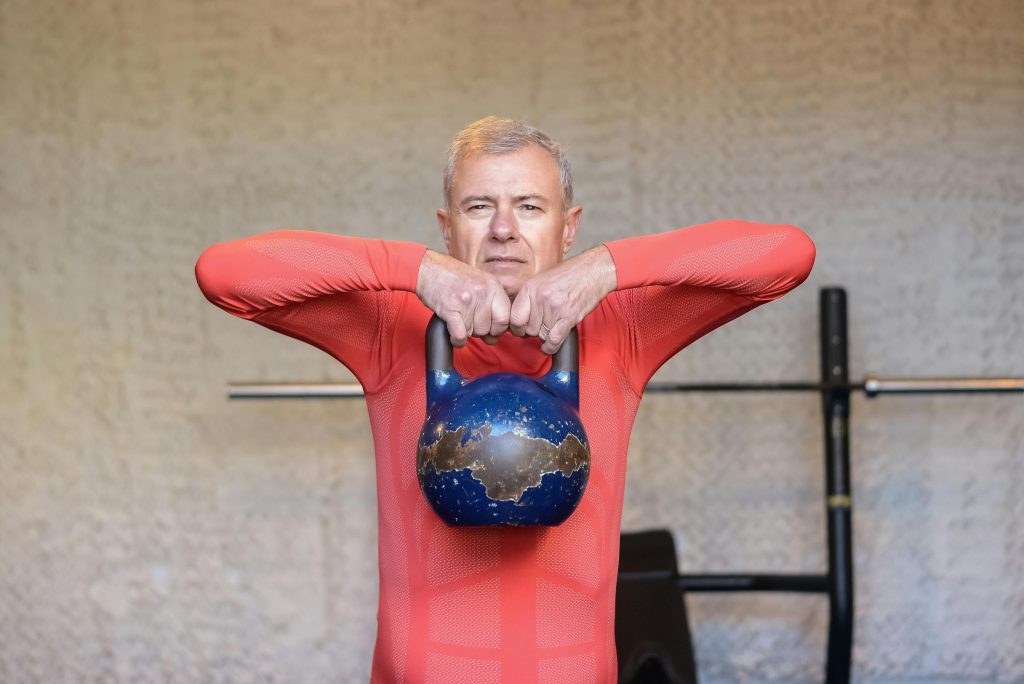
In the world of geriatric health, a diagnosis of osteoporosis is often treated as a signal to slow down and avoid “stressful” activity. At geriatricrehab.es, we take the opposite approach. Bone is a living, dynamic tissue that follows a fundamental biological law: it adapts to the demands placed upon it. To reverse skeletal thinning, we must engage in high-intensity Strength Training for Osteoporosis. This isn’t about gentle movements or light aerobics; it is about creating enough mechanical tension to literally “bend” the bone, signaling the body to deposit new minerals. By shifting our focus from protection to progression, we can transform a fragile frame into a resilient foundation.
1. The Mechanical Blueprint of Bone
For decades, the standard advice for bone health was “weight-bearing exercise” like walking. While walking is beneficial for cardiovascular health, the geriatric community is now learning that it is largely insufficient for building bone mineral density (BMD). To understand why, we must look at Wolff’s Law, which states that bone grows or remodels in response to the forces that are placed upon it.
When you perform Strength Training for Osteoporosis, your muscles pull on the tendons, which in turn pull on the bone. This pull creates a “strain” on the bone tissue. If that strain is high enough, it triggers a cellular response that makes the bone denser and thicker. In the absence of this high-intensity stimulus, the body—seeking efficiency—reabsorbs bone minerals, leading to the porous, brittle state we recognize as osteoporosis. Reversing this process requires a “mechanical shout” that only heavy resistance can provide.
2. The ‘Why It Matters’ Section: Functional Carryover and Fracture Prevention
We don’t just lift weights to improve a T-score on a DEXA scan; we lift weights to change the trajectory of a person’s life. The “Functional Carryover” of skeletal loading is the ultimate insurance policy against the most feared complication of aging: the hip fracture.
For Seniors: From Fragile to Fearless
- The “Trip and Save”: Strong bones are your suit of armor. If you have built bone density through Strength Training for Osteoporosis, a simple trip or stumble is much more likely to result in a bruise rather than a fracture.
- Carrying Life’s Loads: When your spine and hips are dense, you can confidently carry a heavy bag of soil in the garden or lift a 20lb turkey out of the oven. These aren’t just chores; they are the activities that define an independent life.
- The Grandparent Advantage: Many seniors fear picking up their grandchildren due to back pain or “fragile” vertebrae. High-intensity loading builds the structural integrity required to lift, hold, and play without the constant shadow of injury.
3. The Science Behind Strength Training for Osteoporosis
For the allied health professional, the mechanism of bone growth is found in the process of mechanotransduction. This is the biological process where a mechanical force is converted into a chemical signal. When we load a bone at 60–80% 1RM, we reach the “Minimum Effective Strain” threshold required to deform the bone matrix slightly.
For Professionals: Myofibrillar Protein Synthesis and Osteoblastic Activity. This mechanical deformation is sensed by osteocytes, the “command centers” inside your bone. They send out signals to recruit osteoblasts —the cells responsible for building new bone. As highlighted in Geriatric Physical Therapy (2020), this process is closely linked to myofibrillar protein synthesis rates. As we build thicker muscle fibers through high-intensity resistance, we increase the potential for higher tension during every movement.
By applying the Physical Stress Theory (PST), we recognize that bone, like muscle, must be pushed out of its comfort zone to adapt. If the stress is too low (the “Maintenance Zone”), bone density will continue to decline. We must move our patients into the “Overload Zone” to trigger the synthesis of the collagen matrix that will later be calcified into new, strong bone.
4. Implementing High-Intensity Strength Training for Osteoporosis
In many clinical settings, there is a “fear of the fracture” that leads therapists to prescribe low-load, high-repetition exercises. However, the Physical Stress Theory (PST) dictates that for a tissue to increase its tolerance, the stress applied must exceed the previous level of adaptation. For bone, this threshold is remarkably high.
For Professionals: The 60–80% 1RM Threshold. As detailed in Geriatric Physical Therapy (2020), bone tissue is remarkably resistant to change. It requires a high “magnitude” of strain to trigger the modeling process. Loading at 60–80% 1-Rep Max (1RM) is the clinical standard for providing enough “Mechanical Shout” to the skeleton.
By utilizing high-intensity Strength Training for Osteoporosis, we are specifically targeting the myofibrillar protein synthesis rates that lead to larger, more powerful muscle contractions. These contractions create a “bending moment” on the bone. While this sounds counterintuitive, this microscopic bending is the exact signal needed to halt the activity of osteoclasts (bone-clearing cells) and stimulate the activity of osteoblasts (bone-building cells).
5. Common Myths of Fragility: “Heavy Weights Will Break My Bones”
The most pervasive myth in geriatric care is that a person with osteoporosis has a “glass skeleton” that will shatter under load. This myth is not only false—it is dangerous, as it leads to the very inactivity that accelerates bone loss.
- Myth: “Lifting weights is too risky if I have low bone density.”
- The Reality: Clinical trials, such as the landmark LIFTMOR study, have shown that high-intensity resistance and impact training are not only safe for seniors with osteoporosis but are actually the most effective way to prevent the fractures people fear.
- Myth: “I should stick to swimming or walking to be safe.”
- The Reality: These are “low-strain” activities. Because water supports your weight and walking is a repetitive, low-impact force, they do not provide the “Minimum Effective Strain” needed to build new bone. They are great for the heart, but they are “silent” to the skeleton.
- Myth: “My bones are too old to change.”
- The Reality: Bone remodeling happens throughout the entire lifespan. While the rate may slow down, the biological machinery for building bone remains intact. You are never too old to give your skeleton a reason to get stronger.
6. Site-Specific Loading: Training the Hip and Spine
One of the most common errors in Strength Training for Osteoporosis is a lack of specificity. Bone adapts locally. This means that doing bicep curls will not strengthen your hips, and using a chest press machine will do little for your lumbar spine. We must load the areas most at risk for fracture.
The “Axial Loading” Principle. To protect the spine and hips, we must use “Axial Loading”—exercises where the weight travels through the long axis of the body.
- For the Spine: We focus on “hip hinges” and “weighted carries.” By keeping the spine in a neutral, braced position while holding weight, we create the compressive forces necessary to densify the vertebral bodies.
- For the Hips: The “Sit-to-Stand” and “Step-Up” are gold standards. These movements force the femoral neck (the most common site of hip fractures) to support and balance significant weight, triggering the deposition of calcium and phosphorus exactly where it is needed most.
Take-Home Tips for Caregivers:
- The “Proud Chest” Cue: When your loved one is lifting or standing, remind them to keep a “proud chest.” This naturally aligns the spine and ensures the weight is being distributed through the bones of the back safely and effectively.
- Watch for “Ploping”: If your loved one “plops” down into a chair, it means they’ve lost control of the movement. This sudden impact can be jarring for the spine. Encourage them to “sit as slow as a snail” to build the eccentric strength that protects their bones.
- Safety Spotting for Step-Ups: When practicing step-ups (an elite bone-builder), stand on the side of their “weaker” leg. Your presence provides the psychological safety they need to push into the higher intensities required for skeletal change.
7. Measuring Success: Beyond the DEXA Scan
When seniors begin Strength Training for Osteoporosis, they often wait with bated breath for their next DEXA scan. While Bone Mineral Density (BMD) is the clinical gold standard, it is a “lagging indicator”—it can take 12 to 24 months for significant changes to appear on a scan. In the clinic, we look for “leading indicators” of skeletal health.
Understanding Your T-Score: A T-score compares your bone density to that of a healthy 30-year-old.
- -1.0 or higher: Normal bone density.
- -1.0 to -2.5: Osteopenia (low bone mass).
- -2.5 or lower: Osteoporosis.
Functional Markers of Bone Health. At geriatricrehab.es, we measure “Fracture Resilience” through movement. If your T-score remains stable but your “Timed Up and Go” (TUG) score improves by three seconds, your real-world fracture risk has plummeted. Why? Because you are now less likely to fall, and your muscles are better at absorbing the impact of a stumble. Improvements in upright posture and grip strength are also powerful proxies for the structural integrity of the spine and the systemic health of the musculoskeletal system.
8. The Caregiver Corner: Safety Spotting for High-Load Exercises
As we transition a loved one into high-intensity loading, the caregiver’s role shifts from “helper” to “safety technician.” High-intensity Strength Training for Osteoporosis is extremely safe when performed with proper alignment, but it requires a watchful eye to prevent “compensation.”
Technical Spotting Protocols:
- The “Alignment Anchor”: When your loved one is performing a weighted “Sit-to-Stand,” stand behind them. Watch the curve of their lower back. If you see the spine begin to round (flexion), provide a gentle tactile cue at the small of the back to remind them to hinge at the hips.
- The “Off-Loading” Hand: During heavy carries, stay within arm’s reach. If they lose their balance, do not grab their arm (which can cause a shoulder strain); instead, place your hand on their center of mass (the hip or pelvis) to stabilize them.
- Monitoring the “Grip Fatigue”: Bone-building weights can be heavy for the hands. If you see their grip start to slip during a carry, end the set immediately. Dropping a weight can create a sudden “startle response” that risks a fall.
9. A 12-Week Roadmap: Progressive Strength Training for Osteoporosis
Bone remodeling is a marathon, not a sprint. This protocol is designed to safely bridge the gap between “fragility” and the high-intensity loading required by the Physical Stress Theory.
Phase 1: Structural Readiness & Form Mastery (Weeks 1-4)
- Focus: Perfecting the “Hip Hinge” and “Bracing” mechanics.
- Intensity: Bodyweight to 50% 1RM.
- Goal: Teaching the nervous system how to distribute weight through the bones rather than the joints.
Phase 2: Crossing the Strain Threshold (Weeks 5-8)
- Focus: Introducing external resistance to trigger myofibrillar protein synthesis.
- Intensity: 60-70% 1RM.
- Exercises: Weighted Sit-to-Stands, Goblet Squats, and “Suitcase” Carries. This is where we begin to deform the bone matrix enough to signal the osteoblasts.
Phase 3: Maximal Osteogenic Loading (Weeks 9-12)
- Focus: High-intensity “Impact” and “Axial Loading.”
- Intensity: 75-80% 1RM.
- Exercises: Deadlifts (with proper form), heavy Farmer’s Walks, and “Heel Drops” (standing on toes and dropping to heels to create a safe impact force). By this phase, the skeletal system is undergoing active remodeling.
10. Conclusion: Forging a Future of Fortitude
A diagnosis of osteoporosis is not a life sentence of fragility; it is a call to action. As we have explored throughout this guide, your bones are a dynamic, responsive organ system that thrives under pressure. By moving away from the “Maintenance Zone” and embracing high-intensity Strength Training for Osteoporosis, you are fundamentally changing the biology of your skeleton. You are signaling to your body that your frame must be strong enough to support an active, independent, and vibrant life.
At geriatricrehab.es, we believe that the most dangerous thing an osteoporotic senior can do is “nothing.” While the fear of a fracture is real, the surest way to prevent one is to build a muscular and skeletal “exoskeleton” that can withstand the forces of daily living. By applying the Physical Stress Theory and pushing towards that 60–80% 1RM threshold, you aren’t just lifting weights—you are forging a future of fortitude, ensuring that your bones remain as resilient as your spirit.
Are you tired of being told to “be careful” while your bone density continues to slip away? It’s time to stop surviving and start thriving. At geriatricrehab.es, we offer a specialized “Skeletal Strength & DEXA Review”—a clinical evaluation that translates your bone density scores into a safe, high-intensity roadmap for growth. Consult a specialist today at geriatricrehab.es to start building the foundation you deserve.













