
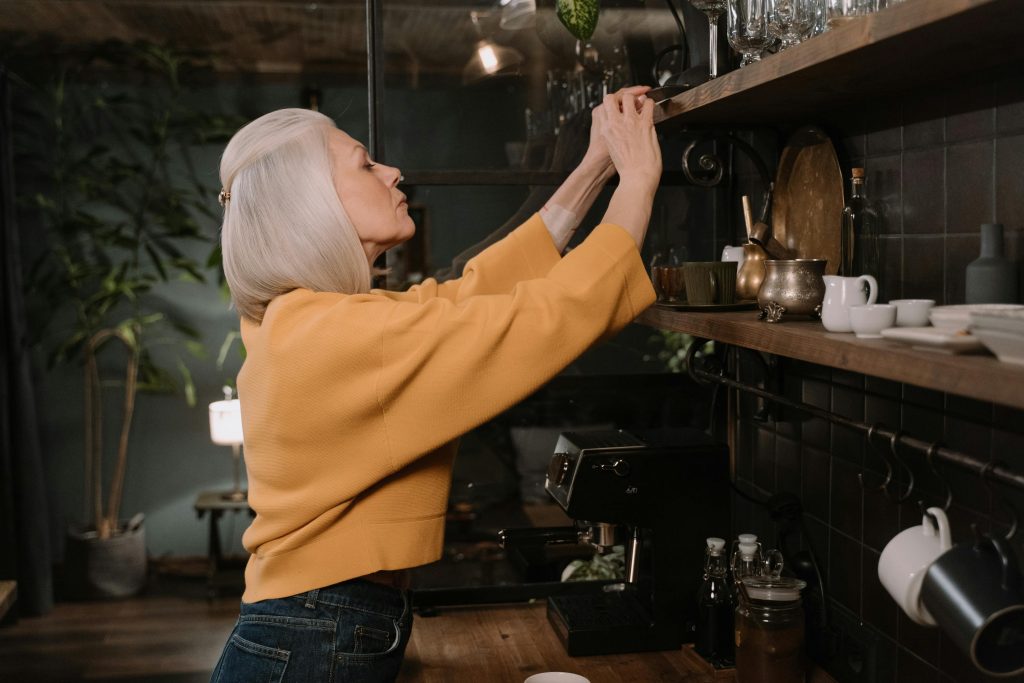
In the hierarchy of geriatric independence, we often prioritize walking and balance—and for good reason. However, the ability to interact with your environment is dictated by your Upper Body Strength. Whether it is reaching for a gallon of milk on a high refrigerator shelf, pushing open a heavy commercial door, or catching yourself during a stumble, your upper extremities are your primary tools for environmental mastery. At geriatricrehab.es, we see too many seniors settle for “gentle stretching” for their shoulders, only to find their world shrinking as they lose the power to lift their own laundry. To maintain true autonomy, we must move beyond low-resistance activities and embrace the intensity required to keep the upper body “load-ready.”
1. The Vertical Reach of Independence
Loss of Upper Body Strength is one of the most insidious contributors to the “Frailty Spiral.” It often starts small: a heavy cast-iron skillet stays in the cupboard because it’s too heavy to lift; a lightbulb goes unchanged because reaching overhead feels precarious. These are not merely inconveniences; they are clinical markers of declining functional capacity.
When we lose the ability to reach and lift, we lose the ability to perform basic Activities of Daily Living (ADLs). For the aging adult, the shoulder is not just a joint—it is a “Pharmacy of Function.” Keeping this pharmacy open requires a dedication to resistance training that maintains muscle mass (hypertrophy) and bone mineral density in the humerus and radius. By focusing on purposeful, high-intensity movement, we ensure that the “reach of independence” remains within your grasp well into your 80s and 90s.
2. The ‘Why It Matters’ Section: Functional Carryover for ADLs
At geriatricrehab.es, every exercise we prescribe must pass the “So What?” test. We don’t train for aesthetics; we train for Functional Carryover.
For Seniors: Real-World Wins
- The “Kitchen Mastery” Win: Being able to lift a 5lb bag of flour or reach the back of the pantry without pain or tremors. Upper Body Strength ensures you don’t have to wait for someone else to help you prepare a meal.
- The “Laundry Freedom” Win: Lifting a full basket of wet laundry requires significant pulling and pressing power. Strength in the upper back and arms prevents the “stooped” posture often associated with carrying heavy loads.
- The “Safety Brake” Win: If you lose your balance, your arms are your first line of defense. Robust strength in the triceps and chest allows for a “protective reach” to brace against a wall or counter, potentially preventing a catastrophic hip fracture.
3. The Bio-Mechanics of Upper Body Strength
For the allied health professional, upper body function in the elderly is a delicate balance of scapular stability and glenohumeral mobility. As we age, the “scapulohumeral rhythm”—the coordinated movement of the shoulder blade and the arm bone—often degrades, leading to impingement and weakness.
For Professionals: Myofibrillar Protein Synthesis and PST. To fix this, we must look at the Physical Stress Theory (PST). Many geriatric protocols fail because the stimulus is too low to trigger a cellular response. As highlighted in Geriatric Physical Therapy (2020), to combat sarcopenia in the deltoids and rotator cuff, we must drive myofibrillar protein synthesis rates through significant mechanical tension.
Lifting at 60–80% 1RM is not just for the legs. The muscles of the upper back (trapezius and rhomboids) require this intensity to maintain the upright posture necessary for efficient breathing and reaching. When we load the upper body, we are signaling the body to divert amino acids to repair and thicken these specific fibers, creating a resilient “scapular platform” that supports every reach and lift.
Take-Home Tips for Caregivers:
- The “Reach Test”: Occasionally watch your loved one in the kitchen. Are they avoiding high shelves? Instead of moving items to a lower shelf, encourage them to perform “Wall Slides” to maintain that range, and consult a therapist to begin loading that movement.
- Safety Spotting for Lifting: When your loved one is practicing a lifting task (like picking up a box from a table), stand by their side. Ensure they keep the object “close to their heart.” The further away an object is held, the more stress it puts on the spine.
- Grip as a Vital Sign: If you notice your loved one struggling to open jars they previously could handle, their Upper Body Strength is likely declining. This is a perfect time to introduce high-intensity pulling exercises like seated rows or supported “farmer’s carries.”
4. Driving Upper Body Strength through High-Intensity Loading
In many senior centers, “upper body day” consists of light stretching or moving small 1lb weights in repetitive circles. While this may improve local circulation, it does almost nothing to build the Upper Body Strength required to lift a 10lb grocery bag or a 25lb grandchild.
For Professionals: The PST and Bone Mineral Density. According to the Physical Stress Theory (PST), tissues only adapt when the stress exceeds the maintenance level. For the aging humerus and wrist, high-intensity loading is a prerequisite for maintaining bone mineral density. We advocate for loads of 60–80% 1RM because this “mechanical shout” is what triggers osteoblastic activity.
If a senior is only using a light “yellow” resistance band, they are likely stuck in the “Atrophy” or “Maintenance” zone of the PST. By increasing the resistance—moving to heavier dumbbells or high-tension cables—we stimulate the Type II motor units. This ensures that when a senior needs to catch themselves during a fall, their triceps and chest muscles have the “explosive” capacity to push back against the ground or a wall.
5. Common Myths of Fragility: “Overhead Lifting Will Tear My Rotator Cuff”
Staff Tip for Length: The “Use It or Lose It” Shoulder. One of the greatest fears in geriatric care is the “overhead reach.” We are told that as the rotator cuff thins with age, we should avoid lifting our arms above our heads. At geriatricrehab.es, we call this the “Fragility Trap.”
- Myth: “I shouldn’t lift my arms over my head because I have a tear.”
- The Reality: Many seniors have asymptomatic rotator cuff tears. The best way to manage a thinning cuff is to strengthen the surrounding “compensatory” muscles like the deltoids and serratus anterior. Avoiding overhead movement leads to “Frozen Shoulder” (adhesive capsulitis), which is far more debilitating than a well-managed tear.
- Myth: “Heavy weights will make me bulky and stiff.”
- The Reality: Seniors lack the hormonal profile to become “bulky.” What you perceive as “stiffness” is often actually weakness. A strong muscle is a flexible muscle; when the shoulder is strong enough to handle a load, the nervous system allows it to move through a full range of motion without “guarding” or tightening up.
- Myth: “I’m too old to start lifting weights.”
- The Reality: Research cited in Geriatric Physical Therapy (2020) shows that even individuals in their 90s can achieve significant hypertrophy and Upper Body Strength gains within 12 weeks of high-intensity training.
6. The “Grip-to-Shoulder” Pipeline
You cannot have a strong shoulder if you have a weak hand. In the geriatric population, grip strength is more than just a measure of hand health—it is a “vital sign” for all-cause mortality and total body vigor.
The Hand-Shoulder Connection When you grip an object tightly, a process called “irradiation” occurs. The tension in your hand sends a neurological signal up your arm to “pre-fire” the rotator cuff and the stabilizers of the shoulder blade. If your grip is weak, your shoulder remains “unlocked” and vulnerable during lifting tasks. This is why we integrate “Farmer’s Carries” and heavy gripping tasks into our Upper Body Strength protocols. By strengthening the hand, we provide the neurological foundation for safe, powerful reaching and lifting.
Take-Home Tips for Caregivers:
- The “Carry-All” Strategy: Instead of carrying all the groceries for your loved one, give them the lighter, but still challenging, bags to carry into the house. This “Farmer’s Carry” is a functional way to build grip and shoulder stability.
- Safety Spotting for Overhead Presses: When they practice reaching overhead (even with a small weight or a soup can), stand behind them. Place your hands lightly near their elbows. This allows you to guide the “tracking” of the arm and provide a small boost if their shoulder “shrugs” toward their ear.
- The “Jar Test”: If they can no longer open a standard pickle jar, it’s a sign to start grip-strengthening exercises immediately. Use “Hand Putty” or have them squeeze a tennis ball for 10 seconds at a time to keep that “Grip-to-Shoulder” pipeline open.
7. Measuring Success: The Arm Curl Test and Reach Metrics
In clinical practice at geriatricrehab.es, we use objective benchmarks to move beyond guesswork. The primary tool for assessing functional Upper Body Strength is the Arm Curl Test, a component of the Senior Fitness Test (SFT).
How the Test Works: The goal is to complete as many bicep curls as possible in 30 seconds using a 5lb weight for women or an 8lb weight for men.
- The Threshold: For individuals aged 70–74, the “normal” range is 12–17 reps for women and 14–21 reps for men.
- The “So What?”: Scoring below these ranges is a clinical red flag. It indicates that the individual likely lacks the muscular reserve to perform ADLs like carrying heavy groceries or safely pushing themselves up from a chair or bed. By tracking this metric alongside reach-height measurements, we can see the direct impact of high-intensity training on a patient’s “Functional Age.”
8. The Caregiver Corner: Safety Spotting for Overhead Tasks
Reaching into a high cupboard or changing a lightbulb are among the most common times seniors experience a “loss of balance” event. As a caregiver, your role is to provide a “safety envelope” that allows the senior to practice these movements without the risk of a fall.
Technical Spotting Protocols:
- The “Scapular Guide”: When your loved one is practicing overhead reaches, stand behind them. Place your hands lightly on their shoulder blades (scapulae). Encourage them to “keep their shoulders down” while their arms go up. This prevents the “Neck Shrug” compensation, which leads to headaches and strain.
- The “Safety Anchor”: If they are reaching while standing, place one of your feet behind theirs and keep a hand near their lower back. This prevents a “backward topple” if they overextend their reach.
- The “Step-Up” Rule: Never let a senior use a stool or ladder if they haven’t mastered the Upper Body Strength required to maintain a “three-point contact” (two feet, one hand) while reaching.
9. A 12-Week Roadmap for Upper Body Strength
Building resilience in the upper body requires a structured progression that honors the Physical Stress Theory. This roadmap transitions the senior from basic postural awareness to high-intensity functional mastery.
Phase 1: Postural Alignment and Scapular Priming (Weeks 1-4)
- Goal: “Find your Shoulders.”
- Intensity: 40-50% 1RM (Low resistance/High focus).
- Focus: Wall slides, “IYT” movements, and chin tucks. We are ensuring the “scapular platform” is stable before we add heavy loads.
Phase 2: Loading the Pull and Push Patterns (Weeks 5-8)
- Goal: Crossing the Intensity Mandate threshold.
- Intensity: 60-70% 1RM.
- Focus: Seated rows, chest presses with bands, and bicep curls. This is where we begin to drive myofibrillar protein synthesis rates by ensuring the last two reps of each set are difficult.
Phase 3: High-Intensity Functional Reaching (Weeks 9-12)
- Goal: Real-world power.
- Intensity: 75-80% 1RM.
- Focus: Overhead dumbbell presses, “Farmer’s Carries” for grip, and weighted reaching tasks. By Week 12, the senior should be able to lift a 10lb object from the floor to a shoulder-high shelf with total control.
10. Conclusion: Reaching for a Better Quality of Life
At geriatricrehab.es, we believe that your world should not get smaller as you get older. The ability to reach, lift, and carry is the physical manifestation of your independence. When we neglect Upper Body Strength, we aren’t just losing muscle; we are losing the ability to interact with our homes, our hobbies, and our loved ones.
By embracing the Intensity Mandate and training at 60–80% 1RM, you are doing more than just “staying active.” You are biologically signaling to your body that you still need to be strong, resilient, and capable. Whether it’s reaching for a cherished book on a high shelf or carrying a heavy bag of groceries into your home, every rep you perform in the clinic is an investment in your future autonomy. Don’t let your reach shrink—train it to be as bold as your spirit.
Are you ready to reclaim your reach and lift with confidence? Don’t settle for “gentle” when you were built for “strong.” At geriatricrehab.es, we offer a specialized “Upper Body Functional Screen”—a clinical assessment that identifies your mobility gaps and builds a high-intensity roadmap tailored to your life. Consult a specialist today at geriatricrehab.es to ensure your independence is always within reach.













