
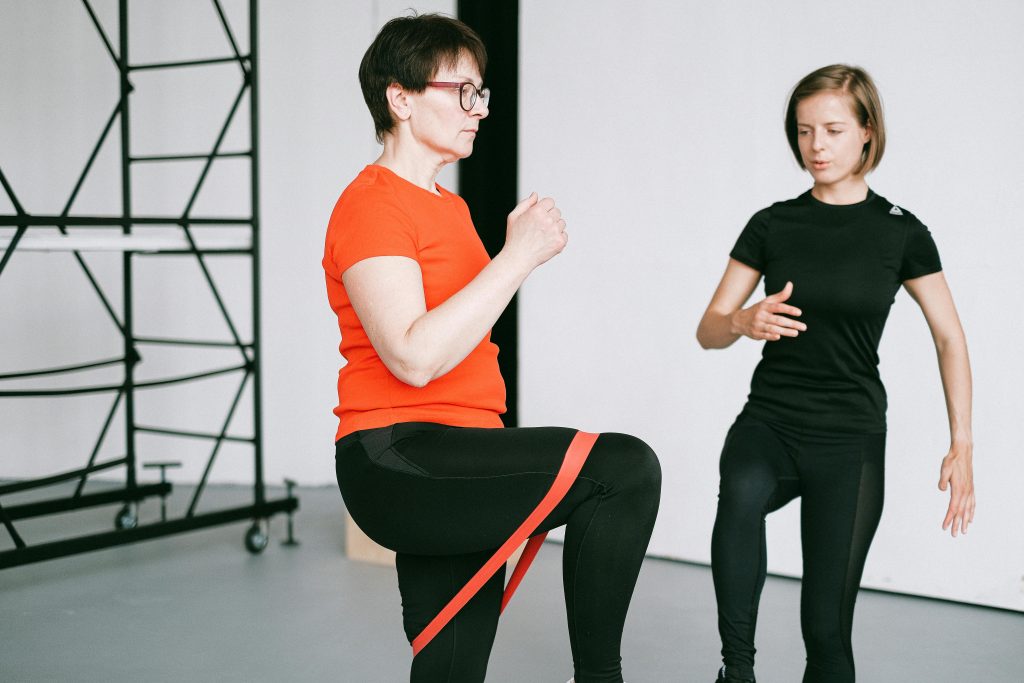
In the pursuit of longevity and physical independence, the debate often centers on the equipment: Should a senior use the colorful elastic bands found in most physical therapy clinics, or should they reach for the “iron” usually reserved for younger athletes? At geriatricrehab.es, we argue that this is a secondary question. The primary question is whether your chosen Resistance Training Tools are providing a sufficient “Mechanical Shout” to your muscles to trigger growth. Whether you are holding a dumbbell or stretching a piece of latex, the aging body requires a specific intensity to overcome “Anabolic Resistance.” In this guide, we will break down the science of these tools to help you choose the best vehicle for your journey towards a more resilient, stronger self.
1. The Tools of the Trade
For many older adults, the term “resistance training” conjures images of heavy, intimidating machinery. However, Resistance Training Tools encompass a wide spectrum of equipment designed to provide an external force that the muscle must overcome. This includes everything from free weights (dumbbells and kettlebells) to variable resistance tools like elastic bands and tubes.
The fundamental goal of using these tools in geriatric rehabilitation is to induce “structural remodeling.” As we age, we preferentially lose the Type II (fast-twitch) muscle fibers responsible for power and fall prevention. To stop this loss, the muscle needs to experience a certain level of tension. While the “tool” is simply the means of delivering that tension, the choice between bands and weights can significantly impact the ease of use, the safety of the exercise, and the specific way the muscle is challenged throughout its range of motion.
2. The ‘Why It Matters’ Section: Functional Carryover
We prioritize Resistance Training Tools not for the sake of the workout itself, but for the “Functional Carryover” into your daily life. The strength you build in the clinic or your living room must translate into freedom in the real world.
For Seniors: Translating Rubber and Iron into Independence
- The “Grocery Store” Win: Whether you use a band to strengthen your back or a dumbbell to strengthen your legs, the result is the same: the ability to walk through the store and carry your bags to the car without exhaustion.
- Playing with Grandkids: Stronger legs mean you can get down on the floor to play and, more importantly, have the power to stand back up unassisted.
- The Stability Factor: Free weights specifically challenge your “stabilizer” muscles. This has a direct carryover to your balance; if you can control a 10lb weight in your hand, you are much better equipped to control your own body weight if you trip on a rug.
3. Understanding Resistance Training Tools: Physics and Physiology
For the healthcare professional, the distinction between bands and weights lies in the “Resistance Curve.” Free weights provide constant resistance; a 5kg dumbbell weighs 5kg at the bottom, middle, and top of a bicep curl. This is excellent for measuring absolute strength and ensuring consistent loading on the bone—a key factor for improving bone mineral density (BMD).
For Professionals: Variable Resistance and Myofibrillar Protein Synthesis. In contrast, resistance bands provide variable resistance. The further the band is stretched, the harder it becomes. This is known as an “ascending resistance curve.” From a physiological standpoint, this is highly effective because it often matches the “strength curve” of the human body; we are typically strongest at the end of a movement (the “lockout”).
However, the challenge with elastic resistance training tools is the quantification of load. To trigger myofibrillar protein synthesis rates, we need to ensure the senior is working at 60-80% 1-Rep Max (1RM). As cited in Geriatric Physical Therapy (2020), if the band is too light, the “Mechanical Shout” is too quiet. For professionals, this means we must focus on “Rate of Perceived Exertion” (RPE) to ensure the rubber is providing enough tension to flip the anabolic switch.
4. Clinical Efficacy of Resistance Training Tools at High Intensity
A common misconception in geriatric care is that resistance bands are for “rehab” and weights are for “fitness.” In reality, both are simply vehicles to deliver the necessary dose of physical stress. According to the Physical Stress Theory (PST), as outlined in Geriatric Physical Therapy (2020), tissues must be stressed beyond their “Maintenance Zone” to prevent atrophy.
For Professionals: Justifying the 60-80% 1RM. To reverse sarcopenia, the Resistance Training Tools must provide enough load to reach 60-80% of the patient’s 1-Rep Max (1RM). At this intensity, the mechanical tension on the muscle fibers is sufficient to trigger myofibrillar protein synthesis rates. If a senior is using a light-resistance yellow band for 30 repetitions, they are training for endurance, but they are not building the structural muscle needed for independence. Professionals must prescribe bands with high “k-values” (stiffness) or heavy enough dumbbells to ensure the patient reaches fatigue within 8 to 12 repetitions. Without this intensity, the anabolic signal remains dormant.
5. Common Myths of Fragility: “Weights are Dangerous for Old Joints”
Staff Tip for Length: Overcoming the Fear of Gravity. The “Fragility Myth” often stops seniors from using the very tools that could save their independence. We frequently hear that “iron” is too hard on the joints, but the clinical evidence suggests the opposite.
- Myth: “Bands are safer because they are lighter.”
- The Reality: Safety is a result of control, not just weight. A resistance band can “snap back” if lost, whereas a dumbbell follows a predictable path of gravity. Both are safe when the movement is mastered.
- Myth: “Lifting weights will cause arthritis to flare up.”
- The Reality: High-intensity resistance training actually improves the health of the joint by stimulating the production of synovial fluid (the joint’s natural lubricant). By using heavy Resistance Training Tools, we strengthen the muscles around the joint, which reduces the “bone-on-bone” impact during daily walking.
- Myth: “I’m too old to see a difference from lifting weights.”
- The Reality: Studies cited in the 2020 textbook show that even individuals in their 90s can significantly increase muscle cross-sectional area and power. The body never loses its ability to respond to a “Mechanical Shout”—it just needs the right volume.
6. Pros and Cons: A Comparative Analysis for Caregivers
Choosing between Resistance Training Tools often comes down to the environment (home vs. clinic) and the specific needs of the senior. To help caregivers navigate this, here is a breakdown of how these tools compare across key clinical categories:
Portability
- Resistance Bands: Excellent; these are lightweight and can easily fit into a drawer or a travel bag, making them ideal for maintaining a routine during trips.
- Free Weights: Poor; they are heavy, bulky, and require a dedicated storage space or a home gym setup.
Safety
- Resistance Bands: High; there is a significantly lower risk of injury from dropping the equipment on one’s feet, although they do require secure anchoring.
- Free Weights: Moderate; these require active “Safety Spotting” and careful handling to avoid drops or strains.
Progress Tracking
- Resistance Bands: Difficult; it is hard to quantify exactly how many “pounds” of force are being used as the rubber ages or is stretched to different lengths.
- Free Weights: Very easy; you can track progress with 100% accuracy (eg, moving from a 5lb dumbbell to an 8lb dumbbell).
Joint Impact
- Resistance Bands: Very low; they provide a smooth, variable resistance that is often more comfortable for those with acute arthritis.
- Free Weights: High; they provide a constant force due to gravity, which is more demanding on the joints but better for bone density.
Best For
- Resistance Bands: Developing power, movement velocity, and performing consistent home-based rehabilitation.
- Free Weights: Building absolute strength, increasing bone density, and reaching the higher 1RM benchmarks.
7. Specific Use Cases: When to Reach for the Band vs. the Bell
While both are effective Resistance Training Tools, they serve different clinical purposes based on the patient’s immediate needs. According to the principles in Geriatric Physical Therapy (2020), we must match the physics of the tool to the physiological goal.
- Bands for High-Velocity Power: Because elastic resistance is light at the beginning and heavy at the end, it is the perfect tool for “Power Training.” We can ask a senior to move “fast” against a band with less risk of joint jarring. This is critical for the “Snap” needed to catch oneself during a stumble.
- Weights for Absolute Strength and Bone Health: To improve Bone Mineral Density (BMD), the skeleton needs a “Constant Load.” Gravity-based weights (dumbbells) are superior here. The steady pressure of a 10lb weight through the arm or leg provides a clearer signal to the bone-building cells (osteoblasts) than the variable pull of a band.
8. The Caregiver Corner: Safety Spotting for Diverse Tools
As the intensity increases towards the 60–80% 1RM threshold, the risk of a “loss of control” rises. Caregivers must adapt their Safety Spotting based on which Resistance Training Tools are in play.
Safety Spotting for Free Weights:
- The “Shadow” Technique: When your loved one is performing squats with a dumbbell, stand slightly behind them with your hands near their hips. Do not touch them unless they “wobble.”
- The “Wrist Guard”: For upper body weights, watch the wrists. If the wrist starts to “flop” or bend, the weight is too heavy for their current grip strength.
Safety Spotting for Resistance Bands:
- The “Anchor Check”: Always stand between the senior and the door/anchor point during the first set to ensure the band is secure.
- The “Snap-Back” Zone: Never stand directly in the line of the band. If the senior loses their grip, the band will fly towards the anchor. Position yourself to the side so you can assist without being struck.
- Safety Spotting for Sit-to-Stands: If the band is looped under their feet for a squat, watch that the band doesn’t slide off the front of their shoes.
9. A 12-Week Roadmap for Mastering Resistance Training Tools
To ensure we are meeting the Intensity Mandate without causing injury, we utilize a “Hybrid Progression.” This allows the body to adapt to the variable pull of bands before moving to the constant load of weights.
Phase 1: Foundational Movement with Bands (Weeks 1-4)
- Goal: Neuromuscular priming and joint lubrication.
- Intensity: 40-50% 1RM (High reps, low-to-medium tension).
- Exercises: Banded rows, seated leg extensions, and “No-Money” shoulder rotations. We are teaching the brain to “find” the muscle.
Phase 2: Hybrid Loading—Bands + Weights (Weeks 5-8)
- Goal: Crossing the Physical Stress Theory threshold.
- Intensity: 60-70% 1RM.
- Exercises: Banded squats (stepping on the band) while holding light 2lb weights. This creates a “Double Shout” to the myofibrillar protein synthesis rates. The resistance is now heavy enough that the senior cannot talk comfortably during the set.
Phase 3: Maximal Load with Free Weights (Weeks 9-12)
- Goal: Absolute strength and Bone Mineral Density gains.
- Intensity: 75-80% 1RM.
- Exercises: Goblet squats with a heavy dumbbell, overhead presses, and weighted step-ups. By this stage, the senior is using the heaviest Resistance Training Tools they can safely manage, ensuring they have a “Power Reserve” for the real world.
10. Conclusion: The Best Tool is the One You Use Correctly
The debate between resistance bands and free weights is ultimately a secondary concern to the Intensity Mandate. As we have explored throughout this guide, your muscles do not have “eyes”; they only recognize the level of tension and mechanical stress placed upon them. Whether that stress comes from a piece of high-grade latex or a solid iron kettlebell, the physiological requirement for a “Mechanical Shout” remains the same.
At geriatricrehab.es, we believe the most successful seniors are those who use a “Hybrid Approach.” Utilize the portability and variable resistance of bands for power and travel, but respect the constant gravitational load of weights for absolute strength and bone health. By matching the tool to the specific phase of your 12-week roadmap, you ensure that you are consistently crossing the Physical Stress Theory threshold. Remember: the goal isn’t just to “lift” or “stretch”—it is to rebuild the foundation of your independence.













