
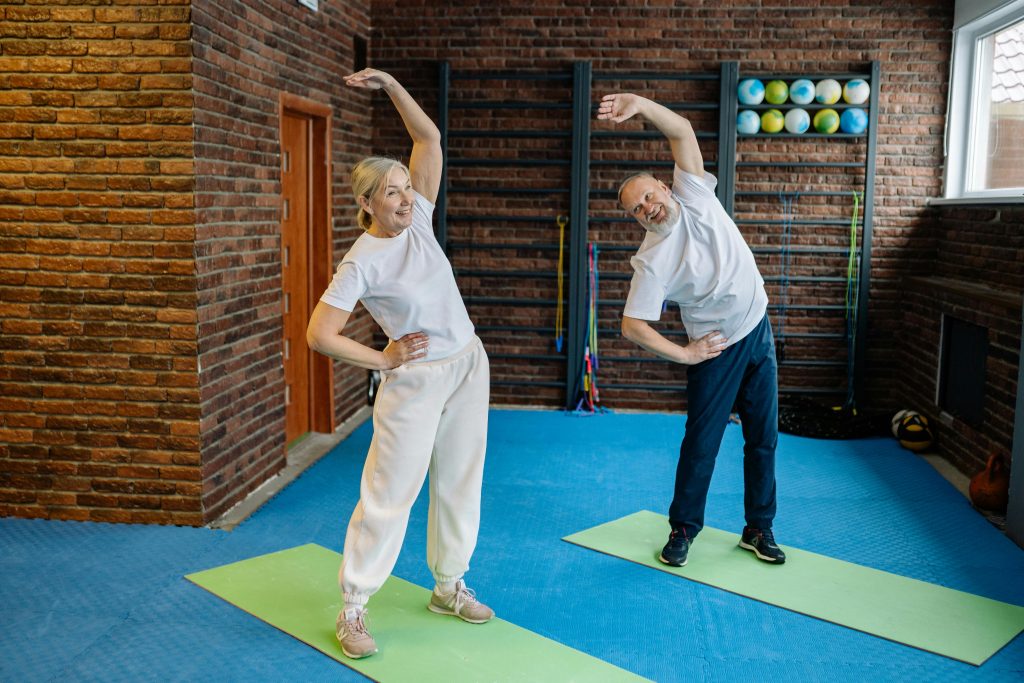
In geriatric rehabilitation, we often emphasize that “movement is medicine,” but like any potent prescription, the delivery method matters. For the aging body, the transition from rest to activity is a high-stakes physiological event. As we navigate the Slippery Slope of Aging, our Physiological Reserve—the buffer that protects our heart and lungs from sudden stress—becomes more precious. Ensuring Senior Exercise Safety starts long before the first rep and ends long after the last. A structured warm-up and cool-down are not “optional extras”; they are essential safeguards that prevent cardiac strain, manage blood pressure, and protect fragile connective tissues from injury.
1. The Physiology of Transition
In the clinical framework of Geriatric Physical Therapy (2020), we visualize the senior’s health as being on a Slippery Slope of Aging. At the top is a robust Physiological Reserve, allowing the body to handle sudden changes in temperature, heart rate, or physical demand. However, as we age, this slope becomes steeper. A sudden burst of activity without preparation is no longer just a “challenge”; it is a potential push down toward frailty.
For the senior, exercise is the fuel that adds Vigor to your years. But just as you wouldn’t redline a cold engine in the middle of winter, you cannot ask an aging heart and musculoskeletal system to go from 0 to 60 instantly. A proper warm-up “refills” the reserve by gradually increasing core temperature and shunting blood flow from the internal organs to the working muscles. By prioritizing Senior Exercise Safety through transition phases, we ensure that movement remains a healing force rather than a source of strain.
2. The Aging Heart: Senior Exercise Safety and Cardiac Output
From a Professional Perspective, we must respect the age-related changes in the cardiovascular system. The aging heart undergoes a decrease in maximal heart rate and a stiffening of the left ventricle. This means the “ramp-up” time required to reach a steady state of oxygen consumption is significantly longer than in younger populations.
When we ignore Senior Exercise Safety, we risk a “mismatch” between oxygen demand and supply. The baroreceptor response—the body’s internal pressure-sensing system—becomes blunted with age. If a senior starts a high-intensity task abruptly, the heart may not be able to increase cardiac output quickly enough, leading to transient ischemia or arrhythmias. A 10-minute gradual warm-up allows the coronary arteries to dilate and the stroke volume to increase incrementally, protecting the myocardium from sudden wall stress.
3. Pharmacokinetics and Performance: Meds and the Warm-Up
The success of a warm-up is often dictated by pharmacokinetics—specifically, how medications interact with the body’s response to exertion. Many seniors are on Beta-Blockers or Calcium Channel Blockers for hypertension. These drugs have a profound impact on the “Exercise-Response” because they artificially “cap” the heart rate.
- Volume of Distribution (Vd): Due to changes in body composition (increased fat, decreased water), many heart medications have a higher Vd, meaning they linger in the system with an extended half-life.
- First-Pass Metabolism: Reduced liver blood flow in seniors can lead to higher systemic concentrations of these drugs, making the heart even more resistant to “speeding up” during exercise.
Take-Home Tip for Caregivers (The Dose Detective): If your loved one takes their blood pressure medication in the morning, they may feel a “heavy leg” or a sense of “sluggishness” during their walk. This isn’t necessarily laziness; it is the medication working. During this peak window, the warm-up must be doubled in length to allow the body to overcome the drug’s “braking” effect on the heart. Never rush the start of a session if the “Dose Detective” notes the morning pill was taken recently.
4. Functional Training: The Dynamic Warm-Up Audit
In geriatric rehabilitation, we don’t exercise just for the sake of the gym; we exercise for the sake of the home. A warm-up is not just “stretching”; it is the rehearsal of the movements you need to remain independent. By applying the SAID Principle (Specific Adaptation to Imposed Demands), we use the warm-up to prepare the skeleton and muscles for the exact “loads” they will face during the day.
Below is a Functional Audit mapping daily tasks to the specific “Prep” movements that ensure Senior Exercise Safety.
Functional Audit: Mapping Daily Life to the Warm-Up
1. Driving (Checking blind spots)
- The Functional “Prep” Move: Seated Neck/Trunk Rotations
- Clinical Benefit: Increases cervical range of motion and “wakes up” the vestibular system to prevent dizziness during rapid head turns.
2. Reaching a high kitchen shelf
- The Functional “Prep” Move: Wall Slides / Shoulder Rolls
- Clinical Benefit: Prepares the rotator cuff and improves scapular rhythm to prevent impingement or “pinching” during overhead loading.
3. Stepping into a bathtub
- The Functional “Prep” Move: Standing Hip Marches
- Clinical Benefit: Activates the hip flexors and pelvic stabilizers, ensuring the balance and strength required to navigate high thresholds safely.
4. Walking to the mailbox
- The Functional “Prep” Move: Ankle Pumps and Circles
- Clinical Benefit: Increases synovial fluid (joint “oil”) in the ankle and improves “toe clearance,” reducing the risk of tripping on uneven pavement or rug edges.
5. Getting off a low sofa
- The Functional “Prep” Move: Partial Sit-to-Stands
- Clinical Benefit: Primes the quadriceps and glutes for the “explosive” power needed to transition from a deep-seated position to standing.
Functional Tip: If a senior finds these “prep” moves difficult, it is a clinical sign that their Physiological Reserve is reaching a critical low. Use these movements as a daily diagnostic tool—if the hip marches feel “heavy,” today is a day for a longer, gentler warm-up.
5. Overcoming “The Feelings”: Navigating Stiffness and Heavy Legs
For the senior, the biggest barrier to starting is often “the feelings.” This is the sensation of morning stiffness or that “heavy leg” feeling that makes you want to stay in your chair. Physiologically, this is often due to a lack of synovial fluid (joint “oil”) and a lower resting core temperature.
To “oil the hinges,” we recommend the “Heat then Hydrate” strategy:
- Passive Heat: Use a warm pack or a warm shower to relax stiff connective tissues.
- Hydrate the Joint: Perform 10–20 repetitions of a joint-specific movement without weight (like swinging your legs while sitting) to pump synovial fluid into the cartilage.
- Acknowledge the Meds: Remember that morning “sluggishness” is often a side effect of blood pressure medication. Don’t fight the feeling; move through it gradually until your Vigor returns.
6. The Cool-Down: Senior Exercise Safety and Post-Activity Hypotension
While the warm-up is about getting the blood to the muscles, the cool-down is about getting the blood back to the heart. In the aging body, the veins in the legs become less elastic. If you stop exercising abruptly, the blood can “pool” in your lower extremities—a phenomenon known as venous pooling.
This is the most dangerous time for Senior Exercise Safety. If the blood stays in your legs, it isn’t going to your brain. This leads to “that dizzy feeling when you stand up too fast” or, worse, fainting immediately after a walk.
The Cool-Down Protocol:
- Phase 1 (Active Recovery): Walk at a very slow pace for 3–5 minutes. This keeps the “calf muscle pump” working to push blood back up to the heart.
- Phase 2 (Static Stretching): Gently stretch the muscles you used. This helps reset the nervous system from “flight” mode back to “rest” mode.
- Phase 3 (The Stage Stand): Before leaving the exercise area, sit for 2 minutes and perform ankle pumps. This ensures your blood pressure has stabilized before you transition to walking to your car or the kitchen.
7. The Story of Mr. J: A Case Study in the Prescribing Cascade
In geriatric medicine, a single moment of neglected safety can trigger a domino effect of medical interventions. This is best illustrated by the story of Mr. J, an active 82-year-old who took pride in his daily 30-minute brisk walk.
- The Initial Incident: One humid morning, Mr. J finished his walk and immediately sat down on his porch to check his mail, skipping his 5-minute slow-walk cool-down.
- The Cascade: Because his “muscle pump” stopped suddenly while his blood vessels were still dilated, he experienced a rapid drop in blood pressure. When he stood up to go inside, he experienced “that dizzy feeling,” blacked out, and fell.
- The Medical Spiral: In the ER, his fall was attributed to “syncope” (fainting). Fearing a heart condition, his physician added a new heart rhythm medication. This drug had a long half-life and made him feel perpetually lethargic—a side effect that was mistaken for depression, leading to a prescription for an antidepressant.
The Resolution: By the time Mr. J reached physical therapy, he was on four new medications and was too afraid to walk. We didn’t treat the “depression”; we treated the transition. We taught him that his fall wasn’t a sign of a failing heart, but a failure of the cool-down. By reintroducing Senior Exercise Safety and a structured transition protocol, we were able to restore his Vigor and work with his doctor to safely taper the unnecessary medications.
8. The Beers Criteria: Safety Prep for the High-Risk Patient
For the Allied Health Professional, the warm-up and cool-down are the most critical windows for monitoring patients on “high-risk” medications. The Beers Criteria provides a list of drugs that can turn a standard exercise session into a safety crisis.
- Antihypertensives: Drugs like Alpha-blockers increase the risk of orthostatic hypotension during the “Dizzy Pivot” of a cool-down.
- Sedative-Hypnotics: If a senior takes a sleep aid with a long half-life, they may still be under its influence during a morning warm-up, leading to impaired balance and increased fall risk.
- The Volume of Distribution (Vd) Factor: Remember that because seniors have a higher percentage of body fat, these medications can be “stored” in the tissues, making their effects unpredictable during the thermal changes of a warm-up.
Advocacy Tip: If a senior is taking medications on the Beers list, the transition phases must be elongated. A 5-minute warm-up is not enough for a brain and heart competing with chemical sedatives. Aim for 15 minutes of low-intensity movement to ensure the nervous system is fully “awake” before increasing the load.
9. Clinical Strategies: SAID Principle and Thermal Regulation
To truly apply the SAID Principle (Specific Adaptation to Imposed Demands), we must recognize that the demand we are imposing during a warm-up is metabolic flexibility. The aging body struggles with thermoregulation—the ability to move heat from the core to the skin.
- The Golden 10 Minutes: Research in geriatric exercise science suggests that 10 minutes is the “threshold” for significant increases in muscle temperature and joint lubrication in adults over 70.
- Vasodilation Lag: It takes longer for the “pipes” (blood vessels) to open up in a senior. A premature increase in intensity (moving too quickly to 85% heart rate reserve) can lead to a “pressor response,” where blood pressure spikes dangerously because the peripheral vessels aren’t yet open to receive the flow.
Professional Perspective: Monitor the “Dose-Response.” A successful warm-up should produce a light “sheen” of sweat and a gradual increase in respiratory rate. If the patient is gasping for air within the first three minutes, the “Imposed Demand” has exceeded their current Physiological Reserve, and you must back off to prevent a cardiac event.
10. Conclusion: The Senior Exercise Safety Spotter’s Guide
To truly maximize Senior Exercise Safety, we must respect the Dose-Response relationship of physical activity. In geriatric rehabilitation, the “dose” is not just the weight on the bar, but the intensity of the heart’s work.
- The 40% Threshold: A low-intensity warm-up (around 40% of the heart rate reserve) is the clinical entry point. It provides enough stress to “wake up” the metabolism without depleting the Physiological Reserve.
- The 85% Peak: For seniors aiming for “Optimal Aging,” pushing toward 85% of the heart rate reserve is where significant Vigor is built. However, you cannot reach this peak safely without a “ramped” transition. Jumping straight to high intensity creates a metabolic “debt” that the aging heart may struggle to repay, leading to extreme fatigue or cardiac strain.
Caregiver Focus: The Safety Spotter’s Guide
Transition phases are when balance is most precarious. As a caregiver, you are the “Safety Spotter” during the most vulnerable moments of the session.
- The Sit-to-Stand Assist: During the warm-up or cool-down, your loved one may need help moving from a chair. To protect your own back, never pull on their arms. Instead, stand in front of them with a wide base, knees bent. Have them lean forward (“nose over toes”) while you provide a steadying hand on their hips or a gait belt.
- The Post-Exercise “Dizzy” Check: Always stay close during the first two minutes of the cool-down. If you notice them swaying or if they report “that dizzy feeling,” have them sit immediately and perform ankle pumps.
- Hydration Transition: Ensure they drink water during the cool-down. Dehydration shortens the half-life of blood volume, making the “Dizzy Pivot” much more likely.
Movement is the fuel that adds life to your years, but safety is the vessel that carries it. By mastering the art of the warm-up and the science of the cool-down, you ensure that every step taken is a step toward resilience, not a slide down the slope.
Are you unsure if your current routine is safe for your heart and joints? Don’t leave your health to chance. Schedule a “Safety Audit” with our expert team at geriatricrehab.es today and learn how to transition into a stronger, more vigorous you.













