
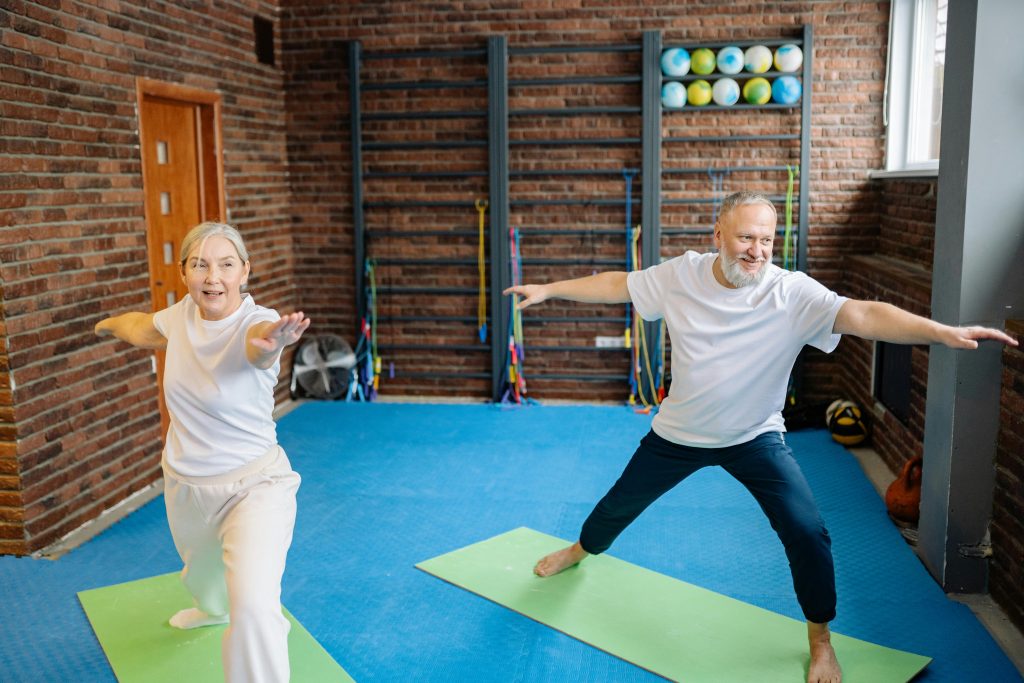
In geriatric rehabilitation, we often focus on the legs as the primary movers, but even the strongest legs cannot stabilize a swaying tower. At geriatricrehab.es, we view the core not as a “six-pack” for the beach, but as the “Internal Scaffolding” that protects your independence. Engaging in Core Balance Exercises is the clinical equivalent of dropping a heavy anchor in a restless sea; it provides the stability needed to navigate the world with confidence. According to Geriatric Physical Therapy (2020), central stability is the “fuel” for your posture and the “Safety Buffer” for your balance. By strengthening this midsection, we aren’t just preventing falls, we are giving you the vigor to walk through the garden or navigate a busy supermarket without a second thought.
1. The Central Anchor of Independence
When we talk about balance, we are really talking about the control of your Center of Mass (COM). For most adults, this “anchor point” sits right behind the belly button. If your core is weak, your anchor is loose. Every time you reach for a glass or step over a threshold, a weak core allows your upper body to “drift,” forcing your legs to work twice as hard to catch you. This is why Core Balance Exercises are the first line of defense against the Slippery Slope of Frailty.
Building “Central Vigor” means transforming your trunk into a reliable transit hub. Whether you are rising from a chair or turning to hear a friend speak, every movement originates in the core. By reinforcing this foundation, we expand your “Safety Buffer.” This buffer is the gap between a “stumble” and a “save.” A robust core allows you to react faster and more efficiently, ensuring that a small trip doesn’t turn into a significant event. Rehab isn’t about restriction; it’s about the freedom that comes from knowing your anchor will hold.
2. The ‘Feelings’ Section: Understanding “Mid-Body Drift”
Many seniors describe a feeling of being “unsteady” or “top-heavy,” even if they feel their legs are still strong. This is often the result of “Mid-Body Drift.” When the deep muscles of the trunk lose their endurance, the spine begins to collapse forward, and the body’s “Safety Buffer” shrinks.
For Seniors: Reframing the Core
- The “Proud Posture” Concept: Think of your core as the fuel that keeps your spine tall. When you stand tall, you look and feel more capable. This is “Postural Vigor.”
- The Confidence Gap: Falling is scary, but the fear of falling is what often keeps seniors at home. Improving your core strength closes that gap. It gives you the “internal grit” to trust your body again.
- Exercise as Medicine: We don’t do these movements to “get fit” in the traditional sense; we do them to add years to your life and life to your years. A steady core is the gift of a more active social life.
3. The Role of Core Balance Exercises in Postural Alignment
For the healthcare professional, the core is best understood through the “Canister Model.” This anatomical canister is comprised of the diaphragm (the roof), the pelvic floor (the base), the multifidus (the back), and the transversus abdominis (the wraparound walls).
For Professionals: The Biomechanics of Trunk Stiffness
- Dynamic Stability vs. Static Strength: Citing Geriatric Physical Therapy (2020), trunk “stiffness” is a protective mechanism. When a senior is subjected to a perturbation (a push or trip), the brain must rapidly “stiffen” the canister to prevent the spine from buckling.
- Sensory Organization Testing (SOT) and the Core: In SOT, we measure how a patient uses visual, vestibular, and somatosensory cues to stay upright. A weak core “muffles” these signals. If the trunk is unstable, the brain receives “noisy” data about where the body is in space, leading to delayed reactive balance.
- The Transversus Abdominis (TrA) Feed-Forward Mechanism: In a healthy system, the TrA fires before a limb moves. In frail seniors, this mechanism is often delayed. Core Balance Exercises specifically target this “pre-activation,” restoring the body’s natural safety timing.
Take-Home Tips for Caregivers:
- The “Tall Spine” Facilitation: When your loved one is sitting or standing, avoid telling them to “sit up straight.” Instead, use a tactile cue: gently place a finger between their shoulder blades and ask them to “lift away” from your touch. This encourages the deep extensors to fire without causing muscle guarding.
- The “Breathing Check”: A major red flag of core weakness is “Valsalva” (holding the breath) during movement. If you see your loved one holding their breath while standing up, remind them to “exhale for power.”
- Protect Your Own Anchor: When assisting with exercises, keep your own core braced and your feet wide. Your back is only as safe as your own core is strong.
4. The SAID Principle: Building a Reactive Midsection
The Specific Adaptation to Imposed Demands (SAID) principle is the bedrock of geriatric strength. To improve balance, the “imposed demand” on the core must be dynamic. While a seated abdominal crunch has some value, it does not prepare the body for the sudden shift of a trip or a reaching task.
For Professionals: Engineering the Perturbation Response
- From Static to Dynamic: To build a robust core, we must move beyond static holds. We impose demands that require the trunk to stabilize against moving limbs. This is the essence of Core Balance Exercises in a clinical setting.
- The “Anti-Rotation” Demand: Real-world falls often happen when we are turning. By using “Pallof Presses” or resisted rotations, we train the obliques and multifidus to resist unwanted spinal rotation, essentially “locking” the anchor when the world pushes against it.
- Velocity-Specific Loading: Geriatric Physical Therapy (2020) notes that power (force x velocity) declines faster than strength in seniors. We must train the core to fire quickly. This “Reactive Vigor” is what allows a senior to stiffen their trunk in the split-second before their center of mass leaves their base of support.
5. The Functional Audit: Mapping the Core to Daily Victories
In the clinical framework of Geriatric Physical Therapy (2020), the core is the “central stabilizer” that dictates the safety of every limb movement. To address the hardware of Active Living, we use the Functional Audit to identify “High-Risk” moments and reveal how core stability provides the necessary Safety Buffer to succeed.
- Task: Getting out of bed (The Log Roll).
- The Core Benefit: Protecting the lumbar spine from “shear” forces.
- The Mapping: A strong core allows the senior to move the hips and shoulders as one solid unit. This prevents the “twisting” that often causes morning back pain and ensures a stable transition to sitting.
- Task: Reaching into a low dishwasher or oven.
- The Core Benefit: Maintaining a neutral spine during a “hinge.”
- The Mapping: Without core stability, the senior will round their back (flexion), shifting their weight too far forward. Core Balance Exercises like the “Bird-Dog” train the back extensors to hold the spine steady while the arms are busy.
- Task: Looking behind while walking (The Grocery Store Glance).
- The Core Benefit: Dissociation of the head and trunk.
- The Mapping: Many falls occur when a senior turns their head, and their whole body follows. A stable core allows the neck to move independently of a steady torso, preventing a “spiraling” loss of balance.
- Task: Standing up from a deep, soft sofa.
- The Core Benefit: Generating upward momentum.
- The Mapping: The core acts as the “transmission” that transfers power from the legs to the upper body. If the core is “mushy,” the energy from the legs is lost, and the senior “plops” back down.
6. Preventing the Slippery Slope with Core Balance Exercises
The “Slippery Slope of Frailty” often begins with a subtle change in posture. As core Vigor declines, the “Canister” begins to leak. This leads to Kyphosis the forward rounding of the upper back, which is a primary predictor of future falls.
For Professionals: Sensory Organization and the Forward Lean
- The “Kyphotic Shift”: When the core fails, the center of mass moves forward, closer to the toes. This shrinks the “Safety Buffer.” In Sensory Organization Testing (SOT), these patients show a marked inability to use their ankles for balance because they are already “maxed out” on their forward lean.
- Proprioceptive Blurring: A weak core creates “noise” in the nervous system. If the trunk is constantly swaying, the brain has a harder time distinguishing between a real trip and its own instability.
- Reversing the Slide: We use Core Balance Exercises to pull the senior back up the slope. By strengthening the “Posterior Chain” (the back side of the core), we physically move their center of mass back toward the middle of their feet, instantly widening their Safety Buffer and restoring their confidence to walk in open spaces.
Take-Home Tips for Caregivers:
- The “Environmental Audit” for the Core: Look at where your loved one spends their time. Soft, low chairs are “Core Killers.” They encourage a rounded back and make standing up an energy-expensive chore. Swap them for firm chairs with armrests to support their “Anchor.”
- The “Reach Test”: While your loved one is seated, ask them to reach for an object on a side table. Watch their midsection. If they “collapse” toward the object rather than staying tall, their core Vigor is low.
- Empowerment over Fear: Instead of saying “Careful, you might fall,” try saying “Keep your anchor strong as you reach.” This shifts the focus to their internal strength rather than the external danger.
7. Finding the “Stability Sweet Spot”: Dose-Response
In the “Exercise is Medicine” framework, the results are in the dosage. For Core Balance Exercises to be effective, they must move the senior out of the “Atrophy Zone” and into the “Vigor Zone” without crossing into the “Injury Zone.”
For Professionals: Titrating the Trunk Load
- The 40% HRR “Steady State”: This level of intensity involves deep, diaphragmatic breathing and gentle core activation (like “transversus draws”). It is essential for “re-connecting” the brain to the muscle, but it won’t build the power needed to save a fall.
- The 85% HRR “Reactive Vigor”: To build a true “Safety Buffer,” we need higher intensity. This is achieved through “unstable surfaces” or resisted movements, where the senior must work hard to stay upright. At this level, the senior should feel a “healthy fatigue” in their midsection. If they begin to “wobble” excessively or hold their breath, the dose is too high.
- Frequency vs. Fatigue: The core is made of postural muscles designed for endurance. Geriatric Physical Therapy (2020) suggests that “little and often” is superior to one long session. Three 5-minute “core snacks” throughout the day provide better neurological reinforcement than a single 15-minute bout.
8. The Caregiver Corner: The “Safety Spotter’s Guide” to Trunk Training
As a caregiver, you are the “External Scaffolding” for your loved one’s core. Your goal is to provide enough support to keep them safe, but not so much that their own muscles stop working.
The “Safety Spotter” Protocol for Core Work:
- The “Stability Shield”: When your loved one is practicing standing Core Balance Exercises, stand slightly behind them with your hands hovering near their hips. Do not hold them unless they lose their balance. This “hovering” gives them the confidence (Vigor) to push their limits while you remain the ultimate safety net.
- Tactile Cueing for Posture: If you see them slouching, place two fingers on their breastbone (sternum) and ask them to “lift your heart” toward your fingers. This is a much more effective cue than “stand up straight,” which often leads to rigid, unnatural posture.
- Protect Your Own Back: When helping a senior up from a chair, do not pull on their arms. Instead, have them “hug” their own chest, and you provide a steady hand on their waistband. Keep your feet wide and your knees bent. Your safety is just as important as theirs.
9. Advanced Core Balance Exercises for Spinal Integrity
While the “abs” get all the glory, the posterior chain (the back extensors and glutes) and the pelvic floor are the true heroes of spinal integrity. In Core Balance Exercises, we must train the “Back-Side Core” to prevent the “Forward Fall” tendency associated with the Slippery Slope.
For Professionals: The Posterior Scaffolding
- Spinal Extensor Vigor: The muscles running along the spine act as a “Biological Brace.” Geriatric Physical Therapy (2020) notes that as these muscles weaken, the senior develops a “flexed-forward” posture. We prioritize “Extension” exercises like the “Superman” (modified for chairs or beds) to pull the spine back into a neutral, safe alignment.
- The Pelvic Floor Connection: The pelvic floor is the “basement” of the core canister. It works in tandem with the deep abdominals to manage internal pressure. Exercises like “Kegels” paired with “Exhale for Power” ensure that when a senior lifts a heavy object, their internal anchor doesn’t “leak,” preventing both injury and incontinence.
- Multifidus Training: These tiny muscles stabilize each vertebra. We train them through “weight-shifting” drills, having the senior stand and slowly shift their weight from foot to foot while keeping their torso perfectly still.
Take-Home Tips for Caregivers:
- The “Wait-Time” Rule: When you give a postural cue, wait 5 seconds. Seniors often have a slightly slower “processing speed” for motor tasks. Give their brain time to find the muscle.
- The “Grip” Check: If you see your loved one white-knuckling their walker or a chair during exercises, their core isn’t doing the work their hands are. Encourage them to “soften your hands” to force the Vigor back into their midsection.
- Celebrate the “Tall Wins”: When you see them standing tall in the grocery line, tell them! “Your anchor looks really strong today.” Positive reinforcement builds the confidence that powers their Vigor.
10. Conclusion: Anchoring Your Future
Independence is not just about the strength of your legs; it is about the resilience of your center. As we have explored, your core is the physiological “transit hub” that dictates how safely and confidently you move through the world. By prioritizing Core Balance Exercises, you are doing more than just “working out”; you are reinforcing the internal scaffolding that keeps you off the Slippery Slope of Frailty.
At geriatricrehab.es, we believe that a strong anchor leads to a boundless life. Whether you are reaching for a dish, walking through a crowded park, or simply standing tall to greet a friend, your core provides the “Safety Buffer” that turns a potential fall into a confident save. Your posture is the outward reflection of your internal Vigor. Start building your anchor today, and reclaim the stability that adds years to your life and, more importantly, life to your years.
Is your “internal anchor” feeling a bit loose? Don’t wait for a stumble to start building your Safety Buffer. At geriatricrehab.es, we offer specialized “Core & Vigor Stability Checks” to help you identify your unique stability needs. Visit geriatricrehab.es today to download our “Core for Balance Home Guide” and schedule a consultation with our clinical team to anchor your future!













