
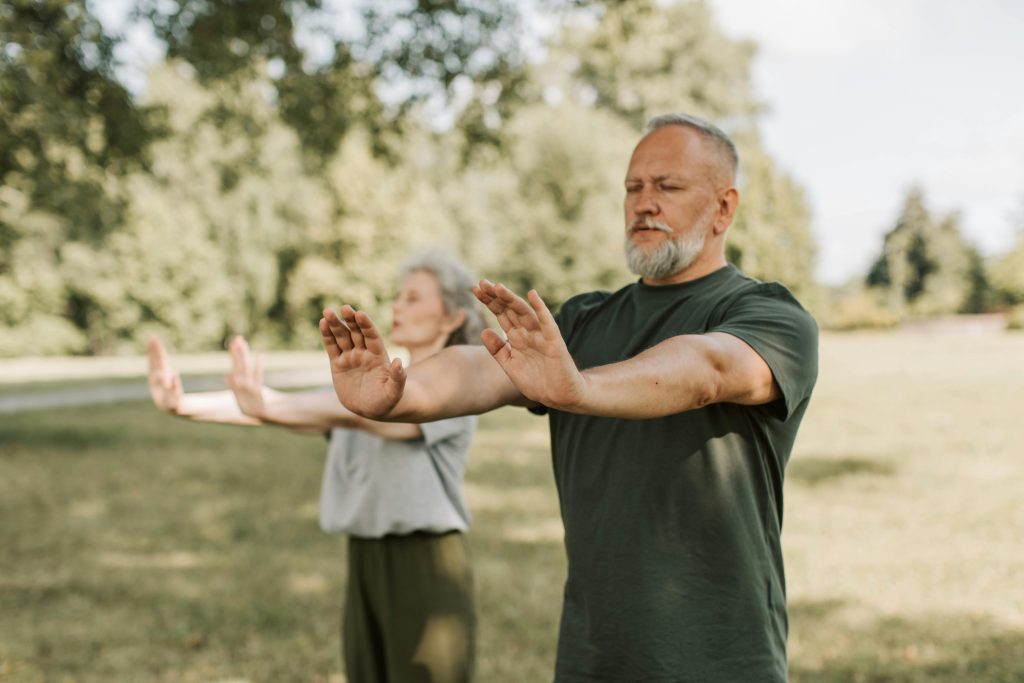
To the untrained eye, standing still looks like a passive state of rest. However, at geriatricrehab.es, we recognize that standing is an incredibly active, sophisticated biological feat. Every second you are upright, your brain is processing a mountain of data to keep your body from toppling over. This micro-movement is known as “postural sway.” Understanding Postural Sway in Seniors is essential because it is the primary window into the health of your nervous system. By learning the difference between “functional sway” and “pathological drift,” we can build a more robust “Safety Buffer.” This isn’t just about avoiding a fall; it is about building the “Reactive Vigor” required to walk with your head held high through a windy garden or a crowded supermarket.
1. The Constant Dance of Stability
In the framework of Geriatric Physical Therapy (2020), balance is defined not by the absence of movement, but by the efficiency of the corrections. Postural Sway in Seniors is often compared to an “inverted pendulum.” Your feet are the pivot point, and your body is the weight swinging above it. Because our Center of Mass (COM) is located relatively high around the second sacral vertebra, gravity is constantly trying to pull us off-center.
To combat this, your muscles perform “micro-adjustments.” A small sway forward triggers the calves; a small sway back triggers the shins. This “dance” is a sign of life and vigor. However, as we descend the Slippery Slope of Frailty, these corrections can become delayed or exaggerated. When the sway becomes too large, it consumes more energy, leading to “balance fatigue.” Our goal in rehabilitation is to “quiet” the sway, tightening your internal scaffolding so that your movements are precise, confident, and fueled by strength rather than fear.
2. The ‘Feelings’ Section: The “Drunken Sailor” Sensation
Many seniors experience a distressing sensation of “unsteadiness” while standing still, sometimes described as feeling like they are on a boat or like a “drunken sailor.” This feeling often leads to a cycle of fear: the more wobbly you feel, the less you move; the less you move, the weaker your “Safety Buffer” becomes.
For Seniors: Reframing the Sway
- Sway is Information: Think of sway as your body “searching” for its center. Your brain is asking your feet, “Where are we?” and your feet are answering. Some sway is actually a sign that your sensory systems are working!
- The Confidence Gap: The goal of rehab isn’t to make you a statue; it’s to give you a “Safety Buffer.” When you have a wide buffer, a little sway doesn’t feel like a threat; it just feels like a minor adjustment.
- Vigor over Velocity: Instead of trying to stop moving, we focus on making your “save” movements stronger. When your “Ankle Strategy” is vigorous, you can catch yourself before the sway feels scary.
- Confidence in the Garden: Improving your stability means you stop looking at your feet and start looking at the world. That is the true “fuel” of independence.
3. Measuring Postural Sway in Seniors
For healthcare professionals, measuring Postural Sway in Seniors is about quantifying the “Center of Pressure” (COP) excursions. While the Center of Mass is where your weight lives, the COP is where your feet are pushing into the ground to control that weight.
For Professionals: The Cone of Stability
- The Physiological Limits: Every individual has a “Cone of Stability,” the maximum angle they can lean in any direction without moving their feet. In healthy aging, this cone remains wide. In frailty, the cone shrinks, meaning even a small amount of Postural Sway in Seniors can push them past their limit of stability.
- The “Inverted Pendulum” Mechanics: Geriatric Physical Therapy (2020) emphasizes that sway is controlled primarily by the ankle plantarflexors and dorsiflexors. If a patient lacks ankle range of motion or “stiffness” in these muscles, their sway velocity increases, which is a significant predictor of fall risk.
- Sway Velocity vs. Sway Area: While the total area of sway matters, velocity (how fast the body is moving back and forth) is often a more critical indicator of neurological health. A “fast” sway suggests the brain is struggling to process sensory data quickly enough to make smooth corrections.
4. The SAID Principle: Moving Beyond Static Standing
The Specific Adaptation to Imposed Demands (SAID) principle is the cornerstone of building “Balance Vigor.” To improve stability, the “imposed demand” must match the real-world challenge. While standing still (Static Balance) is a starting point, it does not prepare the senior for the dynamic shifts of walking, turning, or reaching.
For Professionals: Engineering Sensory Adaptation
- The Demand for Variability: If a patient only practices standing on a flat, firm floor, their brain adapts to a predictable environment. However, the world is unpredictable. We must apply Postural Sway in Seniors by introducing “sensory perturbations”, such as foam pads or uneven surfaces, to force the brain to adapt its weighting of sensory input.
- Velocity-Specific Training: Falls rarely happen slowly. We use the SAID principle to train the “Reactive Buffer” by practicing quick weight shifts. This ensures that the muscles are primed to fire with the necessary speed to “dampen” a sudden increase in sway.
- The “Maintenance” vs. “Improvement” Zone: Geriatric Physical Therapy (2020) notes that to move from the Maintenance Zone to the Improvement Zone on the Physical Stress Theory (PST) scale, the balance challenge must feel “difficult.” If the patient doesn’t feel a little “wobbly,” they aren’t adapting.
5. The Functional Audit: Mapping Sway to Real-World Hazards
To provide actionable clinical value and address the hardware of Active Living, we use the Functional Audit. This identifies specific moments where Postural Sway in Seniors becomes a risk and provides the necessary “Vigor Fix”.
- Task: Washing hair in the shower.
- The Sway Risk: Closing the eyes or looking up removes visual cues, often increasing sway significantly.
- The Vigor Fix: “Tandem Standing” (one foot in front of the other) with eyes closed in a safe, supported environment. This trains the ears and feet to take over when the eyes are busy.
- Task: Standing in a slow-moving grocery store queue.
- The Sway Risk: “Static Fatigue.” Long periods of standing still can lead to muscle “creep” and increased sway velocity.
- The Vigor Fix: “Weight-Shifting” drills. Learning to consciously shift weight from side to side or heel to toe keeps the muscles active and “shushes” the sway before it becomes unstable.
- Task: Reaching for a high shelf in the pantry.
- The Sway Risk: Moving the Center of Mass (COM) high and forward, often while on tiptoes.
- The Vigor Fix: “Functional Reach” training. Practicing reaching tasks while maintaining a “Stiff Core” to prevent the torso from swaying beyond the base of support.
- Task: Walking on a windy day.
- The Sway Risk: External perturbations (the wind) pushing the body, requiring rapid “Hip Strategy” corrections.
- The Vigor Fix: “Perturbation Training.” Gentle, unpredictable pushes at the hips (with a caregiver) to sharpen the brain’s ability to “catch” the sway.
6. Sensory Organization Testing (SOT): The Brain’s Three “Eyes”
In a clinical setting, we use Sensory Organization Testing (SOT) to determine why a senior is swaying. The brain uses three primary inputs to maintain balance: Somatosensory (the feel of the floor), Vision (what we see), and Vestibular (the inner ear).
For Professionals: Deciphering the SOT Scores
- The Hierarchy of Input: Typically, a healthy adult relies 70% on somatosensory input and 30% on vision/vestibular when on firm ground. However, Postural Sway in Seniors often increases because the brain begins to over-rely on vision (“Visual Dependency”).
- The Conflict Test: During SOT, we “cheat” the systems. We might move the walls or tilt the floor. If a senior’s sway increases dramatically when the floor moves, we know they have a Somatosensory Deficit.
- The Transition of Strategies: Based on the magnitude of the displacement measured in the SOT:
- Ankle Strategy: Used for small, slow sways on firm ground.
- Hip Strategy: Triggered when the sway is large, fast, or the surface is narrow/unstable.
- Stepping Strategy: The “Emergency Exit.” Triggered when the sway moves the COM completely outside the base of support.
- Clinical Takeaway: Geriatric Physical Therapy (2020) teaches that we must “re-weight” these systems. If a senior has poor sensation in their feet (neuropathy), we must train their vestibular system to be the “primary anchor” to reduce sway.
Take-Home Tips for Caregivers:
- The “Lighting Audit”: Because many seniors are “Visually Dependent,” their sway will increase in the dark. Ensure hallways have motion-sensor nightlights to prevent “nighttime drift.”
- The “Surface Audit”: Be aware that transition points moving from a wood floor to a thick rug are high-sway moments. Place a piece of bright “Grip Tape” at these transitions to alert the senior’s visual system.
- Encourage the “Wobble”: When practicing balance, don’t tell them “Don’t move.” Tell them, “Stay in your center.” Moving is how the brain learns where the edges are!
7. Dose-Response: Challenges that Build Vigor
In the “Exercise is Medicine” philosophy, the dosage determines the adaptation. To dampen Postural Sway in Seniors, we must provide a stimulus that is challenging enough to trigger the nervous system to “tighten” its control.
For Professionals: The Vigor Threshold
- The 40% vs. 85% Intensity Rule: * 40% HRR (Maintenance): Quiet standing or gentle weight shifting. This is safe but rarely improves the “Safety Buffer.”
- 85% HRR (Improvement): Challenging the senior with “unstable surfaces” or “reactive perturbations.” At this intensity, the senior should be visibly swaying and working hard to remain upright. This “Vigor Zone” is where the brain learns to prioritize inner-ear (vestibular) signals over unreliable visual cues.
- Volume and Recovery: Balance is neurologically taxing. We prioritize short, high-frequency bouts (e.g., three 5-minute sessions daily) rather than one long, fatiguing session. Geriatric Physical Therapy (2020) notes that as a senior becomes metabolically fatigued, their sway velocity increases, and their “Reaction Time” slows, turning a productive session into a risky one.
8. The Caregiver Corner: The “Safety Spotter’s Guide” and Environmental Audit
As a caregiver, your role is to provide a “Stability Shield” that allows the senior to push their boundaries without the risk of injury. This requires a dual focus: on the senior’s movement and on the room they move in.
The “Safety Spotter” Protocol:
- The Hover Technique: Stand slightly behind and to the side of the senior. Keep your feet wide and your knees bent to protect your own back. Keep your hands a few inches from their hips, but do not touch them. Touching provides “haptic input” that artificially lowers their sway, preventing their own brain from learning to self-correct.
- The “Stability Shield” Cue: If the sway becomes too large, provide a firm tap at the hip to redirect them to the center, rather than catching their arms and pulling them off-balance.
The Room-by-Room Environmental Audit Checklist:
- Living Room: Remove all throw rugs. Ensure furniture is stable and “non-rocking.” Clear “swing paths” for the Stepping Strategy.
- Kitchen: Place frequently used items at waist height to minimize “High-Shelf Sway.” Ensure the floor is non-slip and free of pet bowls or cords.
- Bedroom: Install motion-sensor nightlights. Ensure the path from the bed to the bathroom is a straight, unobstructed line.
- Bathroom: Install “stud-mounted” grab bars (not suction cups). Place a non-slip mat inside and outside the shower to provide a firm somatosensory anchor.
9. Assistive Devices: The Buyer’s Guide and Psychology of the Cane
When Postural Sway in Seniors exceeds the “Safety Buffer,” an assistive device acts as an “External Anchor.” It effectively widens the base of support and provides additional sensory feedback to the brain.
The Buyer’s Guide: Choosing Your Tool
- The Standard Cane: Best for mild sway. It provides a “third point” of contact, sending tactile signals to the brain about where the body is in space.
- The 2-Wheeled Walker (Front-Wheeled): Ideal for those who need a consistent “anchor” but still have a natural gait speed. The friction of the back legs provides a “braking” mechanism for those with fast, forward-leaning sway.
- The 4-Wheeled Walker (Rollator): Best for seniors with low endurance who need a seat. Caution: Rollators can be “runaway” devices for those with poor reactive balance. They require higher cognitive function to manage the brakes.
The “Psychology of the Cane.” Many seniors resist devices because they feel it makes them “look old.” At geriatricrehab.es, we reframe this: A cane is not a sign of weakness; it is a performance enhancer. Much like a hiker uses trekking poles to conquer a mountain, a senior uses a device to conquer the supermarket. Using a device actually increases Vigor by reducing the “energy cost” of balance, allowing the senior to walk further and stay active longer. It is the fuel that keeps you in the game.
Take-Home Tips for Caregivers:
- The “Device Fit” Check: A cane or walker that is too high will cause shoulder pain; one that is too low will increase forward sway. The handle should be at the level of the “wrist crease” when the arm is hanging naturally.
- Validation over Correction: If a senior is hesitant to use a walker, focus on the “Wins.” Say: “I love that we can walk to the park together now because you have that support.”
- Print the Checklist: Use the audit above today. A “safe room” is the laboratory where Vigor is built.
10. Conclusion: Reclaiming Your Center
The “inverted pendulum” of our bodies is in a constant state of correction, a testament to the incredible sophistication of our nervous system. As we have explored, Postural Sway in Seniors is not a sign of failure, but a sign of a body that is actively working to maintain its upright Vigor. By understanding the transition from ankle to hip to stepping strategies, we can move from a place of fear to a place of clinical confidence.
At geriatricrehab.es, stability is the foundation of a life well-lived. Whether you are navigating a crowded grocery store or simply enjoying a quiet afternoon in your garden, your “Safety Buffer” is the invisible shield that protects your independence. By applying the SAID Principle, utilizing the correct assistive devices when necessary, and maintaining a “Vigor-ready” home environment, you are adding years to your life and, more importantly, life to your years. Start reclaiming your center today; your body is ready to catch you.
Are you ready to quiet the sway and widen your Safety Buffer? Don’t let the “Drunken Sailor” sensation keep you on the sidelines. At geriatricrehab.es, we specialize in “Sway & Stability Assessments” designed to identify your specific sensory needs. Visit geriatricrehab.es today to download our “Vigor Balance Guide” and schedule a session with our clinical experts to reclaim your center!













