
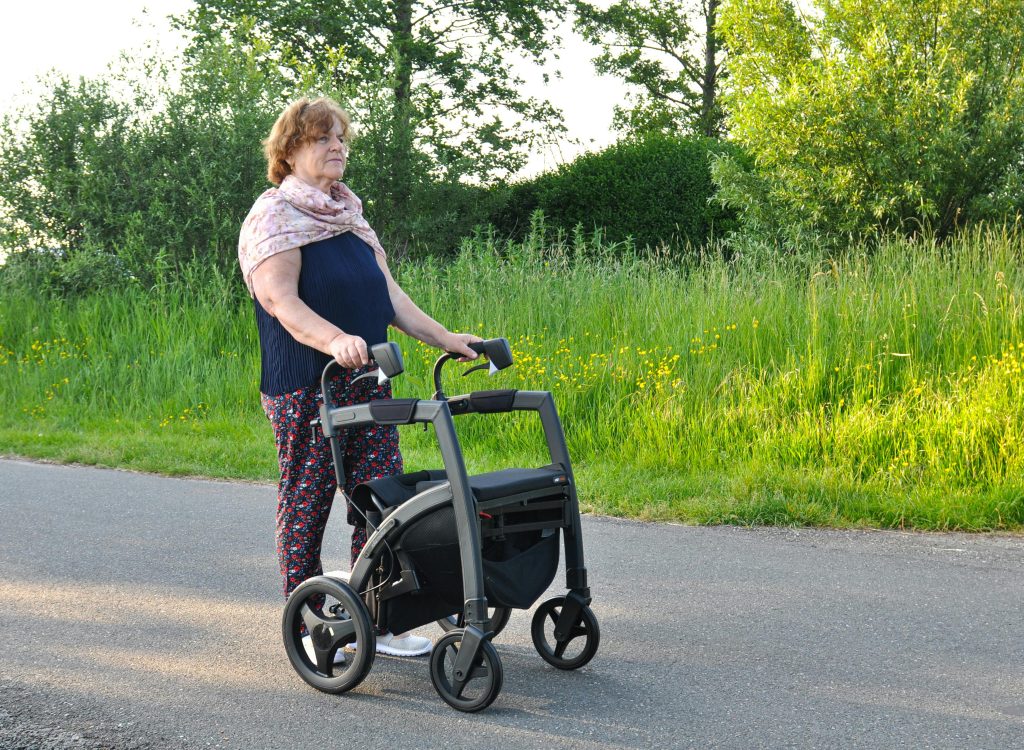
In the world of geriatric rehabilitation, an assistive device is not a sign of surrender; it is a performance enhancer. At geriatricrehab.es, we view Mobility Aids for Seniors as the “fuel” that allows you to expand your world. Just as a hiker uses trekking poles to conquer a mountain or a golfer uses a glove to sharpen their swing, a cane or walker is a high-tech tool designed to widen your “Safety Buffer.” This buffer is the invisible space of confidence that allows you to walk through a grocery store, visit a museum, or stroll through your garden without the paralyzing fear of a fall. Based on the principles in Geriatric Physical Therapy (2020), the right device doesn’t “make you old,” it makes you capable. By matching the mechanical support of the device to your unique physiological needs, we add years to your life and, more importantly, life to your years.
1. The Performance Enhancer, Not the Limitation
When we discuss Mobility Aids for Seniors, we are talking about the science of base expansion. Every human has a “Base of Support” (BOS), the area beneath them that keeps them upright. As we age, our “Slippery Slope of Frailty” can lead to a shrinking BOS, where even a small stumble can feel catastrophic. A cane or a walker effectively expands that base, providing a “third or fourth leg” that gives the brain a larger target for stability.
This is “Instrumental Vigor.” It is the intentional use of a tool to maintain a high level of activity. For many, the transition to a device is the difference between staying trapped in a single room and having the freedom to navigate a busy neighborhood. When the device is fitted correctly, it doesn’t just hold you up; it acts as a sensory probe, sending high-fidelity data back to your brain about the terrain ahead. This increased sensory input is the key to rebuilding confidence.
2. The ‘Feelings’ Section: The Psychology of the Cane
Perhaps the greatest hurdle in geriatric rehab isn’t muscle weakness, but the “Psychology of the Cane.” Many seniors resist using Mobility Aids for Seniors because they feel it signals the end of their youth. They worry about “looking old” or becoming “dependent.”
For Seniors: Reframing the Tool
- The Performance Comparison: Think of the world’s most elite explorers. They use equipment to go further and stay safer. A walker is your “expedition gear” for the urban environment.
- The Freedom Anchor: A device doesn’t take away your independence; it protects it. If a cane allows you to go to your grandchild’s soccer game instead of staying on the couch, the cane has provided more freedom, not less.
- Confidence as Vigor: The moment you stop worrying about your feet is the moment you start enjoying your life again. The right device silences the “fear-talk” in your head, allowing your Vigor to shine through.
- Style and Substance: Modern devices come in sleek designs and vibrant colors. Choosing a device that reflects your personality can help turn it from a “medical necessity” into a “personal accessory.”
3. Matching Mobility Aids for Seniors to Functional Needs
For health professionals, choosing a device is a clinical titration. We must balance the need for stability against the need for maneuverability and the patient’s cognitive load.
For Professionals: The Hierarchy of Support
- The Single-Point Cane (SPC): Used for patients who need minor balance assistance (widening the BOS by only a few inches) or to offload a painful joint. It requires the least amount of “gait interference” but provides the lowest stability.
- The Quad Cane (Small or Large Base): This provides significantly more stability than an SPC. However, it can be “clunky” and requires a slower gait cycle to ensure all four points hit the ground simultaneously. It is ideal for hemiplegic patients (post-stroke) who need a sturdy anchor.
- The Hemi-Walker: The “bridge” between a cane and a walker. It offers massive lateral stability for those with significant one-sided weakness, but it is heavy and difficult to use in tight spaces.
- The 2-Wheeled (Front-Wheeled) Walker: The clinical gold standard for most seniors. It allows for a natural gait speed while providing a constant forward anchor.
Citing Geriatric Physical Therapy (2020), we must also consider the “Energy Cost of Walking.” A device that is too heavy for a frail senior can actually accelerate fatigue, leading to a higher fall risk. Our goal is to find the “Minimum Effective Dose” of support enough to keep the Safety Buffer wide, but light enough to keep the Vigor high.
Take-Home Tips for Caregivers:
- The “Trial Run”: If your loved one is resistant, suggest using the device “just for long walks” or “in crowded places.” Once they feel the relief of the widened Safety Buffer, they are often more willing to use it consistently.
- Focus on the “Wins”: Instead of saying “You need this so you don’t fall,” try “Look how much faster and more confidently you can walk to the mailbox with this!”
- The Sound Check: If a cane or walker is making a loud “clunk” or “rattle,” it often means the rubber tips are worn out, or the height is misaligned. A quiet device feels like a high-quality tool; a noisy one feels like a “broken” one.
4. The SAID Principle: Training the “New” Gait
Handing a senior a walker without training is like handing someone a musical instrument without a lesson; they might make some noise, but they won’t make music. The Specific Adaptation to Imposed Demands (SAID) principle tells us that the body will adapt specifically to how the device is used.
For Professionals: Preventing “Learned Helplessness”
- The Postural Trap: Many seniors lean too heavily on their Mobility Aids for Seniors, leading to a “kyphotic” (hunched) posture. This shifts the center of mass too far forward, actually shrinking the Safety Buffer.
- The Demand: We must impose the demand of “Upright Vigor.” Training should focus on keeping the pelvis inside the frame of the walker.
- Proprioceptive Integration: We use the device to feed the brain information. By practicing “weaving” through cones or transitioning between floor surfaces, the senior learns to treat the walker as a sensory extension of their own arms.
5. The Buyer’s Guide: Rollators vs. Walkers
To provide immense clinical value and address the hardware of Active Living, we must break down the “Big Three” of the walker world. Choosing the correct device is a clinical intervention that ensures your Physiological Reserve is supported rather than sabotaged.
- The 2-Wheeled (Front-Wheeled) Walker (FWW):
- Pros: Provides a steady, predictable “braking” action because the back legs (usually with glides or tennis balls) create friction. It encourages a natural step-through gait.
- Cons: Requires a bit more upper-body strength to lift and turn in tight corners.
- Best For: Seniors with Parkinson’s, those with significant balance “sway,” or those who need a reliable “anchor” to lean on.
- The 4-Wheeled Walker (Rollator):
- Pros: Extremely maneuverable. It usually comes with a seat and a basket, making it the “SUV” of Mobility Aids for Seniors. Great for those with low endurance who need to sit frequently.
- Cons: The “Runaway Rollator” effect. Because all four wheels spin, the device can roll away from a person during a stumble.
- Best For: Seniors with good reactive balance who primarily struggle with stamina (lung or heart issues) rather than falling.
- The Hemi-Walker / Side-Stepper:
- Pros: Provides a massive base of support for one side of the body.
- Cons: Very slow to use and encourages an asymmetrical walking pattern.
- Best For: Post-stroke recovery where one arm and leg are significantly weaker than the other.
6. The Perfect Fit: Ergonomics and Measurement
An ill-fitted device is a hazard. If it’s too high, it causes shoulder impingement; if it’s too low, it causes back pain and a forward-leaning fall risk.
For Professionals and Caregivers: The Clinical Fitting Protocol
- The Shoe Factor: Always measure the senior while they are wearing their “usual” walking shoes. A one-inch heel height change can ruin a perfect fit.
- The “Wrist Crease” Rule: Have the senior stand tall (with assistance if needed) with their arms hanging naturally at their sides. The handle of the cane or walker should line up exactly with the crease of the wrist.
- The Elbow Angle: When the senior’s hands are on the grips, there should be a 20° to 30° bend in the elbow. This allows the muscles to act as “shock absorbers” and provides the mechanical advantage needed to push up during a “save.”
- The Width Check: For walkers, ensure the senior can stand inside the frame. If they are walking behind it like they are pushing a shopping cart, the device is likely too far forward, and their Safety Buffer is compromised.
Take-Home Tips for Caregivers:
- The “Brake” Check: If you choose a rollator, the first thing to teach is the “Parking Brake.” Ensure your loved one can confidently lock the wheels before they attempt to sit on the built-in seat.
- The “Glide” Audit: For 2-wheeled walkers, check the back “skis” or tennis balls. If they are worn down to the plastic, the walker will “catch” on carpets, which can cause a forward trip. Replace these every 3–6 months.
- Shoulder Cues: If you see your loved one’s shoulders “shrugging” up toward their ears while using their device, it’s a sign the handles are too high. Lower them one notch to restore their Postural Vigor.
7. The Functional Audit: Mapping the Device to Daily Victories
To truly widen the “Safety Buffer,” Mobility Aids for Seniors must be integrated into the specific challenges of the home. We use a Functional Audit to ensure the tool is solving problems, not creating new ones.
- Task: Stepping over a doorway threshold or rug edge.
- The Vigor Fix: For a walker, teach the “Lift-Set-Step” sequence. The front wheels go over first, then the back. For a cane, the cane always moves with the weaker leg to provide a constant anchor.
- Task: Navigating from a hardwood floor to a thick carpet.
- The Vigor Fix: This is a “High-Friction” transition. We train the seniors to shorten their stride slightly. The device provides the sensory data that the senior feels the change in resistance through the handles, allowing the brain to adjust the “Step Trigger” speed.
- Task: Entering and exiting a bathroom.
- The Vigor Fix: Bathrooms are often too narrow for walkers. We audit the “Transfer Point.” This is the moment the senior leaves the walker to transition to a grab bar. We ensure the walker is angled to provide a steady “hand-off” rather than being pushed away.
8. The Caregiver Corner: The “Safety Spotter’s Guide” to Device Transitions
As a caregiver, your role is to be the “External Scaffolding” until the senior trusts their new tool. Helping someone use Mobility Aids for Seniors requires a specific set of biomechanics to protect both of you.
The “Safety Spotter” Protocol:
- The “No-Pull” Rule: Never pull on the senior’s arms to help them stand. This destabilizes their core and makes it harder for them to find the walker’s center. Instead, have them push up from the chair armrests first, then reach for the walker once they are steady.
- The “Stability Shield” Position: When they are learning a new device, stand slightly behind and to their side. Keep your feet wide and your knees bent. Do not hold the walker for them; they need to feel the “wobble” to learn how to correct it.
- Car Loading Mechanics: When putting a walker in a car, do not bend at the waist. Squat down, hug the folded walker close to your chest (keeping your spine “tall”), and use your legs to lift. This protects your back so you can remain a strong partner in their rehab.
9. Environmental Audit: Making the Home “Device Friendly”
The most advanced walker in the world is useless if it cannot fit through the bathroom door or if it constantly snags on clutter. A “Vigor-friendly” home is an environment that removes the “friction” from every movement. To ensure the highest level of safety and independence, here is a descriptive audit of the essential modifications for a home:
- Entryways and Doorways: Ensure that all primary entry points have at least a 32-inch clear width to allow walkers to pass through without catching the wheels on the frame. Create a “landing strip” near the door, a clear, 5×5-foot space where the walker can be parked or turned without obstructing the path for others.
- Hallways and Pathways: Remove hallway tables, large plants, or decorative baskets that narrow the walking path. The goal is to allow the senior to walk with a natural stride using their mobility aid, rather than forcing them into a dangerous “side-shuffle” to get past furniture.
- The Living Room: Remove all throw rugs immediately. These are the primary enemies of rolling walkers and canes; the edges easily catch under wheels or tips, leading to a forward trip. Additionally, ensure all electrical cords are tucked behind furniture or secured along baseboards to prevent them from tangling in the device.
- The Kitchen: Maintain a clear “turning radius” so a senior can perform a 360-degree turn with their walker without hitting the table or refrigerator. Rearrange cabinets so that frequently used items are at waist height (the “Power Zone”), preventing the need to lean precariously away from their support to reach high or low shelves.
- The Bedroom: Ensure the path from the bed to the bathroom is a straight, unobstructed line. Install motion-sensor nightlights that illuminate the floor, allowing the senior to see exactly where they are placing their cane or walker during nighttime trips, which is when the “Safety Buffer” is naturally at its lowest.
Take-Home Tips for Caregivers:
- The “Path Clearance” Drill: Once a week, walk through the house with your loved one as they use their device. Look for “tight squeezes” where the walker wheels might catch on furniture legs.
- Tactile Feedback: If they seem to be “forgetting” to use their cane, gently touch the arm they should be using. This “tactile cue” is more effective and less frustrating than verbal reminders.
- The “Independence Audit”: Ask your loved one, “Is there anywhere in the house where you feel the walker gets in the way?” This empowers them to participate in their own environmental safety.
10. Conclusion: Reclaiming the Garden
Choosing the right assistive device is not a sign of surrender; it is the start of a more confident and active chapter. As we have explored, Mobility Aids for Seniors are the mechanical keys that unlock a wider “Safety Buffer.” They allow your brain to stop worrying about the threat of a fall and start focusing on the joy of your destination. Whether it is the precision of a single-point cane or the steady support of a front-wheeled walker, these tools are designed to work in harmony with your body’s natural Vigor.
At geriatricrehab.es, every senior deserves a tool that fits their life and their goals. By following the “Wrist Crease Rule,” maintaining your equipment, and ensuring your home is a “clear-path zone,” you are taking direct control of your independence. Remember, the goal of rehabilitation isn’t just about “not falling”; it is about having the Vigor to walk into your garden, visit your neighbors, and engage with the world on your own terms. Your device is your partner in this mission.













