
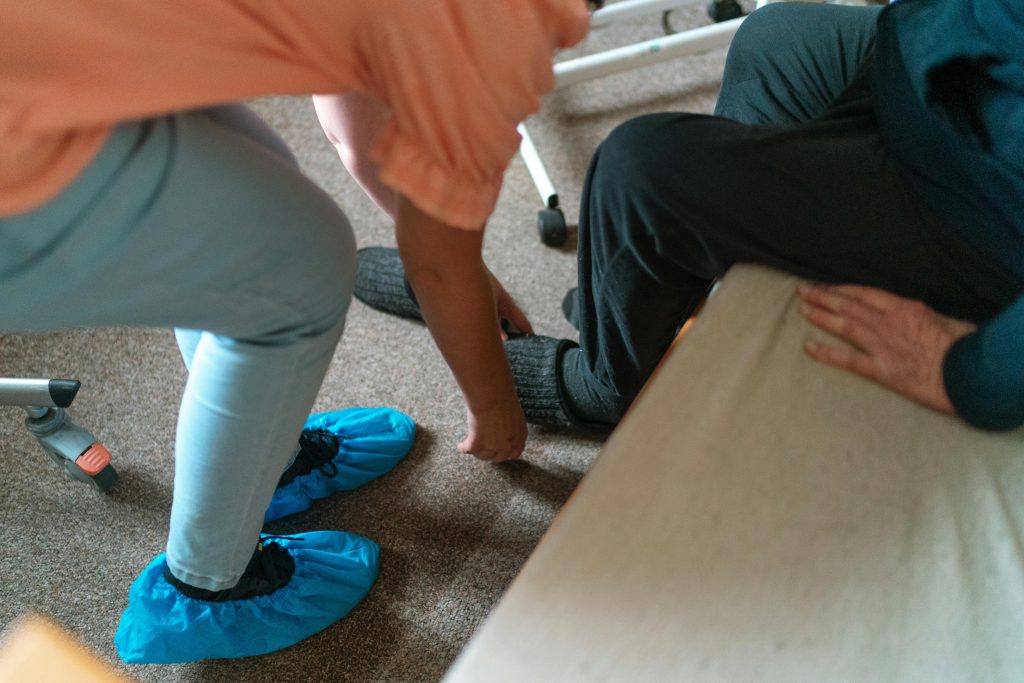
In the world of geriatric care, we often talk about “fall prevention” as if it is a defensive battle—a series of “don’ts” that restrict an older adult’s life. However, true health isn’t the absence of movement; it’s the presence of capability. For those living with bone density loss, the primary goal of physical therapy is to shift the focus from fragility to strength. By building a “Safety Buffer” through environmental mastery and mechanical loading, we proactively manage Osteoporosis Fall Risk. This guide is designed to move beyond fear, providing both clinical depth for professionals and actionable confidence for seniors and caregivers to ensure that life remains active, wide, and empowered.
1. Beyond the Fear—Building Your “Safety Buffer”
For many older adults, a diagnosis of osteoporosis feels like a shrinking of their world. The fear that a single trip could lead to a life-altering fracture often results in “activity curtailment”—where one stops going to the grocery store or walking in the park to stay “safe.” However, in Geriatric Physical Therapy (2020), we emphasize that true safety comes from a Safety Buffer. This is the gap between your physical ability and the demands of your environment.
When we manage Osteoporosis Fall Risk, our goal isn’t just to keep you in a chair; it’s to widen that buffer so you have the strength to recover from a stumble and the bone density to withstand an impact. Rehab is about more than “not falling”; it’s about the freedom to live without the constant shadow of “what if.” Whether it is having the confidence to walk in your garden or the stability to navigate a busy supermarket, our goal is to help you reclaim your space in the world.
2. The Physiology of Resilience: Bone Density as Structural Insurance
Think of your bones as the “structural insurance” of your body. In the clinical world, we discuss “Physiological Reserve”—the extra capacity our organs and systems have to handle stress. Osteoporosis is a depletion of that reserve in the skeletal system. As we age, the balance between bone-building (osteoblasts) and bone-clearing (osteoclasts) tilts toward loss.
For someone with a high Osteoporosis Fall Risk, the internal architecture of the bone (the trabeculae) becomes disconnected. However, this is not a one-way street. Through the principle of “Exercise as Medicine,” we know that bone is living tissue that responds to mechanical loading. By strategically placing stress on the bone through guided exercise, we can maintain or even improve that structural insurance, ensuring that if a fall does occur, the skeleton is prepared to handle the force.
3. Beyond Prevention: Protecting the Body from Osteoporosis Fall Risk
Not every fall results in a fracture. The outcome of a fall is a mathematical equation: the force of the impact versus the strength of the bone. For those with Osteoporosis Fall Risk, the “force” side of the equation becomes critical.
Clinically, we see three primary fracture sites. First is the Distal Radius (Wrist), usually caused by a “FOOSH” (Fall On Outstretched Hand). While common, this is often a sign that the body’s “stepping strategy” failed, and the arms had to intervene. Second is the Vertebral Compression, which can happen from vertical jarring or even minor trips due to compromised vertical strength. Finally, the Hip Fracture is often the result of a sideways fall directly onto the greater trochanter.
Caregiver Corner: Immediate Take-Home Tips
- The “Hand-Check”: Encourage your loved one to keep their hands free when walking (no carrying heavy bags). If they trip, they need their arms for balance or to safely guide their descent.
- Hip Protectors: For those with very low bone density, specialized “hip protector” garments can act as a shock absorber, significantly reducing the force transmitted to the bone during a sideways fall.
4. Managing Osteoporosis Fall Risk: The Professional Perspective on SOT
For the healthcare professional, managing Osteoporosis Fall Risk requires a sophisticated understanding of how the brain processes “sway.” We cannot treat balance as a single entity; it is the result of the brain’s ability to prioritize sensory information. This is where Sensory Organization Testing (SOT) becomes the gold standard for clinical assessment.
The SOT evaluates how a patient utilizes three primary systems: Somatosensory (input from feet and joints), Visual (spatial orientation), and Vestibular (the inner ear’s “gyroscope”).
In a clinical setting, we often identify “Visual Dependency.” If a patient with brittle bones relies too heavily on sight, they are at extreme risk in low-light conditions or busy environments. By isolating these systems through the six conditions of SOT, we can create specific “Sensory Weighting” exercises. For a patient with a high fracture risk, retraining the brain to trust the vestibular system when the floor is uneven can be the difference between a controlled recovery and a devastating sideways fall.
5. The Three Pillars of Recovery: Ankle, Hip, and Stepping Strategies
Balance is not a static state; it is a series of rapid-fire “recovery strategies” that the body uses to keep the center of mass over the base of support. In the Geriatric Physical Therapy (2020) framework, we categorize these strategies based on the magnitude of the displacement (how hard you were pushed or how far you tripped).
- The Ankle Strategy (Small Displacement): When you experience a tiny sway, your body uses the muscles around the ankle to pull you back to center. If a senior has “stiff ankles” or poor calf strength, this first line of defense is lost.
- The Hip Strategy (Moderate Displacement): If the sway is larger, the body shifts the pelvis rapidly. This is a higher-velocity movement. For those with Osteoporosis Fall Risk, a weak hip strategy often leads to the “wobble” that precedes a fall.
- The Stepping Strategy (Large Displacement): If the displacement moves your center of gravity outside your “base of support,” you must take a step to catch yourself.
Note for Seniors: Think of these as your “Internal Safety Buffer.” In rehab, we don’t just practice standing still; we practice “stepping” in a safe environment. This ensures that if you trip over a curb at the supermarket, your brain knows exactly how to reach out and find the ground before your hip does.
6. Exercise as Medicine: Wolff’s Law and Loading the Skeleton
The most empowering aspect of bone health is that bone is a dynamic, living tissue. It follows Wolff’s Law, which states that bone grows and remodels in response to the mechanical loads placed upon it. To combat Osteoporosis Fall Risk, our exercise prescription must move beyond simple stretching.
We utilize a “Loading Hierarchy”:
- Weight-Bearing Aerobics: Walking is a foundational start, but it often isn’t enough to build new bone.
- Resistance Training: Lifting weights or using resistance bands creates a “tug” on the bone via the tendons, which signals osteoblasts to lay down new mineral density.
- Impact Loading: Controlled, low-level impact (like heel drops or marching) provides the specific stimulus needed to strengthen the femoral neck—the most common site of hip fractures.
Take-Home Tips for Caregivers:
- Consistency is Key: Bone remodeling is a slow process. Encourage a “little and often” approach to weight-bearing activity.
- Postural Awareness: Encourage “tall” sitting and standing. Maintaining the natural curve of the spine reduces the “anterior loading” that causes vertebral compression fractures.
7. The Environmental Audit: Reducing Osteoporosis Fall Risk at Home
When a senior has an increased Osteoporosis Fall Risk, their home environment must act as a partner in their safety, not an adversary. An “Environmental Audit” is more than just a quick glance; it is a clinical assessment of the home’s layout. Caregivers can use this checklist to perform a walk-through today:
- The Entryway & Hallways:
- Lighting: Are there “dark zones” between the bedroom and bathroom? Install motion-activated LED strips.
- Thresholds: Check for raised transitions between rooms. Use high-visibility tape to mark slight changes in floor height.
- The Living Room:
- The “Throw Rug” Rule: If a rug isn’t tacked down or removed, it is a trip hazard.
- Furniture Stability: Ensure chairs have firm armrests. Seniors should not have to “launch” themselves from a soft sofa; the seat height should allow the knees to be level with the hips.
- The Bathroom (The Highest Risk Zone):
- Vertical Grab Bars: Install these near the entry of the shower. Do not rely on towel racks, which are not weight-rated for human support.
- Non-Slip Treatment: Apply a non-slip coating to the tub floor, even if using a rubber mat.
- The Kitchen:
- The “Chest-Height” Rule: Rearrange cabinets so the most-used items (coffee, plates, meds) are between waist and chest height to avoid the need for step stools or deep bending.
8. The Psychology of the Cane: Overcoming the “Look Old” Stigma
One of the greatest hurdles in managing Osteoporosis Fall Risk isn’t physical—it’s psychological. Many seniors view a cane or walker as a “white flag” of surrender to old age. This stigma often leads to “furniture walking” (clinging to walls and tables), which is far more dangerous than using a dedicated mobility aid.
To help a loved one accept a device, we must reframe its purpose:
- It is a Stability Enhancer: A cane isn’t a sign of weakness; it is a tool that widens your “Safety Buffer.” It allows you to focus on the conversation or the scenery rather than staring at your feet.
- Independence, Not Dependence: A device is what makes the trip to the museum or the walk to the mailbox possible. Without it, the world shrinks; with it, the world stays open.
- The “Luxury” Reframe: Encourage the selection of a device that reflects personal style—whether it’s a sleek carbon-fiber cane or a rollator in a favorite color. When a device looks like a piece of high-end equipment rather than a “medical supply,” the stigma fades.
9. The Ultimate Buyer’s Guide: Canes, Hemi-Walkers, and Rollators
Selecting the right device is a clinical decision that should ideally involve a physical therapist. However, understanding the pros and cons of each helps in making an informed choice for long-term Osteoporosis Fall Risk management.
| Device Type | Pros | Cons | Best For |
| Standard Cane | Lightweight, portable, inexpensive. | Provides minimal weight-bearing support. | Mild balance issues or slight “unsteadiness.” |
| Hemi-Walker | Extremely stable; provides a wide base of support. | Bulky; requires the use of one strong arm. | Significant one-sided weakness (e.g., post-stroke). |
| 2-Wheeled Walker | Promotes a natural gait; stable enough to lean on. | Can be difficult to maneuver on thick carpets. | Those who need to “weight-bear” through their arms. |
| 4-Wheeled Rollator | Includes a seat for rest; very maneuverable. | Can “run away” if brakes aren’t used correctly. | Seniors with low endurance who need frequent breaks. |
Technical Tip: When fitting a device, the handle should be at the level of the user’s wrist crease when their arm is hanging naturally at their side. This ensures a 15–30 degree bend in the elbow, which is the “power position” for stability.
10. Conclusion: Your Roadmap to Optimal Aging
In the field of geriatric rehabilitation, we often say that “movement is medicine.” When dealing with an increased Osteoporosis Fall Risk, this medicine must be dosed correctly—balancing the need for physical challenge with the necessity of safety. By understanding the principles of the Safety Buffer, we transition from a mindset of limitation to one of empowerment.
True resilience in the face of osteoporosis is a dual-track journey:
- The Internal Track: Strengthening the skeletal scaffold through progressive loading, optimizing the sensory systems via SOT-informed training, and mastering the three pillars of balance recovery.
- The External Track: Fracture-proofing the environment through rigorous audits and embracing the technical advantages of high-quality assistive devices.
A diagnosis of brittle bones is not a sentence to a sedentary life; rather, it is a signal to become more strategic about how you move. By implementing the “Caregiver Corner” tips and the “Professional Perspective” frameworks discussed today, you can ensure that a trip doesn’t become a fracture, and a fracture doesn’t become the end of your independence.
Don’t wait for a fall to take action. If you or a loved one is concerned about bone health or balance, visit geriatricrehab.es to find a specialized physical therapist. Our team is dedicated to helping you build the strength, confidence, and resilience needed for a vibrant, mobile future. Your best years are built on a strong foundation—let’s start building it today.













