
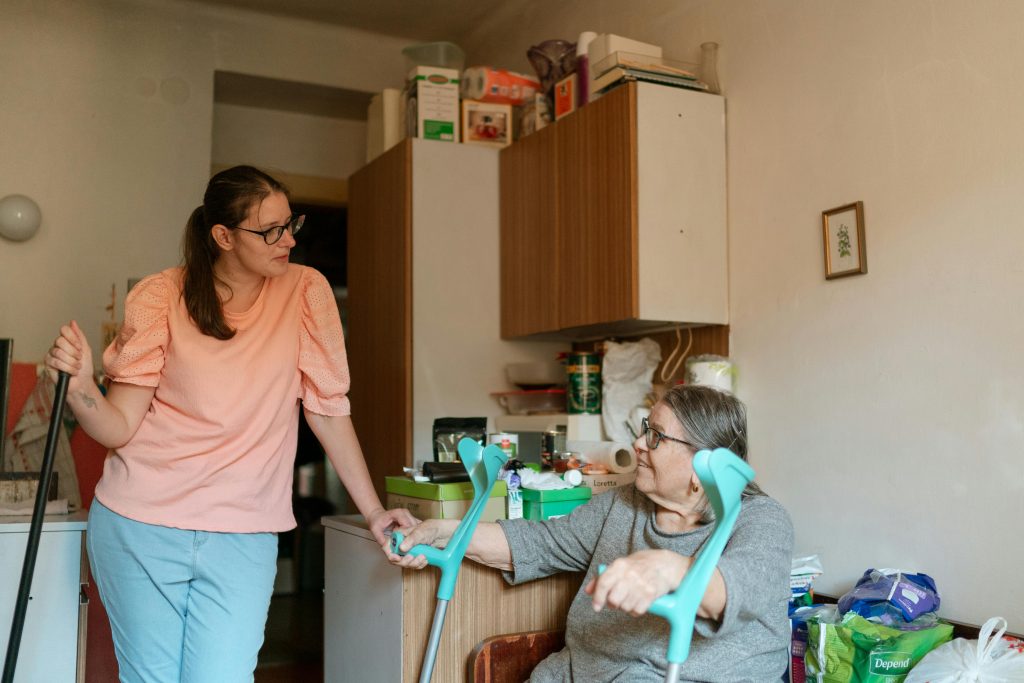
Providing Caregiver Fall Support is a delicate balance of physics and empathy. In geriatric rehabilitation, we view the caregiver not just as a pair of extra hands, but as a critical “spotter” who maintains a senior’s “Safety Buffer.” The goal of this guide is to move beyond the fear of a fall and focus on the mechanics of safe mobility. By understanding how to assist without hovering, you help your loved one maintain the confidence to walk in their garden or navigate the home, ensuring that their independence remains the priority while their safety is secured.
1. The Empowered “Spotter” and the Safety Buffer
In geriatric rehabilitation, we often focus so much on the physical mechanics of the senior that we overlook the critical role of the person standing next to them. To provide effective Caregiver Fall Support, one must transition from being a “protector” to being a “facilitator.” Many seniors experience a shrinking world because they fear that a single trip will end their independence. This fear creates a cycle of inactivity that actually increases risk.
The solution is the Safety Buffer. This is the margin of error between a senior’s current physical ability and the demands of their environment. As a caregiver, your role is to widen that buffer. Rehab isn’t just about the absence of falls; it’s about the presence of life. It’s about having the confidence to walk in the garden to pick a tomato or navigate the supermarket aisles without anxiety. When you act as a “spotter,” you aren’t just preventing a fall; you are providing the psychological floor that allows your loved one to reach for a higher level of function.
2. Why it Matters: Postural Sway and the “Slippery Slope”
To assist effectively, we must understand the physics of the human body. Every individual has a “Center of Mass” (COM), which is typically located near the pelvis, and a “Base of Support” (BOS), which is the area between the feet. Stability is maintained as long as the COM stays over the BOS. In older adults, the BOS often narrows due to fear, while the COM becomes more unstable due to decreased core strength and slower neurological processing.
As outlined in Geriatric Physical Therapy (2020), aging can lead to a “Slippery Slope” where physiological reserves—the extra strength and energy we have in our muscles and nerves—begin to dwindle. When a senior loses these reserves, they have less “room to wobble.” Providing Caregiver Fall Support means recognizing when the COM is drifting too close to the edge of the BOS. By understanding that balance is a dynamic, constant struggle against gravity, caregivers can move from reactive grabbing to proactive “shadowing,” allowing the senior to use their own muscles while the caregiver remains within an inch of intervention.
3. Communication and Body Mechanics: The Foundation of Caregiver Fall Support
The most dangerous moments for falls often occur during “transfers”—moving from a bed to a chair or a chair to a walker. These moments fail most often due to a communication breakdown. A sudden pull from a caregiver can actually startle a senior, causing their nervous system to “freeze” and increasing the likelihood of a collapse.
Practical ‘Take-Home’ Tips for Caregivers:
- The Synchronized Start: Always use a “1-2-3” count. This ensures the senior’s effort and your assistance peak at the same second.
- One-Step Commands: The aging brain often processes information more slowly. Instead of saying, “Stand up and grab your walker,” give one command: “Lean forward.” Once they lean, say: “Push through your heels.”
- Protect Your Foundation: To support them, you must be stable. Stand with a wide, staggered stance (one foot forward, one back) and keep your knees slightly bent. This lowers your own center of gravity and allows you to use your legs, rather than your back, to provide stability.
4. Clinical Insights: Enhancing Caregiver Fall Support through SOT
For the healthcare professional, providing effective Caregiver Fall Support requires a deep understanding of why the balance system is failing. The brain maintains upright posture by integrating three sensory inputs: Somatosensory (the feel of the floor), Visual, and Vestibular (the inner ear).
Clinicians utilize Sensory Organization Testing (SOT) to determine which of these systems is compromised. The test involves six conditions that systematically remove or “sway-reference” these inputs. For example, if a senior’s balance fails specifically when their eyes are closed or in low light, they are “Visually Dependent.”
As a caregiver, you can apply this knowledge by observing “Visual Sensitivity.” If your loved one struggles significantly more at dusk or in a cluttered hallway, their brain is struggling to process visual cues. Understanding this allows you to provide “sensory-specific” support—such as increasing lighting or providing a light touch for somatosensory grounding—rather than just assuming they are “getting weaker.”
5. Dynamic Balance Strategies: Ankle, Hip, and Stepping Mechanics
In the Geriatric Physical Therapy (2020) framework, balance is not a static “on or off” switch. It is a hierarchy of recovery strategies that change based on the magnitude of displacement (how far the body is pushed off center).
- The Ankle Strategy (Small Displacement): When the sway is minor, the body uses the muscles around the ankle to pull the center of mass back. If a senior has stiff ankles or weak calves, this “first line of defense” disappears.
- The Hip Strategy (Moderate Displacement): When the sway is too large for the ankles, the body rapidly shifts the hips. This is a higher-velocity movement that requires significant core and hip strength.
- The Stepping Strategy (Large Displacement): If the push is so large that the center of mass leaves the base of support, the only way to avoid a fall is to take a step.
Caregivers should watch for these transitions. If you see your loved one constantly skipping the “ankle” and “hip” strategies and immediately going to a “staggering step,” their internal balance tuning is off. Your goal as a spotter is to provide a “hand-guard” near the pelvis to assist the hip strategy, helping them regain control before they are forced into a frantic, unsafe step.
6. The Environmental Audit: Proactive Caregiver Fall Support at Home
To truly empower a senior, the home must be a training ground, not a minefield. An “Environmental Audit” is a proactive search for “invisible” hazards. This printable-style checklist is designed for immediate action to lower Caregiver Fall Support demands by making the home inherently safer.
The Room-by-Room Checklist:
- The Entryway & Hallways:
- [ ] Lighting: Install motion-activated LED strips. “Dark zones” are the #1 cause of nighttime trips.
- [ ] Flooring: Secure all rugs with double-sided tape or remove them entirely.
- The Living Room:
- [ ] The “Clear Path”: Ensure there is a 36-inch wide path through all furniture.
- [ ] The Seat Check: Ensure chairs have firm armrests. Avoid “deep” sofas that are impossible to exit without excessive momentum.
- The Bathroom:
- [ ] Vertical Grab Bars: Install a bar near the entry of the tub and a horizontal bar near the toilet. Do not use towel racks; they are not weight-rated.
- [ ] Non-Slip Surfaces: Apply a non-slip treatment to the tub floor.
- The Kitchen:
- [ ] The “Daily Use” Rule: Move all frequently used items (plates, coffee, medications) to counter-top or chest-height shelves. Reaching or stooping is a high-risk movement.
7. The Psychology of the Cane: Overcoming the Stigma of Aging
One of the most difficult aspects of providing Caregiver Fall Support is the senior’s resistance to using a device. Many older adults view a cane or walker as a “white flag” of surrender—a public admission of frailty. This stigma often leads to “furniture walking” (clinging to walls and tables), which is significantly more dangerous than using a dedicated aid.
To help a loved one bridge this gap, we must reframe the technology. A cane is not a sign of weakness; it is a tool for a wider Safety Buffer. It is the difference between staying home and having the confidence to walk through a museum or navigate a busy restaurant. As a caregiver, avoid saying, “You need this so you don’t fall.” Instead, try: “This device is your passport to the park.” When we focus on what the device allows them to do, rather than what it says about their age, the psychological barrier begins to crumble.
8. The Ultimate Buyer’s Guide: Canes, Hemi-Walkers, and Rollators
Choosing the right device is a clinical decision that affects the level of Caregiver Fall Support required. If a device is too heavy, the senior won’t use it; if it’s too light, it won’t provide the necessary stability.
- Standard Single-Point Cane: Best for those who need a “sensory touch” and mild balance assistance. It provides a third point of contact but cannot support significant body weight.
- Hemi-Walker: A “four-legged” cane that provides a wide base of support. It is ideal for those with one-sided weakness (common post-stroke) who still want to walk but need more than a standard cane.
- 2-Wheeled Walker: The gold standard for those with a high fall risk. The fixed rear legs provide a “braking” action, while the front wheels allow for a natural gait without lifting the device.
- 4-Wheeled Rollator: Best for endurance. It includes a seat for rest, making it perfect for the supermarket. However, it can “run away” on slopes, so the user must have the hand strength and cognitive awareness to use the brakes effectively.
Technical Tip for Caregivers: When fitting a device, the handle should be at the level of the user’s wrist crease when their arm is hanging naturally at their side. This ensures a 15–30 degree bend in the elbow, which is the “power position” for stability and weight-bearing.
9. Gait Training Synergy: Positioning and Guarding Techniques
Even with a walker, your physical presence as a “spotter” is often necessary. The way you stand and hold your loved one can either help them or hinder their natural balance strategies.
The Rules of Guarding:
- Stand on the “Weak” Side: Typically, you should stand slightly behind and to the side of their weaker leg. If they begin to tilt, you are already in a position to provide support.
- The Gait Belt Advantage: For those with a high Caregiver Fall Support need, a gait belt is mandatory. It provides a secure handle for you to grab near their center of mass, rather than pulling on their arm or clothing, which can cause shoulder injuries or skin tears.
- The “Shadow” Technique: Keep one hand hovering near their lower back (sacrum) without actually touching them. This allows them to use their own balance muscles while you remain ready to intervene within a fraction of a second.
10. Beyond Physical Strength: Psychological Caregiver Fall Support
Providing Caregiver Fall Support is a journey that moves through various stages of physical and emotional adjustment. As we have explored, the transition from a “protector” who restricts movement to a “spotter” who facilitates it is the key to maintaining a high quality of life. By focusing on the Safety Buffer, you are not just managing a medical risk; you are preserving the dignity and joy of your loved one’s daily experiences.
True success in geriatric care is found in the balance between the internal and external worlds. Internally, we support the senior’s sensory systems and balance strategies (Ankle, Hip, and Stepping). Externally, we optimize the environment through rigorous audits and the selection of high-quality assistive devices. When these elements work in synergy, the “Slippery Slope of Aging” becomes a manageable path rather than an inevitable decline.
Remember that you are not alone in this process. While this guide provides the foundation for daily safety, the guidance of a professional physical therapist is invaluable for tailoring these strategies to your loved one’s specific needs. By working together—senior, caregiver, and professional—we ensure that the path to Optimal Aging is paved with confidence, strength, and the freedom to keep moving.
Empower your caregiving today by performing your first Environmental Audit. If you notice your loved one struggling with their balance strategies or resisting their mobility aids, consult a specialist at geriatricrehab.es. Let’s work together to widen the Safety Buffer and keep the world open for the seniors you love.













