
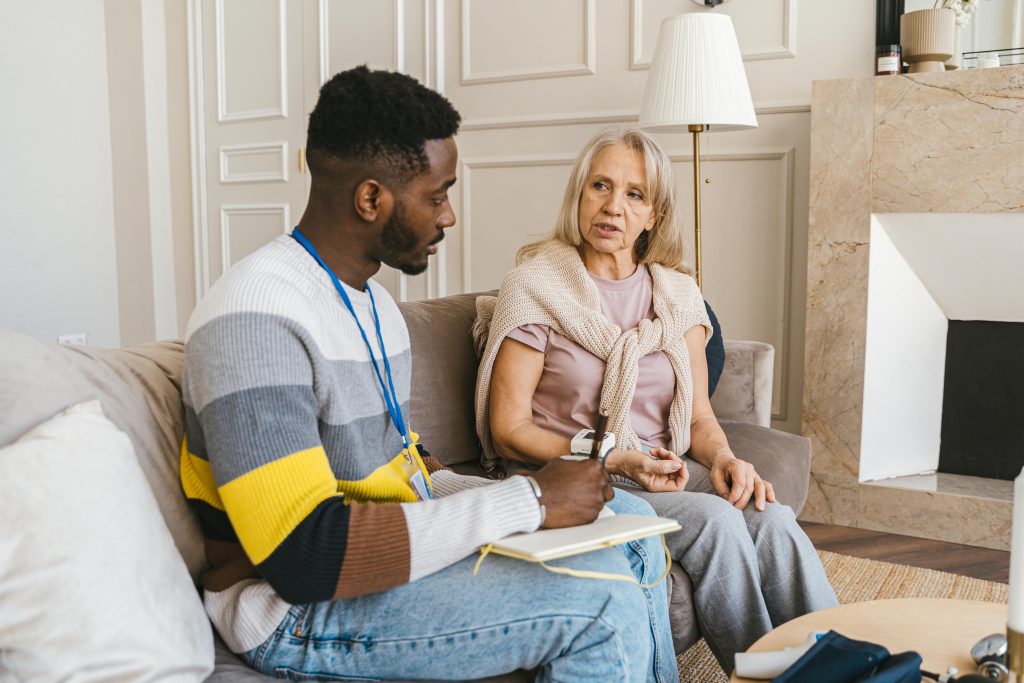
Finding yourself on the floor after a trip or slip is one of the most physically and psychologically challenging moments an older adult can face. However, the fear of “being stuck” often causes more long-term harm than the fall itself. In geriatric rehabilitation, we focus on the skill of floor transfers—specifically getting up from a fall—as a vital component of a senior’s “Safety Buffer.” By mastering specific techniques like the “Backward Roll” or the “Crawling Method,” we move from a state of panic to a state of prepared action. This guide empowers seniors to maintain their independence and gives caregivers the clinical tools to assist safely, ensuring that the floor is no longer a place of fear, but a surface you have the confidence to navigate.
1. The Psychology of the “Long Lie” and the Safety Buffer
For many seniors, the most frightening aspect of aging isn’t the fall itself, but the possibility of a “long lie”—the period of time spent on the floor unable to rise. This fear often leads to “activity curtailment,” where individuals stop doing the things they love, like walking in the garden or browsing the supermarket, simply because they don’t know if they can get back up. In Geriatric Physical Therapy (2020), we reframe this struggle by focusing on the Safety Buffer.
The Safety Buffer is the margin between your physical capacity and the demands of your environment. Rehabilitation isn’t just about preventing a trip; it’s about having the “reserves” to manage a fall if it happens. When you master the skill of getting up from a fall, you aren’t just learning a sequence of movements; you are reclaiming your psychological freedom. The goal is to ensure that the floor is no longer a place of fear, but a surface you have the confidence to navigate and exit independently.
2. Why it Matters: Physiological Reserve and the “Slippery Slope”
The ability to rise from the floor is one of the most physically demanding tasks a human can perform. It requires a significant amount of Physiological Reserve—the extra strength in our quadriceps, core, and shoulders that we don’t use during normal walking. As we move down the “Slippery Slope of Aging,” this reserve is often the first thing to dwindle.
From a medical perspective, a floor-to-stand transfer is a high-intensity cardiovascular and musculoskeletal event. If a senior lacks the “power”—the ability to exert force quickly—they may remain on the floor even if they aren’t seriously injured. This is why we treat floor transfers as a vital sign of “Optimal Aging.” By training these movements, we are essentially building “structural insurance.” We are ensuring that your body has the capability to handle a “large displacement” and return to a position of safety without a clinical crisis.
3. Step 1: The Initial Assessment—Stay Still and Breathe
The moment immediately following a fall is dominated by an adrenaline surge. The natural instinct is to scramble up as quickly as possible, but this is precisely when secondary injuries—like fainting from a rapid heart rate or worsening a fracture—occur. The most critical part of getting up from a fall is actually what you do in the first sixty seconds.
- The 60-Second Rule: Stay exactly where you are. Take three deep, diaphragmatic breaths. This calms the autonomic nervous system and prevents the dizziness that leads to a second fall.
- The Body Scan: Start from your toes and work up. Can you wiggle your ankles? Do you feel sharp pain in your hip or groin? Is there a “grating” sensation in your wrist? If you have severe pain or hit your head, stop. This is the time to stay still and call for help.
- The Environmental Check: Look around. Is there a sturdy chair or couch nearby? Is the floor slippery? If you feel stable and the path is clear, you can proceed to the “Backward Roll.”
Practical ‘Take-Home’ Tips for Caregivers:
- The “Comfort First” Protocol: If your loved one has fallen and cannot get up, do not try to pull them. Your priority is to place a pillow under their head and a blanket over them to prevent hypothermia while waiting for professional help.
- Low-Level Access: Ensure that medical alert buttons or phones are kept at a height that can be reached from the floor. A phone on a high kitchen counter is useless during a “long lie.”
4. Professional Perspective: Clinical Mastery of Getting Up from a Fall
For the healthcare professional, a senior’s inability to getting up from a fall is often not just a matter of muscle weakness, but of “sensory conflict.” When an older adult hits the floor, the rapid change in head position can overstimulate or disrupt the vestibular system. This is where Sensory Organization Testing (SOT) becomes a critical diagnostic tool.
SOT measures how a patient integrates visual, somatosensory (touch), and vestibular (inner ear) inputs to maintain balance. Following a fall, a senior may experience “vestibular mismatch,” where their brain can no longer tell which way is “up” while lying horizontally. Clinicians should use the SOT framework to identify if the patient is “Visually Dependent.” If they are, they will struggle significantly with floor transfers in low-light environments. By understanding the SOT results, we can retrain the brain to “re-weight” sensory input, allowing the senior to maintain spatial orientation even when they are at floor level.
5. Phase 1 of Recovery: The “Backward Roll” and the Four-Point Position
Once the initial assessment is complete and no “red flag” injuries are found, the first physical move is the “Backward Roll.” This technique is designed to minimize the core strength required by using the body’s natural momentum.
- The Roll: While lying on your back, reach one arm across your chest toward the floor on the opposite side. Turn your head in the same direction. This “rotation” naturally brings your hips over, landing you safely on your stomach.
- The Push-Up: From your stomach, place your hands under your shoulders. Instead of a full push-up, focus on pushing your chest off the floor while keeping your knees down.
- The Four-Point Stance: Slowly walk your hands backward until you are on all fours (hands and knees).
Empowering Note for Seniors: This hands-and-knees position is your “Base of Power.” Even if you cannot stand immediately, being on all fours allows you to crawl toward a phone or a sturdy piece of furniture, effectively ending the “long lie.”
6. Phase 2 of Recovery: Managing the Move: Getting Up from a Fall Using a Sturdy Chair
Once you have crawled to a sturdy piece of furniture—such as a heavy armchair or a bolted-down table—you are ready for the final ascent. This stage utilizes the “Half-Kneel” technique, which maximizes leg leverage while providing multiple points of contact for safety.
- The Furniture Grip: Place both hands firmly on the seat of the chair.
- The Strong Lead: Bring your strongest leg forward, placing your foot flat on the floor. You should now be in a “kneeling proposal” position.
- The Power Push: Lean your weight forward over that front foot. Push down through your hands and your front heel simultaneously.
- The Pivot: Once standing, do not walk away immediately. Turn slowly and sit in the chair you just used for support.
Caregiver Corner: The “No-Lift” Rule. If you are assisting, do not pull on the senior’s arms. This can cause shoulder dislocations or skin tears. Instead, act as a “steadying force” by placing your hands on their hips to help guide their center of mass upward. Let the furniture do the heavy lifting.
7. Balance Strategies: Ankle, Hip, and Stepping Mechanics
In the Geriatric Physical Therapy (2020) framework, balance is a dynamic hierarchy of recovery. To prevent the need for getting up from a fall, we must understand the three “Pillars of Recovery” that respond to the magnitude of displacement (how far you are pushed off center).
- The Ankle Strategy (Small Displacement): When you experience a minor sway, your body uses the muscles around the ankle to pull you back to center. If a senior has stiff ankles or poor calf strength, this first line of defense is lost.
- The Hip Strategy (Moderate Displacement): If the sway is larger, the body shifts the pelvis rapidly. This is a higher-velocity movement. For those with low bone density, a weak hip strategy often leads to the “wobble” that precedes a fall.
- The Stepping Strategy (Large Displacement): If the displacement moves your center of gravity outside your “base of support,” you must take a step to catch yourself.
Professional Perspective: For clinicians, “Day 17” training focuses on the transition between these strategies. We don’t just practice standing still; we practice “perturbation training”—deliberate, safe pushes that force the brain to choose the correct strategy. By widening this “Internal Safety Buffer,” we ensure that a trip at the supermarket results in a successful “step” rather than a floor transfer.
8. Home Safety: Reducing the Difficulty of Getting Up from a Fall
To empower a senior, the home must act as a partner in their safety. This “Day 9” checklist is designed for caregivers to perform a walk-through today, identifying floor-level hazards that make getting up from a fall more difficult.
The “Fracture-Proof” Audit:
- The Entryway & Hallways:
- [ ] Lighting: Install motion-activated LED strips. “Dark zones” create the disorientation that leads to trips.
- [ ] Transitions: Mark slight changes in floor height with high-visibility tape.
- The Living Room:
- [ ] The “Throw Rug” Rule: If a rug isn’t tacked down or removed, it is a trip hazard.
- [ ] Furniture Stability: Identify which chairs are “bolted” or heavy enough to be used as a “Half-Kneel” anchor.
- The Bathroom:
- [ ] Vertical Grab Bars: Install these near the shower. Do not rely on towel racks, which are not weight-rated for human support.
- [ ] Non-Slip Treatment: Apply a non-slip coating to the tub floor.
9. The Ultimate Buyer’s Guide: Assistive Devices and the “Psychology of the Cane”
Selecting the right device is a clinical decision that can prevent the need for getting up from a fall. However, the greatest hurdle is often the “Psychology of the Cane”—the fear that using a device makes one “look old.”
Overcoming the Stigma:
- Reframing the Tool: A cane is not a sign of weakness; it is a “Stability Enhancer” that widens your Safety Buffer. It allows you to focus on the conversation, not your feet.
- Independence, Not Dependence: A device is what makes the walk to the garden possible. Without it, the world shrinks; with it, the world stays open.
The Buyer’s Guide:
- 2-Wheeled Walker: Promotes a natural gait and is stable enough to lean on. Best for those who need to “weight-bear” through their arms.
- 4-Wheeled Rollator: Includes a seat for rest and is very maneuverable. However, it can “run away” on slopes. Best for seniors with low endurance who need frequent breaks.
- Hemi-Walker: Extremely stable with a wide base. Best for a significant one-sided weakness.
10. Conclusion: Your Roadmap to Floor Confidence
In the philosophy of Optimal Aging, the floor is not an enemy to be avoided at all costs, but a surface that we must remain capable of navigating. Mastering the skill of getting up from a fall is the ultimate act of self-reliance. It transforms a potential medical crisis into a manageable physical challenge. By focusing on the Safety Buffer, we shift the narrative from what we cannot do to what we can achieve with the right technique and mindset.
True resilience is a dual-track journey. Internally, we must continue to challenge our balance systems—tuning our ankle, hip, and stepping strategies to prevent the fall before it occurs. Externally, we must audit our environments and embrace the tools—be they rollators, hemi-walkers, or grab bars—that keep our world wide and accessible.
When we bridge the gap between clinical excellence and daily practical action, we do more than just prevent injuries; we preserve the dignity and joy of an active life. Whether your goal is to walk in the garden, visit the supermarket, or simply move through your home with peace of mind, remember that strength is built one step (and sometimes one roll) at a time.
Don’t wait for a fall to occur before you practice your recovery. Empower yourself today by discussing floor transfer training with a physical therapist. Visit geriatricrehab.es to explore more evidence-based resources or to find a specialist who can help you build your personalized Safety Buffer. Your independence is worth the practice.













