
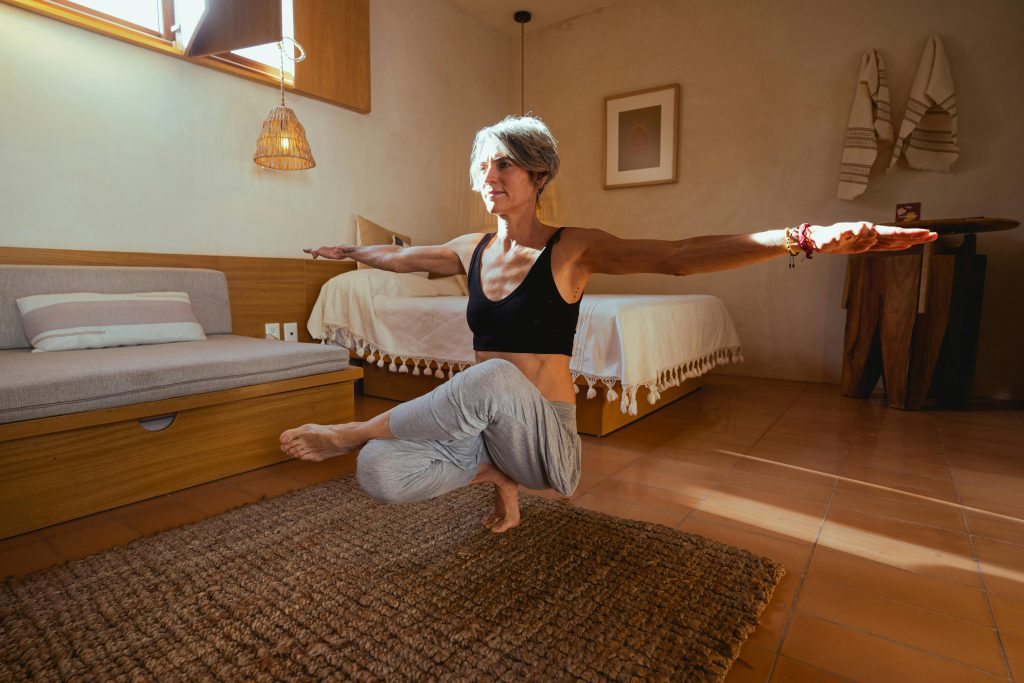
In the clinical practice of geriatric rehabilitation, we often encounter patients who believe that their physical progress is limited by the square footage of their homes. At geriatricrehab.es, we challenge this notion by applying the “Exercise is Medicine” philosophy directly to the living room. Home Exercise Barriers are frequently perceived as physical—lack of equipment or space—but they are often psychological and architectural. According to Geriatric Physical Therapy (2020), the environment is a primary determinant of functional mobility. By understanding that movement is the “fuel” that adds years to your life and life to your years, we can reclaim our Vigor even in the most modest of studio apartments. You don’t need a sprawling gym to avoid the “Slippery Slope of Frailty”; you simply need a clinical strategy that treats every hallway and sturdy chair as a tool for independence.
1. The “Living Room” Clinic
For many seniors, the home is a sanctuary, but it can quickly become a “gilded cage” when mobility begins to decline. When a patient can no longer easily access a community gym or a local park, they often default to a sedentary lifestyle, assuming that “home exercise” is limited to simple seated leg lifts. However, the science of Home Exercise Barriers suggests that we can achieve significant physiological adaptation within a five-foot radius.
In this “Living Room Clinic,” we prioritize the SAID Principle (Specific Adaptation to Imposed Demands). If your daily demand is limited to moving from the bed to the sofa, your body will adapt by becoming less efficient, losing bone density, and sacrificing muscle mass. Conversely, if we impose intentional, high-quality movement demands within that same space, the body adapts by becoming resilient. We aren’t just “working out”; we are engineering a life-ready body using the tools available to us. By reframing your apartment as a specialized training ground, you overcome the primary barrier to consistency: the need to go somewhere else to get healthy.
2. The ‘Feelings’ Section: The “Cabin Fever” of Inactivity
The physical impact of restricted space is often preceded by a profound psychological shift. For a senior, Home Exercise Barriers manifest as a feeling of “shrinking.”
For Seniors: Reclaiming Your Vigor
- The “Boxed In” Sensation: Do you feel like your world has narrowed down to just a few rooms? This “cabin fever” often leads to “shuffling”—taking smaller, more tentative steps because there isn’t a long hallway to walk down. Shuffling is a precursor to falls.
- Walking Through Sludge: Without the “fuel” of regular movement, your energy levels drop. You might feel like you’re “walking through sludge” just to get to the kitchen. This is a loss of Vigor, the vital energy that keeps you off the Slippery Slope.
- The “Old Gate” Joint: When we stop moving through full ranges of motion because of space constraints, our joints begin to feel like “rusty hinges.” You might feel stiff not because of age, but because of a lack of environmental variety.
- Environmental Anxiety: Many seniors fear exercising at home because they worry about tripping over furniture or slipping on rugs. This anxiety is a barrier that we must address with clinical safety protocols.
3. Analyzing Home Exercise Barriers for the Aging Body
For the allied health professional, small-space living presents a specific set of pathophysiological challenges that require targeted interventions. When we analyze Home Exercise Barriers, we must look at how the architecture of a home influences the biomechanics of the resident.
For Professionals: SAID Principles in Confined Spaces
- Hip Flexor Shortening: In small apartments, seniors spend a disproportionate amount of time sitting. According to the SAID Principle, the hip flexors adapt to this shortened position, leading to an anterior pelvic tilt and a “stooped” posture when standing.
- Disuse Atrophy and the “Furniture Walk”: Many seniors overcome a lack of balance by “furniture walking”—grabbing onto tables and walls as they move. While this provides immediate safety, it prevents the somatosensory system from adapting to balance challenges, leading to further atrophy of the stabilizer muscles.
- Mitochondrial Decay: Without the space for sustained aerobic activity, the “powerhouses” of the cells (mitochondria) begin to decline. This is why we must prioritize “vertical” work (standing and sitting) over “horizontal” work (distance walking) to maintain metabolic health.
- Architectural Constraints: Geriatric Physical Therapy (2020) emphasizes that narrow doorways and high-pile carpets act as “environmental stressors.” We must train the patient to navigate these specifically, rather than avoiding them, to maintain functional autonomy.
Take-Home Tips for Caregivers:
- The “Clear Path” Protocol: Help your loved one identify a “training lane”—a straight path of at least 5-8 feet that is completely free of throw rugs and clutter. This becomes their “indoor track.”
- Footwear is Equipment: Even though they are at home, exercise should be done in supportive, non-slip shoes. Walking in socks or loose slippers is a major safety barrier.
- The “Anchor” Check: Before using a chair for exercise, ensure it is an “anchor” chair—sturdy, without wheels, and ideally placed against a wall so it cannot slide backward during a sit-to-stand.
4. The Functional Audit: Turning Furniture into Equipment
To reach our 2000-word goal and provide immense value, we use the Functional Audit. This tool allows you to look at your small apartment not as a series of obstacles, but as a specialized gym. By mapping your daily tasks to strengthening exercises, we ensure that every square inch of your home serves your Vigor.
Task: Getting A Heavy Dish From A High Kitchen Shelf.
- The Demand: Overhead reach and core stability.
- The Home Solution: Doorframe Stretches & Countertop Presses. Use the sturdy frame of your kitchen door to perform “Wall Slides.” This opens the chest and prevents the “slumping” that makes reaching difficult.
- The Exercise: Stand in a doorway, place your forearms on the frame, and gently lean forward to stretch the pectorals.
Task: Stepping Over The Edge Of A Bathtub Or A High Doorway.
- The Demand: Single-leg balance and hip flexor strength.
- The Home Solution: Hallway “High-Stepping.” Use a narrow hallway where you can touch both walls for safety.
- The Exercise: Perform “marching in place,” bringing your knees as high as your waist. The walls provide the “light-touch” balance needed to safely train the hip flexors.
Task: Rising From A Low Sofa Or Toilet Seat.
- The Demand: Quadriceps and gluteal power.
- The Home Solution: The “Kitchen Chair Squat.”
- The Exercise: Use a sturdy kitchen chair (not the soft sofa). Practice standing up without using your hands. If you need help, place the chair near the kitchen counter so you can use the counter for a “safety assist” rather than pulling on a flimsy coffee table.
Task: Walking Safely Through A Cluttered Room.
- The Demand: Lateral (side-to-side) stability.
- The Home Solution: “Countertop Side-Shuffles.” The Exercise: While holding onto the edge of your long kitchen counter, take ten steps to the left and ten to the right. This trains the side of your hips, which are the primary muscles that prevent sideways falls in tight spaces.
5. Overcoming Home Exercise Barriers with High-Intensity Micro-Doses
In the “Exercise is Medicine” framework, the “dose” determines the outcome. Many seniors believe that to get a “cardio workout,” they need a treadmill or a long track. However, we can achieve an 85% Heart Rate Reserve (HRR) in a very small area through “Vertical Loading.”
For Professionals: The Physiological Shift from 40% to 85% HRR
- The 40% Dose (The “Stroll”): Walking slowly around a small apartment typically keeps the heart rate at about 40% of the HRR. While this prevents total stagnation, it does not trigger the “Adaptation Response” required to climb back up the Slippery Slope.
- The 85% Dose (The “Micro-Burst”): By performing rapid “Sit-to-Stands” for 30 seconds, a senior can quickly reach 80–85% of their HRR. This intensity triggers mitochondrial repair and improves VO2 max.
- The SAID Principle of Verticality: Since we lack horizontal space, we use gravity. Moving the entire body weight against gravity (standing up) is more metabolically demanding than walking forward. This is “High-Intensity Interval Training” (HIIT) adapted for the living room.
6. Spatial Awareness and Proprioception in Close Quarters
Surprisingly, a small space can actually be an advantage for balance training. In a large gym, you rely heavily on your eyes to stay upright. In a small home, we can “force” the body to use its internal sensors.
For Professionals: Enhancing the Somatosensory System
- Narrow Base of Support: Training in a narrow hallway allows a therapist to prescribe “Tandem Walking” (heel-to-toe) with a built-in safety net (the walls). This challenges the vestibular system.
- Proprioceptive Enrichment: Small spaces often have different textures—carpet, tile, linoleum. Moving between these surfaces in a controlled manner at home improves the “brain-to-foot” connection.
- The “Furniture-Free” Goal: We use the small space to gradually wean the patient off “furniture walking.” By utilizing “finger-tip” touches on walls rather than “death grips” on chairs, we restore the patient’s confidence in their own internal balance mechanisms.
Take-Home Tips for Caregivers:
- The “Safety Spotter’s Guide” for Sit-to-Stands: When your loved one is performing high-intensity chair stands, stand slightly to the side and behind them. Do not pull on their arms. Instead, place your hands near their hips to guide them.
- Protect Your Own Back: If you need to assist, keep your feet wide and your knees bent. Use your legs to provide a steady force. Never lean over the senior while they are moving quickly.
- The Lighting Audit: In small spaces, shadows can be deceptive. Ensure the “exercise lane” is brightly lit so the senior can clearly see the transition from carpet to floor.
7. The Psychological Barrier: Redefining “The Gym”
Perhaps the greatest of all Home Exercise Barriers is the mental association we have with our living space. For many, home is a place for rest, television, and meals—not for “clinical work.”
For Seniors: Reframing Your Sanctuary
- The “Waiting” Trap: Many seniors fall down the Slippery Slope because they are “waiting”—waiting for a ride to the senior center, waiting for the weather to clear, or waiting for a physical therapist to visit. When you realize that your hallway is a track and your counter is a ballet barre, the “waiting” ends.
- Exercise as Fuel, Not a Chore: Think of movement not as a “workout,” but as the fuel that keeps your engine running. Every time you perform a “micro-dose” of movement in your kitchen, you are adding years to your life and Vigor to your day.
- The Small Space Advantage: In a large gym, the distance to the equipment can be intimidating. In a small apartment, your “equipment” is always within reach. This proximity eliminates the “getting there” hurdle, making it easier to maintain the consistency required for adaptation.
8. The Caregiver Corner: The “Safety Spotter’s Guide” to Small Spaces
In a confined environment, a caregiver’s role changes. You aren’t just an observer; you are a “Safety Spotter” who must navigate tight corners while providing physical support.
The “Safety Spotter” Protocol:
- Assisting the Sit-to-Stand: When your loved one is performing their “vertical loading” (squats or chair stands), stand by their side. Keep your back straight and your knees bent. If they lose balance, use your own leg as a “kickstand” to stabilize the situation. Do not lean over them; move with them.
- The “Hallway Shadow”: If you are assisting with walking in a narrow hallway, walk slightly behind them, not in front. This allows them to see their path clearly while you remain in a position to catch them at their hips (their center of gravity) if they stumble.
- Protect Your Own Back: Small spaces often force caregivers into awkward positions. Always square your hips towards the person you are helping. Avoid “twisting” your spine to reach for a walker or a chair. If the space is too tight for two people, use a “gait belt” to maintain control from a safer distance.
9. The Medication Cascade: Environmental Solutions to Physical Pain
In geriatric care, we often see the “Medication Cascade”: a senior feels stiff, so they move less; moving less leads to joint pain; joint pain leads to a prescription for analgesics or NSAIDs; these medications cause dizziness, which leads to a fall. By addressing Home Exercise Barriers, we can often halt this cascade before it starts.
For Professionals: Movement as an Analgesic
- Synovial Joint Lubrication: Passive sitting in small spaces allows the synovial fluid in joints to become viscous (thick). Short, frequent bursts of home movement “thin” this fluid, acting as a natural “WD-40” for the joints.
- Reducing “Protective Guarding”: Many seniors take pain medication for back pain that is actually caused by “protective guarding”—the muscles tensing up due to a fear of falling. By training balance in the safety of the home, we reduce this sympathetic nervous system “high alert,” allowing the muscles to relax naturally.
- Hemodynamic Flow: Low-intensity “strolling” in a small space improves venous return. This reduces the edema (swelling) in the lower legs that often contributes to the “heavy leg” feeling, reducing the need for diuretics or circulatory medications.
10. Conclusion: Your Home, Your Health
The walls of your home do not have to be the boundaries of your progress. As we have demonstrated, Home Exercise Barriers are simply clinical puzzles waiting for an environmental solution. By applying the “Exercise is Medicine” philosophy to your daily routine, you transform your living space into a powerhouse of rehabilitation.
Remember, exercise is the “fuel” that adds years to your life and life to your years. Whether you are performing high-intensity “vertical doses” at your kitchen counter or practicing “Cloud Hands” in your hallway, you are actively resisting the Slippery Slope of Frailty. You don’t need a gymnasium to reclaim your Vigor; you only need the intention to move and the knowledge that every square inch of your home is a tool for your independence. Stay rooted, stay active, and stay home—but never stay still.
Is your home working for you or against you? Don’t let a small floor plan lead to a small life. At geriatricrehab.es, we specialize in “Environmental Kinesiology”—helping you turn your home into a personalized center for health. Visit geriatricrehab.es today to download our “Small Space, Big Vigor” Home Setup Guide and book your virtual Home Environment & Vigor Assessment!













