
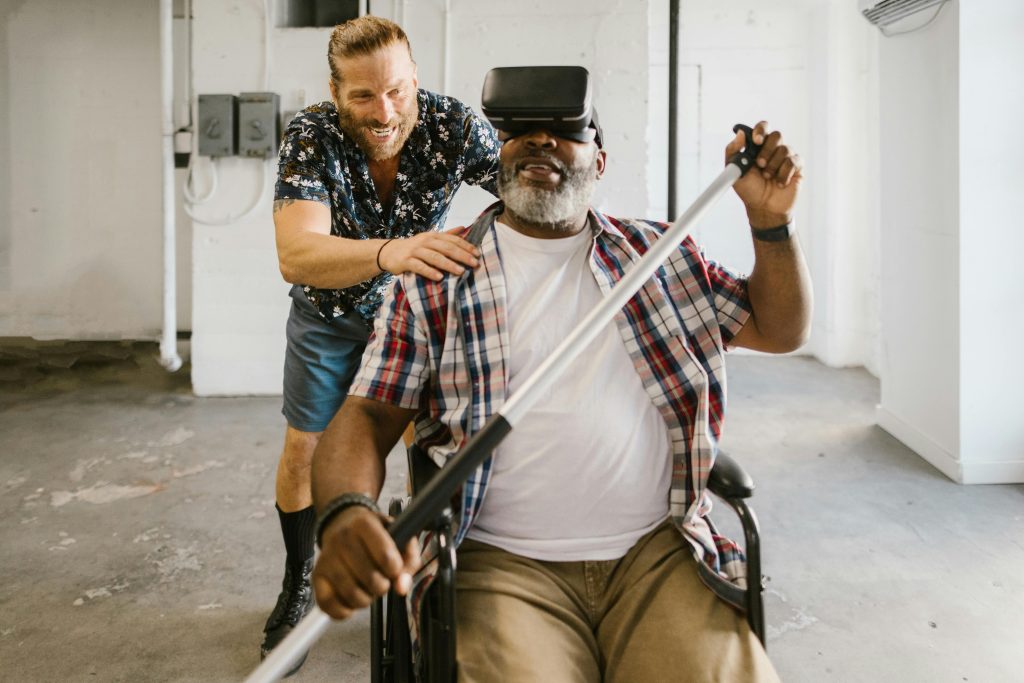
In the clinical framework of geriatric rehabilitation, balance is often misconstrued as merely a matter of muscular strength. However, according to the principles of Geriatric Physical Therapy (2020), stability is actually the result of a complex neurological conversation between three primary systems: the visual, the vestibular, and the somatosensory. To truly arrest a senior’s slide down the Slippery Slope of Aging, we must move beyond basic leg lifts and embrace Sensory Balance Training. By strategically challenging the eyes, the inner ear, and the sensors in the feet, we can rebuild the Physiological Reserve necessary to navigate a world that is rarely flat or well-lit. This multisensory approach is the “fuel” that provides the Vigor needed for lifelong independence.
1. The Three Pillars of Stability
In the clinical framework of Geriatric Physical Therapy (2020), we visualize aging as a journey along the Slippery Slope of Aging. At the top of the slope, your balance is an automatic, background process. You navigate crowds, uneven sidewalks, and dim hallways without a second thought. However, as we slide down, the “resolution” of our senses begins to blur. For many seniors, a fall isn’t caused by a lack of leg strength, but by a “sensory conflict”—a moment where the eyes, feet, and inner ear send contradictory signals to the brain.
For the senior, Sensory Balance Training is the process of sharpening these signals. We view exercise as the fuel that adds years to your life and life to your years. By improving your Vigor, you are essentially cleaning the “lens” through which your brain sees the world. Stability is a three-legged stool; if your vision is poor, your feet must be twice as sharp. If your feet are numb, your inner ear must be the master of your movement.
2. Sensory Weighting: How the Brain Prioritizes Information in Sensory Balance Training
From a Professional Perspective, many seniors develop “Visual Dependency.” As the sensors in their feet (somatosensory) and inner ear (vestibular) dull, the brain compensates by over-relying on the eyes. This is why you see many seniors staring at their feet while they walk. However, this strategy is a double-edged sword. By looking down, you lose the “visual anchor” of the horizon, and your peripheral vision—the part of your sight most responsible for balance—becomes less effective.
In a comprehensive Sensory Balance Training program, we challenge this dependency. We teach “Target Locking,” where a senior maintains their gaze on a stationary point while the body is in motion. This forces the brain to rely on the other two pillars of balance.
Take-Home Tip for Caregivers: If you notice your loved one constantly looking at their feet, encourage them to “look at the picture on the wall” while walking down the hall. This simple shift moves them back up the Slippery Slope by reclaiming their visual horizon.
3. Somatosensory Input: Grounding Your Sensory Balance Training
The somatosensory system is the “touch” pillar of balance. It involves thousands of tiny mechanoreceptors in the soles of your feet and sensors in your joints that tell the brain exactly where you are in space. In the aging body, particularly for those with neuropathy or circulatory issues, these sensors can become “muted.”
To apply the SAID Principle (Specific Adaptation to Imposed Demands), we must impose a demand that forces these sensors to reawaken. This is why “surface training” is vital. If a senior only walks on flat, predictable linoleum, their feet never learn to adapt to the real world.
- Professional Perspective: We progress patients from firm surfaces to foam pads, and eventually to “compliant” surfaces like grass or gravel. This titration of difficulty ensures the nervous system is forced to adapt.
- Seniors Focus: Think of your feet as the “tires” of a car. If the tread is worn (muted senses), you lose traction. Sensory Balance Training is like getting a new set of high-performance tires, giving you the grip and Vigor to walk on any surface with confidence.
4. Functional Training: The Sensory Functional Audit
In the discipline of geriatric rehabilitation, we move beyond the “gym” mindset by linking sensory drills directly to the physical milestones of daily life. For the senior, Vigor is the ability to navigate a home that isn’t always perfectly flat or brightly lit. We utilize a Sensory Functional Audit to map common land-based struggles to the specific “wins” reclaimed through targeted drills.
By applying the SAID Principle, we ensure that your Sensory Balance Training rehearses the exact demands of your environment. Below is a map of the struggle to take corrective action:
Walking in the Dark to the Bathroom (The Win: Nighttime Safety)
- The Land Struggle: Disorientation or “swaying” when the lights are off, because the brain can no longer rely on the visual pillar.
- The Corrective Dose: Eyes-Closed Static Stance. Standing in a corner (for safety) and closing the eyes for 30 seconds.
- The Response: Forces the brain to ignore the “missing” visual data and trust the feet and inner ear.
Stepping into a Tiled Shower (The Win: Bathroom Independence)
- The Land Struggle: A fear of slipping when transitioning from the firm bathroom rug to the slick, slightly sloped shower floor.
- The Corrective Dose: Surface Transition Drills. Practicing stepping from a firm floor onto a soft foam pad or a textured yoga mat.
- The Response: Re-trains the somatosensory receptors to detect changes in friction and slope instantly.
Reaching into a Low Kitchen Cupboard (The Win: Kitchen Vigor)
- The Land Struggle: Dizziness or a “head-rush” when bending down and looking up quickly to find a pot or pan.
- The Corrective Dose: Dynamic Head Turns. Standing while slowly rotating the head left-to-right and up-and-down while maintaining a steady gaze.
- The Response: Strengthens the Vestibulo-Ocular Reflex (VOR), ensuring the world stays still even when your head moves.
Walking on Thick Carpet or Grass (The Win: Community Connection)
- The Land Struggle: Feeling like you are “walking on marshmallows,” leading to a shuffling gait and high fatigue.
- The Corrective Dose: Single-Leg Stance on Foam. Holding a one-legged pose on a compliant surface.
- The Response: Builds the ankle-stabilizing strength and proprioceptive clarity needed for uneven outdoor terrain.
5. The Vestibular System: The Body’s Internal Gyroscope
The vestibular system, located within the inner ear, acts as your body’s accelerometer. It detects the pull of gravity and the speed of your head movements. In the aging process, the “crystals” within the ear can become displaced, or the signals can slow down, leading to the dreaded “Dizzy Pivot”—that moment of instability when you turn around quickly to answer the door or the phone.
From a Professional Perspective, we treat the vestibular system as a muscle that can be conditioned. We use “habituation” exercises to help the brain get used to movements that cause dizziness. By repeatedly being exposed to controlled, safe “tilts” and turns, the brain learns to recalibrate its internal gyroscope. This is essential for maintaining your Physiological Reserve, as it allows you to handle sudden movements without a catastrophic loss of balance.
6. Sensory Weighting: How the Brain Prioritizes Information
A key component of Sensory Balance Training is “Sensory Weighting.” This is the brain’s ability to decide which sense to trust in a given moment. For example, if you are sitting on a stationary bus and the bus next to you starts to move, your eyes might tell you you are moving (visual), but your inner ear and your seat tell you that you are still (vestibular/somatosensory).
In seniors, the brain often gets “stuck” on one sense—usually vision. In the clinic, we use the Clinical Test of Sensory Interaction in Balance (CTSIB) to determine which system is failing.
- The Goal: We want to teach your brain to “re-weight” its inputs. If you are walking on a plush rug in a dim room, your brain should automatically “turn up the volume” on your inner ear and “turn down” the unreliable visual data.
- The Drill: Standing on a foam pad with eyes closed. This effectively “mutes” two systems at once, forcing the vestibular system to take 100% of the workload. This is the ultimate “Vigor” workout for your brain.
7. Cardiovascular Demand and Equilibrium: The Dose-Response of Balance
In the “Exercise is Medicine” framework, the efficacy of Sensory Balance Training is tied directly to the intensity of the “dose.” For the Allied Health Professional, we must distinguish between simple stability and reactive power. To refill a senior’s Physiological Reserve, we utilize the Heart Rate Reserve (HRR) to titrate the difficulty of balance drills.
- The 40% Dose (Stability & Coordination): At this intensity, the senior is performing static drills—like standing on one leg while the eyes are open. This level is excellent for metabolic health and joint lubrication, but it primarily targets the “low-threshold” neural pathways. It keeps the senior at their current level on the Slippery Slope, but it doesn’t necessarily prepare them for a crisis.
- The 85% Dose (Reactive Vigor): This is the high-intensity zone. Here, we introduce “perturbations”—gentle, unexpected nudges or rapid movements that force the heart rate to spike as the body fights to stay upright. This intensity triggers the SAID Principle for the nervous system, building the “fast-twitch” balance reactions needed to catch oneself during a stumble.
Seniors Focus: Think of the 85% dose as your “emergency brake.” You don’t use it every day, but when you need it, you want it to be sharp and powerful. Training at higher intensities ensures your “fuel tank” of Vigor is full enough to handle a trip on a curb without it turning into a fall.
8. Pharmacokinetics and the “Chemical Fog”
For the Allied Health Professional, assessing a patient’s progress in Sensory Balance Training requires a deep dive into their medication list. In seniors, the Volume of Distribution (Vd) and drug clearance rates change significantly, which can create a “Chemical Fog” that mimics a balance disorder.
- Volume of Distribution (Vd): As body fat increases and total body water decreases with age, fat-soluble medications (like certain anti-anxiety drugs or sedatives) have a much higher Vd. This means they linger in the tissues for days rather than hours.
- The Sensory Mismatch: If a drug is still active in the system, it can “slow down” the neural transmission from the inner ear to the brain. The senior isn’t necessarily weak; they are pharmacologically delayed.
- Professional Perspective: We must differentiate between physical ataxia (a lack of coordination) and drug-induced ataxia. If the senior’s balance is significantly worse in the morning (when drug levels may be peaking or “washing out”), it is a pharmacokinetic issue that must be addressed with the prescribing physician.
9. The Beers Criteria: When Medications Sabotage the Senses
Before we can successfully move a senior up the Slippery Slope, we must audit their medications against the Beers Criteria. Many common prescriptions for seniors have side effects that directly sabotage the visual, vestibular, and somatosensory systems.
- Benzodiazepines (e.g., Valium, Xanax): These are notorious for increasing “sway” and slowing down the “Dizzy Pivot” reaction time. They effectively mute the vestibular system.
- Anticholinergics: Found in many over-the-counter sleep aids and bladder medications, these can cause blurred vision and “cotton-mouth,” but more dangerously, they can cause confusion that impairs the brain’s ability to “re-weight” sensory information.
Caregiver Focus: Be a “Dose Detective.” If your loved one has recently started a new medication and you notice they are suddenly touching the walls for support or seem “clumsy,” it may not be a natural decline in balance. It may be a “Beers List” medication interfering with their senses. Always consult their Physical Therapist to see if the medication is fighting against their Sensory Balance Training.
10. Conclusion: The Safety Spotter’s Guide to Sensory Balance Training
To maintain long-term stability and Vigor, we must treat the senses with the same rigor we apply to the muscles. Just as we wouldn’t expect an engine to run on empty, we cannot expect a senior to navigate the Slippery Slope of Aging without the “fuel” of sharp, integrated sensory systems. By respecting the SAID Principle, we ensure the brain is specifically adapted to the unpredictability of the real world.
Caregiver Focus: The Safety Spotter’s Guide
As a caregiver, you are the “Safety Spotter” for their equilibrium. Sensory drills—especially those involving closed eyes or foam surfaces—can be intimidating. Use these techniques to provide support while maintaining your own physical safety:
- The “Nose Over Toes” Assist: When helping your loved one transition from a seated rest to a balance drill, do not pull their arms. Stand to the side, have them lean “nose over toes” to shift their center of gravity, and provide a steadying hand on their hips or a gait belt. This protects your back from strain.
- The Corner Technique: For eyes-closed drills, place the senior in a corner with a sturdy chair in front of them. This provides a “safety cage” that allows them to challenge their senses without the risk of a fall.
- The “Dizzy Pivot” Watch: Always monitor for lightheadedness during transitions. If they feel a “head-rush” after standing, have them pause and perform 10 ankle pumps to get the blood flowing before starting the balance session.
- The Back-Safe Stance: When spotting intense drills, keep a wide base of support and slightly bent knees. Your physical health is the foundation of your exercise adherence.
Stability is not a static state; it is a dynamic conversation. At geriatricrehab.es, we believe that every senior has the capacity to sharpen their senses and reclaim their independence. The key is to stop avoiding the challenge and start training for the “Wins.”
Are you ready to stop the slide? Don’t let a “muddy” sense of balance limit your life. Schedule a personalized “Sensory Audit” with our experts at geriatricrehab.es today, and let’s build a multisensory plan that keeps you upright and active for years to come.













