
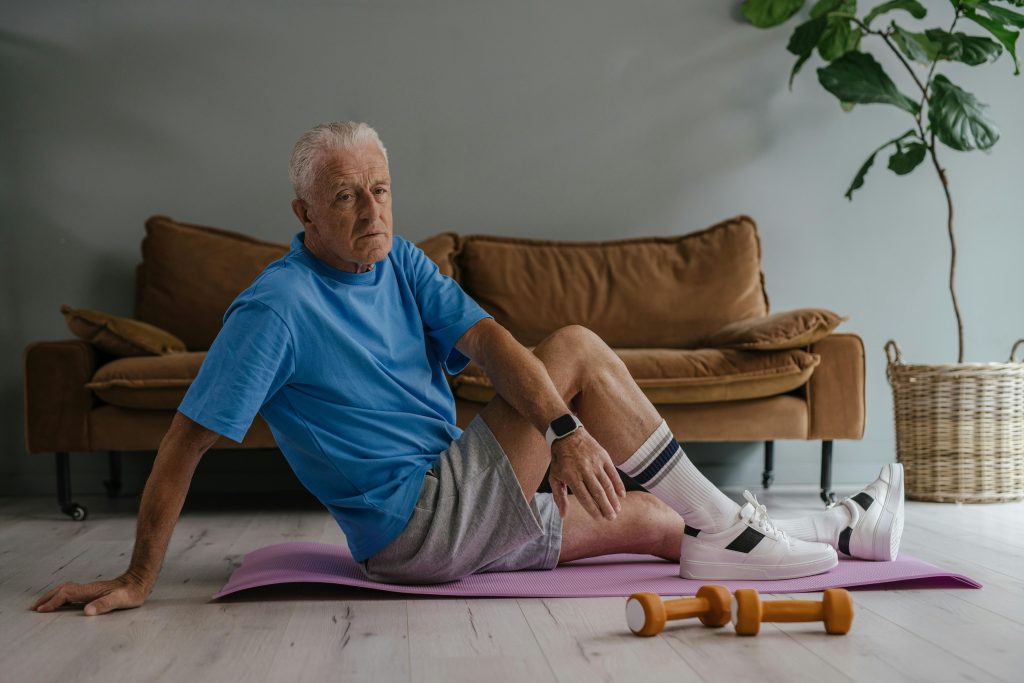
In the era of modern geriatric care, the “Exercise is Medicine” philosophy has been revolutionized by digital data. In the clinical framework of Geriatric Physical Therapy (2020), we emphasize that what gets measured gets managed. Integrating Senior Fitness Technology into a daily routine allows us to visualize the Slippery Slope of Aging in real-time, transforming abstract goals into concrete data. By utilizing smartwatches and health apps, seniors can monitor their Physiological Reserve, widen their Safety Buffer, and maintain the Vigor necessary for long-term independence.
1. Digital Vigor and the Modern Senior
In the clinical framework of Geriatric Physical Therapy (2020), we describe the Slippery Slope of Aging as a gradual loss of Physiological Reserve. For many, this descent is invisible until a fall occurs. However, Senior Fitness Technology provides a “dashboard” for the human body, turning abstract feelings of fatigue or shakiness into actionable data.
By embracing wearables and apps, seniors can actively monitor their Vigor. This isn’t about complexity; it’s about clarity. When you can see that your “Safety Buffer” is expanding because your heart rate is more resilient or your steps are more symmetrical, you stop viewing yourself as “fragile.” Exercise is the fuel that adds years to your life, and tech is the fuel gauge that tells you exactly how far you can go.
2. The Science of Biofeedback: Senior Fitness Technology and the Reserve
From a Professional Perspective, the most significant barrier to geriatric recovery is “under-dosing.” If the exercise is too easy, the body never triggers the SAID Principle (Specific Adaptation to Imposed Demands). Senior Fitness Technology ensures that movement is treated with the same precision as medicine.
By tracking Heart Rate Reserve (HRR), we can ensure a senior is working at a therapeutic level. If a senior stays at a low intensity (below 40% HRR), they may maintain their current status but won’t “climb” back up the Slippery Slope. High-quality wearables allow therapists and caregivers to verify that the “medicine” is reaching a high enough dose to actually rebuild bone density and muscle power.
Take-Home Tip for Caregivers: Don’t fear the “red zone” on a heart rate monitor. If a senior is cleared for exercise, seeing their heart rate rise during a sit-to-stand is a sign of work being done. Use the data to encourage them: “Your heart is working hard to get stronger today!”
3. Step Counting vs. Gait Quality: The Clinical Vital Sign
While the general public is obsessed with the “10,000 steps” goal, geriatric professionals know that how you walk is more important than how much you walk. Senior Fitness Technology now allows us to track “Gait Speed,” which is widely considered the “sixth vital sign” in elderly care.
- Symmetry Analysis: Does the app show one foot spending more time on the ground than the other? This could indicate a “somatosensory” leak where the senior doesn’t trust one leg.
- Gait Speed Fluctuations: A sudden drop in walking speed is often a predictor of an upcoming health event.
- Take-Home Tip for Caregivers: Look at the “trends,” not just the daily totals. If you notice your loved one’s average walking speed has slowed over the last week, it might be time to check for a “biological leak,” such as a hidden infection or a medication side effect, before it leads to a fall.
4. Functional Training: The Digital Mobility Audit
In the “Exercise is Medicine” framework, a Functional Audit is the process of mapping your daily physical struggles to specific digital prescriptions. Senior Fitness Technology serves as the bridge, ensuring that your rehab moves out of the clinic and into your living room. By using apps to set “movement reminders” or “posture alerts,” we utilize the SAID Principle to ensure your body is constantly adapting to the demands of your specific lifestyle.
The Digital Chores-to-Strength Map
- Retrieving Dishes from High Shelves: Reaching upward requires scapular stability and calf power.
- The Digital Dose: Use a “standing desk” app or a simple interval timer to prompt Wall Angels, and Heel Raises three times a day. Your smartwatch can track the “overhead minutes” to ensure you are maintaining the range of motion needed for independence.
- Stepping Over the Bathtub: This high-risk task requires single-leg stability and hip flexion.
- The Digital Dose: Set a “Balance Challenge” in your fitness app. Practice High Marching with a 3-Second Pause during commercial breaks. The accelerometer in your watch can detect the steadiness of your stance, providing immediate feedback on your Safety Buffer.
- Picking Up Keys from the Floor: This requires “braking” strength in the legs.
- The Digital Dose: Map this to Staggered Stance Squats. Use a rep-counter app to ensure you are doing 10-15 controlled descents daily. This builds the eccentric quad control needed to avoid “plopping” into chairs.
- Carrying Laundry or Groceries: Carrying loads shifts your center of gravity and obscures your feet.
- The Digital Dose: The Farmer’s Carry. Use your watch to track “brisk walking” while carrying a light weight (like a half-gallon of milk). This refills the Physiological Reserve needed for multi-tasking in a busy environment.
5. Professional Deep-Dive: SOT and Wearable Accelerometers
For the Allied Health Professional, the most exciting advancement in Senior Fitness Technology is the ability to perform a “Virtual SOT.” Traditionally, Sensory Organization Testing (SOT) requires a multi-million dollar force plate lab to isolate the Visual, Vestibular, and Somatosensory systems.
Today, the tri-axial accelerometers and gyroscopes inside a standard smartwatch can provide a “proxy” for this data:
- Postural Sway Analysis: By wearing a sensor at the waist or wrist during a “Quiet Standing” test, we can measure the Root-Mean-Square (RMS) acceleration. High sway in the mediolateral direction (side-to-side) is a clinically validated digital biomarker for high fall risk.
- Condition 5 Simulation: We can ask a patient to stand on a foam pad (challenging the somatosensory system) while using an app to provide “visual noise” on a tablet. The wearable then tracks how well the Vestibular system compensates for the confusion.
- The Professional Pearl: Accelerometers can detect “near-falls”—those stumbles where the user catches themselves. Tracking the frequency of these “micro-events” allows us to intervene before a “macro-event” (a real fall) occurs on the Slippery Slope.
6. Senior Fitness Technology as an Early Warning System
Protecting your Safety Buffer means more than just exercise; it means having a safety net that never sleeps. Modern Senior Fitness Technology has evolved from simple pedometers into sophisticated predictive tools that can alert caregivers before a crisis occurs.
- Predictive Gait Analysis: AI-driven apps can now detect subtle changes in gait speed and “stride-to-stride variability.” A sudden increase in variability often precedes a fall by several weeks, serving as a digital “Check Engine” light for your health.
- Intelligent Fall Detection: High-G accelerometers can distinguish between a “heavy sit” on a sofa and a hard impact on the floor. If a fall is detected, many watches will automatically start a countdown to call emergency services or a designated “Safety Spotter.”
- Heart Rate as a Stress Metric: By monitoring resting heart rate and Heart Rate Variability (HRV), wearables can signal when a senior is “over-dosed” or fighting a sub-clinical infection, allowing for a proactive reduction in activity to prevent injury.
Take-Home Tip for Caregivers: When setting up a fall-detection device, perform a “Test Drop” (onto a bed) with the senior. This helps them understand the alert sound and how to cancel a “false alarm,” reducing the anxiety often associated with new technology.
7. Assistive Tech: A Buyer’s Guide for Modern Stability
The transition toward Senior Fitness Technology often mirrors the Psychology of the Cane. Just as some seniors resist a walking aid because it feels like a “surrender,” they may resist a smartwatch because it feels overwhelming. However, unlike a traditional cane, these devices are “stealth health”—they provide massive safety benefits in a package that looks like a high-end fashion accessory.
The Wearable Hierarchy
- The Smartwatch (Apple/Samsung/Garmin): These offer the most robust data for the SAID Principle, including heart rate zones, ECG monitoring, and sophisticated fall detection. They are best for seniors looking to maintain high Vigor and track their “Exercise is Medicine” doses.
- The Smart-Cane: A new category of device that integrates sensors into the handle of a cane. These can track weight-bearing status and gait asymmetry, sending a report directly to a physical therapist.
- Medical Alert Pendants: For those further down the Slippery Slope, these simplified devices focus entirely on the Safety Buffer, offering one-touch emergency access and automatic fall detection without the need for a smartphone.
- Smart Insoles: These “hidden” sensors fit inside any shoe and provide the most accurate data on foot-strike and balance, perfect for those who want professional-grade gait analysis without wearing something on their wrist.
8. Case Study: The “Connected” Recovery
Consider “Evelyn,” a 79-year-old who felt her world shrinking after a minor ankle fracture. Her Physiological Reserve was depleted, and her fear of falling (FOF) was keeping her housebound. Traditional rehab felt like a burden until we introduced a gamified fitness app on her tablet paired with a basic smartwatch.
The Tech Intervention: We used the app to set “Vigor Points” for completing her High Marching and Staggered Stance Squats. Her watch provided a “nudging” vibration every hour she was sedentary, encouraging her to move.
The Result: Seeing her “Balance Score” improve week-over-week refilled her psychological reserve. The data proved she was getting stronger, which gave her the confidence to return to her bridge club. Evelyn shifted from a “patient” to an “active user,” using the tech as a bridge to reclaim the life she thought she had lost to the “Slippery Slope.”
9. Caregiver’s Tool: The Remote Monitoring Dashboard
For family caregivers, Senior Fitness Technology provides something priceless: peace of mind. By setting up a “Family Sharing” dashboard, you can support your loved one’s Active Living goals from anywhere in the world.
The Remote Safety Audit
- Alert Thresholds: Set the app to notify you only for significant events, like a detected fall or a heart rate that stays elevated for too long. This prevents “alert fatigue” and allows you to be an effective Safety Spotter without being overbearing.
- The Mobility Trendline: Check the dashboard once a week. Is their average daily movement increasing or decreasing? A downward trend is your cue to call and ask about their Vigor before a health crisis occurs.
- Privacy Guardrails: Ensure your loved one feels in control of their data. Technology should be a tool for empowerment, not a “nanny cam.” Discuss which metrics they are comfortable sharing to maintain their sense of autonomy.
10. Conclusion: Dose-Response and the Future of Senior Fitness Technology
As we have seen, Senior Fitness Technology is more than a collection of gadgets; it is a clinical bridge that connects daily movement to long-term Vigor. By utilizing these tools to monitor your journey, you shift from a passive passenger on the Slippery Slope of Aging to the active pilot of your own health. Tech provides the “bio-feedback” necessary to turn the “Exercise is Medicine” philosophy into a precise, daily reality. As we look toward the future, these devices will only become more integrated, helping you maintain a robust Physiological Reserve and a wide Safety Buffer for years to come.
Professional Perspective: The Digital Dose (40% vs. 85% HRR)
The most critical advantage of using tech in geriatric rehab is the ability to manage the Dose-Response relationship. According to Geriatric Physical Therapy (2020), not all movement is created equal.
- The 40% HRR Zone (Maintenance): This is your “active baseline”—light chores or a casual stroll. While important for joint health and circulation, this dose primarily prevents you from sliding further down the slope. It keeps you “steady.”
- The 85% HRR Zone (The Vigor Zone): This is where true transformation happens. High-intensity functional training (HIFT), such as rapid Sit-to-Stands or weighted Farmer’s Carries, pushes you into this zone. At 85% HRR, the body triggers neural repairs and muscular growth that actually refill your reserve.
Using a smartwatch allows you to verify that you are hitting these “Vigor” targets safely and effectively, ensuring that your hard work actually results in biological change.
Caregiver Focus: The Safety Spotter’s Guide
As a caregiver, your role is to help the senior bridge the “Digital Divide” so they can focus on their physical recovery. Use these principles to be an effective technical and physical Safety Spotter:
- Simplify the Interface: When setting up a watch or app, remove unnecessary icons and simplify the home screen. The goal is to make the “Vigor” data the most prominent feature.
- The “Power Stance” Assist: When your loved one is performing high-intensity drills to hit that 85% HRR goal, stand behind and to the side. Maintain a wide base of support and a neutral spine. If they lose balance, provide tactile cues at the hips—never pull on their arms, as this can cause shoulder strain for both of you.
- Troubleshooting without Tension: If the tech “glitches,” stay calm. Frustration is a major barrier to senior tech adoption. Reframe tech issues as “rest breaks” in the workout.
Is your health data working for you? Don’t leave your recovery to guesswork. Visit geriatricrehab.es to connect with a tech-forward physical therapist who can help you choose and calibrate the perfect Senior Fitness Technology for your unique needs. Let’s turn your data into your strength!













