
In the clinical framework of geriatric rehabilitation, stability is often described as a three-legged stool supported by the vestibular, somatosensory, and visual systems. However, for many seniors, the visual “leg” becomes the primary anchor for mobility. According to Geriatric Physical Therapy (2020), as other senses dull, the brain relies more heavily on the eyes to map the environment. This makes the link between Vision and Falls a critical area of intervention. By understanding how depth perception and contrast sensitivity fluctuate, we can rebuild the Physiological Reserve needed to navigate a world that is rarely flat or well-lit, providing the Vigor necessary for lifelong independence.
1. The Eyes as the Body’s GPS
In the clinical framework of Geriatric Physical Therapy (2020), we visualize aging not as a sudden drop, but as a journey along the Slippery Slope of Aging. At the top of the slope, your balance is a seamless conversation between your eyes, your inner ear, and your feet. However, as we move down the slope, many seniors experience “visual dependency.” This means the brain begins to “mute” the signals from the feet and inner ear, relying almost entirely on what the eyes see to keep the body upright.
For the senior, the link between Vision and Falls is often the source of deep anxiety, but it can also be the source of your greatest strength. We often tell our patients that balance rehab is about creating a Safety Buffer. This buffer is the “fuel” that provides the Vigor and confidence to walk through a crowded supermarket or enjoy a morning in your garden without the constant shadow of anxiety. By sharpening your visual processing, you aren’t just preventing a fall; you are reclaiming your freedom.
2. The Mechanics of Vision and Falls
From a Professional Perspective, the relationship between Vision and Falls is dominated by more than just “20/20” acuity. While acuity helps you read a sign, contrast sensitivity helps you see a grey curb against a grey sidewalk. As we age, the amount of light reaching the retina decreases, making it harder for the brain to distinguish between surfaces, especially in dim lighting.
To satisfy the SAID Principle (Specific Adaptation to Imposed Demands), we must train the brain to utilize peripheral vision for stability. Central vision is for identification (what is that?), but peripheral vision is for orientation (where am I?). If a senior stares at their feet while walking, they lose the “visual anchor” of the horizon, which actually increases their risk of a stumble.
Take-Home Tip for Caregivers: Observation is your best tool. If you notice your loved one constantly looking down at their feet, they are likely struggling with “peripheral flow.” Encourage them to “look at the picture at the end of the hall” while walking. This shift back to a horizontal anchor can immediately stabilize their gait and move them back up the Slippery Slope.
3. Depth Perception: The Challenge of Stairs and Curbs
Depth perception, or stereopsis, is the ability to judge the distance between your body and the environment. This is the primary defense against “miss-steps” on stairs and curbs. In the aging eye, conditions like macular degeneration or even the use of multifocal lenses can distort this perception, creating a “false floor” effect where a step looks closer or further than it actually is. This significantly drains a senior’s Physiological Reserve, as every step requires intense cognitive effort.
- The Challenge: Descending stairs is often scarier than ascending because the visual field is flooded with “empty space,” making it harder for the brain to find a stable target.
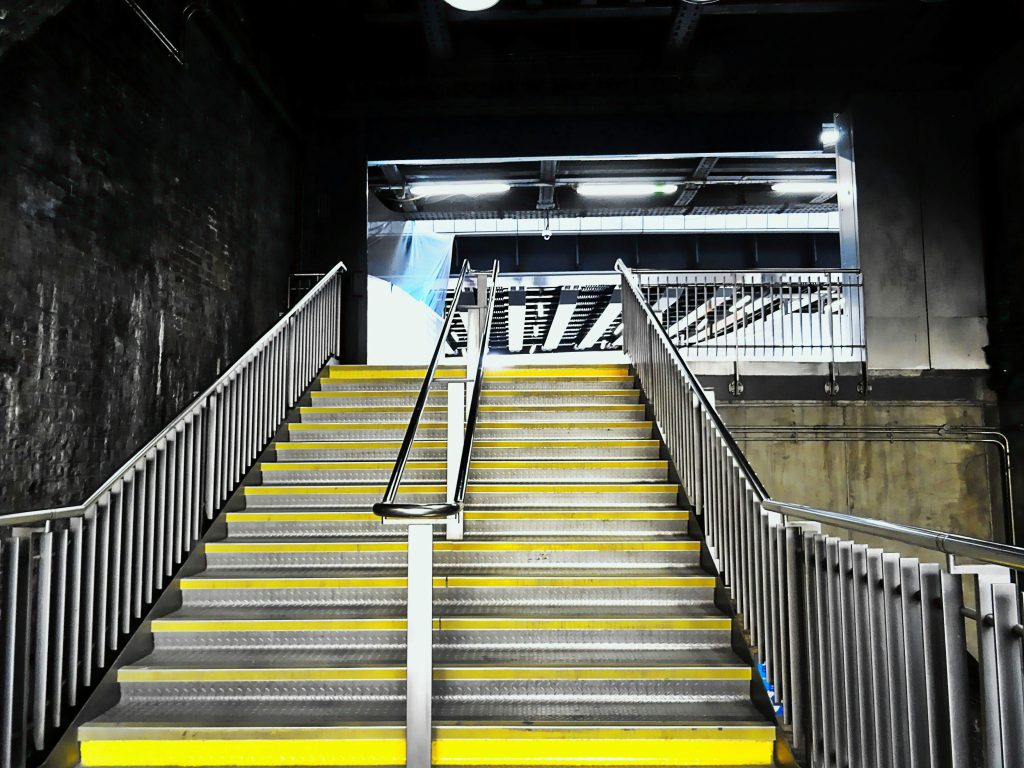
- The Safety Buffer: We recommend using high-contrast markers. Placing a strip of bright yellow or orange tape at the edge of each step provides a “visual target” that overrides depth confusion.
- Seniors Focus: Think of your vision as your body’s GPS. If the map is blurry, you’ll drive slower and with more stress. By using contrast and better lighting, you’re “updating the map,” giving you the Vigor to move through your home with speed and safety.
4. Functional Training: The Visual Functional Audit
In the discipline of geriatric rehabilitation, we move beyond the “gym” mindset by performing a Visual Functional Audit. This process bridges the gap between clinical tests and the “land struggles” seniors face daily. For the senior, Vigor is the ability to walk through a dim hallway at night or reach for a glass on a high shelf without the room spinning. Below, we map common visual deficits to the corrective “dose” required to climb back up the Slippery Slope.
- The Low-Light Struggle (Night Walking): Many seniors avoid getting up at night because their Physiological Reserve is so visually dependent that “lights out” means “balance out.” The corrective dose involves Sensory Weighting Drills. We have the patient practice standing on a firm surface with their eyes closed or in a darkened room while focusing on the “feeling” in their feet. This forces the brain to trust the somatosensory system more.
- The “Busy Floor” Struggle (Shopping Malls): Patterns on carpets or the movement of people in a supermarket can cause “visual vertigo.” The corrective dose is Gaze Stabilization Training. The senior practices focusing on a single, unmoving target (like a sticky note on a wall) while slowly turning their head left and right.
- The “Curb/Step” Struggle: This is where Vision and Falls intersect most dangerously. The corrective dose is Targeted Toe Clearance. We use high-contrast “stepping targets” on the floor, requiring the senior to look ahead at the next target rather than down at their feet, rebuilding the Safety Buffer for outdoor walking.
5. Professional Deep-Dive: Sensory Organization Testing (SOT)
For the Allied Health Professional, understanding the role of vision in stability requires a look at Sensory Organization Testing (SOT). In SOT, we isolate the three systems to see which one is “carrying the load.”
Condition 2 of the SOT (standing with eyes closed) and Condition 5 (standing on a tilt-surface with eyes closed) are critical for identifying visual dependency. If a patient’s score drops significantly in these conditions, they are “Visually Dependent.” This means their Physiological Reserve is being propped up by their sight alone.
Clinical Pearl: To satisfy the SAID Principle, we must train the brain to “re-weight” its inputs. If a patient is visually dependent, we perform balance tasks on foam (challenging the feet) while simultaneously introducing “visual conflict” (like moving a striped pattern in front of them). This forces the vestibular system to take over, making the patient more resilient in complex environments like busy streets or rain-slicked sidewalks.
6. Balance Strategies: Preventing Vision and Falls
When vision is compromised—perhaps by sudden glare or a dark room—the nervous system must rapidly employ Balance Strategies to prevent Vision and Falls. A high-vigor senior can transition between these strategies seamlessly.
- The Ankle Strategy: For small displacements (like a slight sway in a dim room), the muscles around the ankle fire to pull the body back to center. This is the first line of defense.
- The Hip Strategy: If the displacement is larger or the senior is surprised by a “false floor” (misjudged depth), the ankles lack the leverage. The brain switches to the hips, thrusting them to move the center of mass.
- The Stepping Strategy: When the visual data is so poor that the Safety Buffer is breached, the body must take a step to prevent a fall. This is the “emergency brake.”
In geriatric rehab, we often see seniors skip the ankle strategy and move straight to a stiff-legged hip or stepping strategy because their “visual anchor” is missing. By practicing “perturbation training”—gentle, controlled nudges in low-light settings—we retrain the nervous system to use the most efficient strategy for the task, preventing the “over-reaction” that often leads to a tumble.
7. Assistive Devices: The Vision-Aided Buyer’s Guide
When the link between Vision and Falls becomes a daily concern, an assistive device serves as more than just a physical support—it acts as a “tactile sensor” for the environment. However, we must address the Psychology of the Cane. Many seniors resist using a device because they feel it makes them “look old” or signals a surrender to the Slippery Slope.
We reframe this choice: a device is a “performance enhancer” that provides the Vigor to stay involved in the world. For those with visual impairments, the device provides the “ground data” that the eyes can no longer process.
- The Single-Point Cane: Best for those with mild depth perception issues. It provides a “sensory touch” to confirm the distance to the floor.
- The 2-Wheeled Walker (Front-Wheeled): The “gold standard” for visually dependent seniors. It provides a constant, stable frame that stays in the peripheral vision, acting as a permanent “visual anchor.”
- The 4-Wheeled Rollator: Excellent for long community walks, but requires high Physiological Reserve for hand-eye coordination. Caution: For those with poor contrast sensitivity, the “roll-away” nature of a rollator can be dangerous on slopes.
- The Hemi-Walker: Ideal for those who need a wide, stable base but only have the use of one hand (common in stroke survivors with visual field cuts).
8. Case Study: Reclaiming Vigor after Cataract Surgery
Mr. J, an 82-year-old woodworker, found himself sliding down the Slippery Slope of Aging. He had stopped going into his workshop because the shadows made the floor look “uneven,” and he had suffered two “near-miss” stumbles on his porch steps. His Physiological Reserve was drained by the constant cognitive effort of trying to see where his feet were.
The Intervention: Mr. J underwent cataract surgery, which immediately improved his contrast sensitivity. However, his brain was still “stuck” in a state of visual dependency. We applied the SAID Principle, using a “Dose-Response” of balance training on foam pads and head-turn drills to force his inner ear to “wake up.”
The Result: By combining clear vision with sensory re-weighting, Mr. J reclaimed his Safety Buffer. He moved from a “Medium Risk” score to “Low Risk.” Today, he is back in his workshop, moving with Vigor and confidence. He no longer fears the shadows because he has trained his body to trust his feet as much as his eyes.
9. Caregiver’s Tool: The Environmental Audit for Vision
A senior’s balance in the clinic can be perfect, but a “visually hostile” home can lead to Vision and Falls. As a caregiver, you are the architect of the Safety Buffer. Use this room-by-room printable checklist to ensure the home supports their visual needs.
The “Visual Clarity” Checklist
- The Entryway: Eliminate glare. Use “matte” finishes on floors and furniture. Sunlight bouncing off a polished floor can create a “blind spot” that leads to a fall.
- The Living Room: Remove “busy” patterned rugs. Intricate patterns can create a “visual shimmer” that confuses depth perception, making the floor look like it’s moving.
- The Kitchen: Use “color blocking.” Place a dark cutting board on a light counter, or a brightly colored plate on a dark tablecloth. This helps those with low contrast sensitivity see the “edges” of their environment.
- The Bathroom: This is the most dangerous room. Install high-contrast grab bars (e.g., black bars on white tile). Ensure the nightlight is a “red” or “warm” tone to preserve night vision during bathroom trips.
- Stairways: Apply high-contrast tape to the edge of the first and last step. These are the most common places for “miss-steps” in the Vision and Falls cycle.
10. Conclusion: The Safety Spotter’s Guide to Vision and Falls
In the clinical framework of geriatric rehabilitation, the goal is to shift from a state of “frailty” to “fun” on the functional continuum. By understanding the profound link between Vision and Falls, we can transform balance from a source of fear into a series of measurable, improvable skills. Whether you are a professional using the SAID Principle to challenge a patient’s sensory re-weighting or a senior looking to refill your Physiological Reserve, remember that every adjustment—from better lighting to targeted head-turn drills—is a step away from the Slippery Slope of Aging.
Caregiver Focus: The Safety Spotter’s Guide
Assisting a loved one with visual balance drills requires a blend of physical technique and “Vigor-focused” encouragement. Use these principles to be a world-class safety spotter during sensory training:
- The “Nose Over Toes” Assist: When your loved one is practicing transitions with altered vision (like standing up while wearing tinted glasses to simulate dim light), do not pull on their hands. Instead, stand to the side and encourage them to lean “nose over toes.” This uses their natural mechanics to engage the quads and glutes, keeping them stable even when the “visual map” is unclear.
- The “Anchor” Technique: During Gaze Stabilization drills (where they turn their head while looking at a target), stand behind them with your hands hovering near their hips. Do not touch them unless they sway; let their brain do the work of finding stability. Your presence acts as a “Safety Buffer,” allowing them to push their limits without the risk of a tumble.
- The “Environmental Anchor”: If they are practicing walking in a dim hallway, be their “human railing.” Walk slightly ahead and to the side, allowing them to “feather” your arm with a single finger for a split second of confidence. This tactile input replaces the missing visual data, helping them build the Vigor to walk independently again.
By integrating these visual strategies into your daily routine, you aren’t just preventing falls—you are fueling a life of independence, adventure, and clarity.
Ready to see your path to safety more clearly? Don’t let visual uncertainty keep you from the garden or the supermarket. Book a comprehensive Sensory Balance Audit at geriatricrehab.es today. Let’s turn your “Yellow Zone” into a zone of confidence.













